Part IV: Across Borders
Destination Dacca
Jaggi, I am a Corps Commander. I am expected to exploit an opportunity. If an opportunity presents itself to cross the Meghna and give you an aim plus I will take it. I am giving you the West Bank and beyond; you should be happy.1Conversation between Lieutenant General Sagat Singh and his army commander, Lieutenant General Jagjit Singh Aurora, when Aurora came to know that Sagat was planning multiple crossings of the Meghna using helicopters to create an air bridge. See Randhir Singh, A Talent for War: The Military Biography of Lieutenant General Sagat Singh (New Delhi: Vij Books, 2013), p. 198–99.
The Early Battles In The East
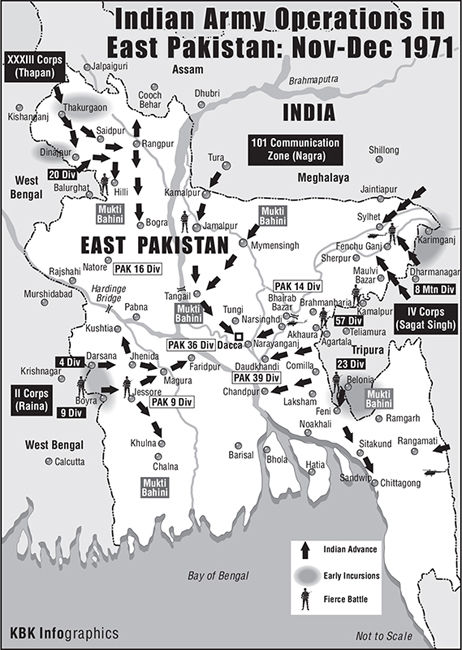
The first major attacks into East Pakistan by the Indian Army along with elements of the Mukti Bahini were launched on the night of 20/21 November along multiple ingress points. Shuja Nawaz goes to the extent of indicating that twenty-three salients inside East Pakistan were attacked2Shuja Nawaz, Crossed Swords: Pakistan, Its Army, and the Wars Within (Karachi: Oxford University Press, 2008), p. 293. as fierce brigade battles were fought at Boyra in the western sector, Hilli in the north-western sector, Akhaura in the eastern sector and Sylhet in the north-eastern sector. Two brigades of the Indian Army’s 9th Division made significant progress towards Niazi’s fortress of Jessore by capturing a large enclave that comprised the forward defensive localities of Boyra and Garibpur by the end of November.
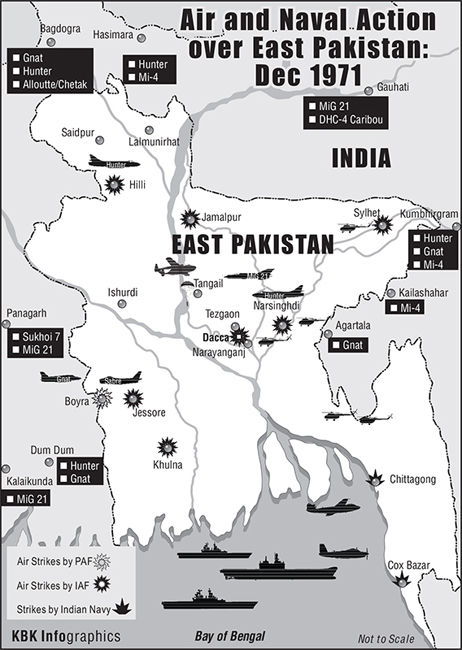
The curtain-raiser for the air campaign also took place in this sector between Sabres of 14 Squadron, PAF, and Gnats of 22 Squadron, IAF. The Gnats were operating an air defence detachment at Dum Dum airport at Calcutta as it was a mere 80 km from the border and needed air defence protection. Corroborating what Shuja Nawaz and John Gill write about large-scale action by the Indian Army in November, Jagan and Chopra suggest that the Indian Army had made significant inroads as early as 12 November and that PAF Sabres were called into action on 19 November to support a beleaguered 107 Brigade, which was fighting a rearguard action around Boyra against two marauding Indian brigades.3P.V.S. Jagan Mohan and Samir Chopra, Eagles over Bangladesh (New Delhi: HarperCollins, 2013), p. 81–83. On 21 November, as the Pakistanis called upon the lone armoured squadron of approximately fourteen Chaffee tanks along with repeated air strikes to throw back the numerically superior Indian forces, the IAF was finally called into action, much to the relief of the Indian brigades under attack.
Controlled by a radar unit located at Barrackpore, a few miles out of Calcutta, four Gnat fighters of 22 Squadron were ‘scrambled’ on two occasions – once in the morning and again in the evening – to try and intercept Sabres that were attacking the Indian brigades. Much to the frustration of the Gnats and the Indian brigades, the Sabres had vanished from the area by the time the IAF fighters arrived over Boyra. After another unsuccessful attempt on the morning of 22 November, the Indians finally drew blood in the afternoon thanks to some aggressive flying by a bunch of four ‘young guns’.4The four Indian pilots were Flight Lieutenants Massey and Ganapathy and Flying Officers Lazarus and Soares.
In a classic aerial dogfight between two comparable machines, the IAF Gnats pounced on a careless bit of tactical flying on the part of the experienced PAF squadron commander who was leading his formation of four Sabres on a ground attack mission. While Wing Commander Chaudhry, the commanding officer of the squadron, managed to get back in a damaged aircraft unscathed, his two young formation members were shot down by Flight Lieutenant Roy Massey and Flying Officers Lazarus, Ganapathy and Soares. Massey, Lazarus and Ganapathy were the IAF’s first Vir Chakra awardees of the conflict. This tactical engagement has been one of the most dissected aerial engagements of the 1971 war and numerous lessons were drawn from it. The encounter is rated amongst the five top air combats in the post WW II era and 22 Squadron celebrates ‘Boyra Day’ even today. When Lal visited the squadron soon after, he remarked, ‘there was such jubilation, it appeared that the war was already won.’ S. Sajad Haider, one of the PAF’s most accomplished fighter pilots and the CO of 14 Squadron at Dacca before Chaudhry, is scathing in his comments about how Chaudhry conducted himself in battle.5S. Sajad Haider, The Flight of the Falcon: Demolishing Myths of the Indo-Pak Wars of 1965 and 1971 (Lahore: Vanguard Books, 2009), p. 235–37. Chaudhry is said to have disengaged prematurely from combat (sic) instead of coming to the assistance of his two young wingmen. He is also said to have falsely claimed to have shot down a Gnat, much to the amusement of his colleagues in the squadron who, after analysing his air combat film, remarked that they ‘could not even see a bird in the picture frame, leave alone an aircraft’.
To the north-west, significant gains were made towards Thakurgaon and Dinajpur; the border defences at Hilli, though, were a tough nut to crack. It was 4 Frontier Force (FF), and a company of 13 Frontier Force along with some armour and artillery, which fought a valiant defensive battle against 202 Brigade of the Indian Army from well-fortified defences. This prolonged battle of attrition from 22 November to 7 December ended when the defences at Hilli were bypassed by another Indian brigade as the defenders withdrew to their depth defences at Bogra. After incurring some losses during the initial days of the war, the Indian Army rightly looked at bypassing fortified forward defences, rather than taking them on headlong.6For an excellent tactical narrative of the battle for Hilli, albeit from an Indian perspective, see Major General Sukhwant Singh (retd), India’s Wars since Independence (New Delhi: Lancer, 2009), p. 146–47. A Pakistani version of the battle has been narrated by the brigade commander of 205 Brigade under whose command the defences at Hilli were placed. See interview with Major General (retd) Tajjamul Hussain Malik by Major Agha Amin, one of Pakistan’s best modern military historians, in ‘The Battle of Hilli – A Narration by Pakistan Brigade Commander,’
Niazi’s northern sector defences comprised a small but compactly defended border post at Kamalpur; a larger battalion defended the town of Jamalpur on the southern bank of the River Lakhya, and the brigade headquarters at Mymensingh. The stubborn but static resistance offered by 31 Baluch at Kamalpur and Jamalpur was broken down by tactically mobile and numerically superior Indian forces from 101 Communication Zone after initial attacks by the Mukti Bahini were repulsed. The Baluchis along with remnants of the Mymensingh Brigade headquarters were then ordered to fall back to Dacca. The battle for Jamalpur was particularly fierce with 1 Maratha Regiment and 13 Guards fighting a brilliant tactical battle that involved the laying of multiple ambushes as Pakistani troops retreated to Dacca. Complementing their effort were a series of air strikes by IAF Hunters as they softened up a surprisingly resilient garrison. Recounting the intricate process of creating ambush positions with mutual cover, Lieutenant General Satish Nambiar, then a major and senior company commander of 1 Maratha, recalls that among the major actions prior to the fall of Jamalpur on 11 December was the trapping of a large Pakistani convoy and causing mayhem among Pakistani ranks with accurate machine gun fire from multiple directions. The surrender of the garrison the next morning saw the crumbling of the last vestiges of resistance to the Indian Army’s northern thrust towards Dacca. Nambiar and his commanding officer, Lieutenant Colonel ‘Bulbul’ Brar, were among the three Vir Chakras awarded to the ‘Jangi Paltan’ (Warring Unit) during the race to Dacca.8A detailed account of the Jamalpur battle and the link-up with 2 Para at Tangail was offered by Lieutenant General Satish Nambiar at his residence in Noida.
To the east, the fortress of Akhaura was just across the border from the Indian town of Agartala and its defences were organized in a similar manner as they were at Hilli. After a spell of spirited resistance from 27 Brigade of 14 Division, the overwhelming pressure exerted by two regular Indian Army brigades attacking from the south, and two battalions of the East Bengal Rifles, proved too much for Brigadier Saadullah. The Pakistani brigade commander withdrew to Bhairab Bazaar on the west bank of the River Meghna in the face of fierce assaults by 73 and 311 Brigades of the IV Crops led by Sagat Singh, but not before blowing up portions of a vital bridge at Ashuganj on 9 December.9For a most detailed narrative of the battle for Akhaura and how the Indian Army’s IV Corps shaped the battlefield in the area, see Randhir Singh, A Talent for War: The Military Biography of Lieutenant General Sagat Singh (New Delhi: Vij Books, 2013), p. 168–175. It was during this battle that Lance Naik Albert Ekka, a young tribal soldier from Bihar, serving with the Indian Army’s 14 Battalion of the Regiment of the Guards (simply called 14 Guards) won the only Param Vir Chakra in the eastern theatre while assaulting fortified Pakistani defences and gun positions at the Gangasagar railway station, some 5 km south of Akhaura.10For an interesting narrative with a human touch on independent India’s Param Vir Chakra winners, see Rachna Bisht Rawat, The Brave: Param Vir Chakra Stories (New Delhi: Penguin, 2014). Lance Naik Albert Ekka’s story is between pages 145 and 154. His company commander, Major Ashok Tara, too would be decorated with a Vir Chakra for his leadership during the same battle – he would later be involved in a dramatic rescue operation involving one of Bangladesh’s second-generation political leaders, Sheikh Hasina Wazed, a daughter of Sheikh Mujibur Rahman. Recalling the operational momentum after the fall of Akhaura where another battalion of the Regiment of Guards (4 Guards) performed magnificently, Lieutenant General Shamsher Mehta, then a major, was commanding a squadron of PT-76 amphibious tanks from 63 Cavalry Regiment and attached to 57 Division, one of the IV Corp divisions. Affectionately called ‘Shammi’ because he resembled a glamorous Indian film star of the 1960s, he offered a rivetting account of the operational momentum created by Sagat Singh despite the blowing up of a major bridge across the River Meghna by the Pakistan Army that any other commander might have found difficult to work around. Added to that was the challenge of crossing the Meghna, ‘a river as wide as a sea and whose far bank we never saw’.11Interview with Lieutenant General Shammi Mehta, 12 October 2014. Mehta says: ‘Sagat needed to open a door after pushing the Pakistanis back and continue with the pursuit.’
The extreme southern sector comprised the two vital port towns of Chittagong and Cox’s Bazar. The whole area was defended by two lightly configured brigades and not assigned much of a task other than defending Chittagong port and town. As two brigades of IV Corps including the Kilo Force of the Mukti Bahini advanced slowly towards Chittagong during the initial days of the war, they were complemented by Brigadier Uban’s Special Frontier Force as it captured Rangamati and prevented the escape of enemy forces into Burma. The two depleted Pakistani brigades huddled in the fortress of Chittagong and hardly offered any resistance.12John. H. Gill, An Atlas of the 1971 India-Pakistan War: The Creation of Bangladesh (Washington: NDU Press, 2003), p. 32–33. Also see Randhir Singh, A Talent for War: The Military Biography of Lieutenant General Sagat Singh (New Delhi: Vij Books, 2013), p. 320.
Extremely vulnerable to attack from three sides, the north-eastern areas of East Pakistan were rather lightly defended by two brigades, one at Sylhet and the other one at Maulvi Bazaar. These forces were meagrely complemented by a ragtag grouping of Mujahids, Razakars and civil defence units. They were literally encircled by an Indian division and a well-led Echo Sector of the Mukti Bahini through a series of tactically well-thought-out operations. This ensured that as the Pakistani forces from other sectors were being effectively squeezed in towards Dacca by simultaneous pressure from the advancing Indians, the two brigades in the Sylhet sector were prevented from withdrawing southwards and reinforcing the defences around ‘fortress Dacca’.13Both Lieutenant General Niazi and John Gill are critical of the decision of the brigade commander of the 313 Brigade at Maulvi Bazaar to withdraw north to the Sylhet garrison rather than head south towards Ashuganj and reinforce 27 Brigade, which had fought a reasonably successful defensive battle as it withdrew from Akhaura to Ashuganj, and then finally across the Meghna to Brahmanbaria. Instead, they were ‘boxed in’ at the fortress town of Sylhet and left vulnerable to a pincer encirclement by forces from Major General Krishna Rao’s 8 Mountain Division as it closed in on them from the south and north-east.
Early Action By The Iaf
The early days of the ‘shadow war’, or shaping the battlefield prior to 3 December, as India would later call it, saw Sabres from 14 Squadron of the PAF provide effective close air support to Pakistan Army’s 27 Brigade at Akhaura. Since there was very little Indian radar cover in the area and the closest IAF airfields were over 130 miles away, intercepting these PAF missions proved to be difficult.14Interview with Lieutenant General Shammi Mehta, who corroborated this, on 12 October 2014. It was only when IAF fighters started operating from Agartala that close support for IV Corps became easily available.
The initial days of the air war saw two major objectives being achieved by the IAF. First was the effective neutralization of the lone Sabre squadron in East Pakistan by repeatedly attacking Tezgaon airfield outside Dacca till it was unusable. Commenting on the decision to launch the first long range (almost 400 km) strikes against Dacca on the morning of 4 December by IAF Hunters of 37 and 17 Squadrons from Hashimara, an airbase in northern West Bengal, Group Captain Manna Murdeshwar (then a squadron leader and a key member of the planning staff at Eastern Air Command) reflects that the IAF might have prevented some initial losses had the Hunters been escorted by air defence fighters like the MiG-21. Notwithstanding the initial IAF losses, its MiG-21s, Hunters and Gnats repeatedly engaged the Sabres in aerial dogfights, shooting down at least three of them in the first three days, with another two claimed by Indian Army ack-ack guns. The systematic degradation of Tezgaon airfield forced the Sabre squadron’s pilots to abandon eleven of the sixteen aircraft by 6 December and flee to West Pakistan via Burma in a Twin Otter light aircraft. Despite the poor leadership of their squadron commander, the rest of the pilots led by their flight commander, Squadron Leader Dilawar, took on a much superior IAF with courage and bravery.15The dogfight between Dilawar’s formation and Wing Commander Sundaresan’s formation of Hunters, also from 14 Squadron, IAF, comes to life in P.V.S. Jagan Mohan and Samir Chopra, Eagles over Bangladesh (New Delhi: HarperCollins, 2013), p. 147–49. For a PAF perspective, also see S. Sajad Haider, The Flight of the Falcon: Demolishing Myths of the Indo-Pak Wars of 1965 and 1971 (Lahore: Vanguard Books, 2009), p. 238–39.
Without belittling the effort of the Hunter and Sukhoi strikes over Tezgaon (Dacca) airfield, it was without doubt the innovative steep-dive bombing attacks by MiG-21s of 28 Squadron and 4 Squadron that created irreparable craters and made the runway unusable. Planned and orchestrated by the enterprising duo of Group Captain Mally Wollen (station commander at Tezpur) and Wing Commander Bishnoi (squadron commander of 28 Squadron, also at Tezpur), Flight Lieutenant Manbir Singh of 28 Squadron, now a sprightly and adventurous septuagenarian, recollects that he was amongst the first to carry out live trials of steep-dive attacks. Armed with 500 kg Russian bombs, MiG-21’s attacked Kurmitola, an unused airfield close to Dacca, on 5 December, before peppering Tezgaon airfield for the next two days and three nights with similar attacks.16Interview with Air Commander (retd) Manbir Singh, VrC, on 5 January 2014, at Pune. Also see Air Chief Marshal P.C. Lal, My Years with the IAF (New Delhi: Lancer, 1986), p. 203. Manbir was among the ‘young guns’ of the IAF who represented a refreshingly aggressive approach during the war. Why the IAF chose to attack Tezgaon airfield with rockets for the first two days of the war baffles many even today. Though the IAF suffered a fair bit of attrition during the first few days of the air campaign, both to Sabres and ground fire, it achieved almost total air superiority by 7 December, thus paving the way for unrestricted close air support (CAS), heli-borne and airborne operations thereafter.
The second objective was to provide effective close air support at some of the tough peripheral battles being fought at Hilli, Kamalpur, Akhaura and the Belonia bulge. The one significant difference this time as compared to 1965 was that every corps had a Tactical Air Centre (TAC) with trained forward air controllers (FACs) who orchestrated the close air support in response to the requirements of field commanders.17P.V.S. Jagan Mohan and Samir Chopra, Eagles over Bangladesh (New Delhi: HarperCollins, 2013), p. 159. The overwhelming superiority of numbers meant that the IAF could not only provide air support to the forward battles being fought, but also carried out interdiction of trains, ammo dumps and defences around the fortresses of Dacca, Narayanganj and Sylhet. This was done primarily by the rocket-firing Hunters and Sukhoi-7s as they blasted logistics reinforcements and defences around the beleaguered garrisons.
A FORWARD AIR CONTROLLER’S TALE
Sealing the fate of the Sylhet garrison was the success of the first large heli-borne operation by the Indian Army on 6 and 7 December. Large and audacious it was if one considers that almost an entire battalion(4/5 Gorkha Rifles) of over 350 fierce khukri-wielding Gorkhas were lifted to within sniffing distance of the Sylhet garrison, which was manned by over 6,000 Pakistani regular and irregular troops.18For a detailed account of the Sylhet heli-lift operation by the CO of 4/5 Gorkha Rifles, Lieutenant Colonel A.B. Harolikar, see Brigadier A.B. Harolikar, ‘The Battle for Sylhet Nov–Dec 1971 by Maj (Retd) Mumtaz Hussaini Shah, Pakistan Army – A Rejoinder by Brig A.B. Harolikar, Indian Army,’
An FAC provides the last-mile connectivity between attacking airborne platforms (could be fixed-wing aircraft or attack/armed helicopters) and their designated targets on the ground. The FAC could either be ground based or direct-fire from a light/scout helicopter. The FAC concept became an integral part of air–land operations in WW II where it was used effectively by Montgomery’s 8th Army and Tedder’s Royal Desert Air Force against Rommel’s Afrika Corps and during Allied operations in Italy and the Normandy landings. The concept was further refined during the Vietnam War and adapted well by the Pakistan Army during the 1965 India–Pakistan war. One of the reasons for the relatively better performance of the PAF in close air support missions as compared to the IAF in 1965 was because of better integration of FACs.
Air Chief Marshal Lal took cognisance of this and ensured that all Indian Army corps in 1971, particularly in the eastern theatre, had well- trained FACs seconded to them well before the outbreak of hostilities. One such FAC was Flight Lieutenant S.C. Sharma, a Dakota pilot from 49 Squadron on attachment to 8 Mountain Division, commanded by Major General K.V. Krishna Rao, which was part of Sagat Singh’s rampaging IV Corps. After a spell of intensive training at Tezpur to familiarize himself with fighter operations and controlling fighter aircraft during close air support, little did Sharma realize that he would be part of the first heli-borne operation conducted by the Indian armed forces on 7 December as the entire 4/5 Gorkha Regiment would be landed close to the sylhet garrison by 105 Helicopter Unit led by Squadron Leader C. S. Sandhu and supported by a couple of armed Mi-4 helicopters led by Flight Lieutenant Singla.19Sandhu, Singla and another young Mi-4 pilot P.K. Vaid would go on to win Vir Chakras for their exploits during the numerous heli-borne missions they would fly during the war. Recounting his version of the action-packed eight days that he spent with the Gorkhas in the thick of battle, directing close air support missions and coordinating aerial resupply and Casualty Evacuation Missions (CASEVAC) with a call sign of Hellcat Control, Sharma recollected over the phone from Jaipur, Rajasthan:
After a helicopter recce of the proposed landing zone to the south of the road railway bridge south of Sylhet on the morning of 7 December by Group Captain Chandan Singh, Brigadier Quinn, the brigade commander, and Lt Colonel Harolikar, the CO of 4/5 Gorkhas, it was decided that the whole battalion would be landed between p.m. and sunset in about four waves. I was in the first wave with the CO and two other officers and about 75–80 troops of ‘C’ Company. To our surprise, the Pakistanis were waiting for us at the landing zone with at least a company of well-dispersed troops. As soon as the helicopters started hovering for landing, the firing commenced.
Drowned by the noise of the helicopters we were unaware of the reception waiting for us until the helicopter crew asked us to get off quickly by jumping off the hovering choppers from about 5 feet. It was only when we had jumped off with all our equipment dispersed here and there that we realized we were under fire. Quickly assuming control after asking all troops to lie still in the fading light, Lt Col. Harolikar took stock of the situation and realized that the subsequent waves were not coming in until he radioed that the landing zone was clear. Having ascertained the position of the defenders as they shouted Allah-O-Akbar to intimidate the pinned down Gorkhas, he and his company crawled stealthily across the landing zone and when they had closed in to less than 40 metres, the Gorkhas sprang up in unison shouting ‘Jai Kali Maa, Ayo Gorkhali’ and closed in with Pakistani troops of 31 Punjab Regiment, mowing down many with their khukris. The defenders retreated to a village 400 metres away and when all was clear, Sharma radioed via his LUP-734 portable radio set that all was clear and the remaining waves could come in. Lighting up the landing zone with merely two lights, the rest of the battalion was heli-landed through the night as ‘C’ company ensured no interference from the Punjabis and a Baluchi company, which had reinforced the Pakistani defences around midnight. The stage was set for a fierce battle the next morning.20Telephonic interview with Wing Commander (retd) S.C. Sharma, VrC, on 11 and 12 January 2015.
The Indians had not anticipated such fierce resistance at Sylhet and as Harolikar and his men fought the Sylhet brigade in a series of skirmishes, Sharma was right there at the forefront of the battle with Harolikar as part of his ‘Rover Group’. For the next six days Sharma directed air strikes by Hunters and Gnats against targets in and around Sylhet and ensured a steady stream of dropped supplies and regular CASEVAC by Mi-4 helicopters of 105 HU. Harolikar is effusive in his praise of Sharma as he repeatedly directed IAF fighters on to targets in the Sylhet garrison.21Brigadier Harolikar, ‘Inside a Chakravyuh in Sylhet,’
INS VIKRANT IN ACTION
While the IAF and the Indian Army were overcoming initial resistance, the Indian Navy with its ‘mini’ carrier battle group comprising the aircraft carrier, INS Vikrant and the frigates, INS Brahmaputra and INS Beas, was lying in wait at Port Cornwallis in the Andamans to attack Chittagong and Cox’s Bazar. There was a problem, however, that worried Captain Swaraj Prakash and his C-in-C, the diminutive but battle-innoculated veteran from WW II, Vice Admiral Krishnan.
The presence of PNS Ghazi, an American-built Tench Class diesel submarine, in the Bay of Bengal was a direct threat to the Vikrant. Highlighting the complete absence of intelligence on both sides was the fact that the Pakistanis all along thought that the Vikrant was in the waters between Vizag and Madras, while it was actually almost 800 nautical miles away in the calm Andaman waters. Fortuitously, the sinking of the Ghazi outside Vizag harbour in the wee hours of the morning of 4 December paved the way for the Vikrant, Brahmaputra, Beas and the rest of the eastern fleet to set sail from the Andamans and operate with impunity in the Bay of Bengal. The sinking of the Ghazi, though, still remains shrouded in mystery. Was it sunk by the destroyer, INS Rajput, or was it the victim of a suicidal foray into an area that it had mined a few days earlier?22S.N. Prasad and U.P. Thapliyal, ed., The India-Pakistan War of 1971 (Dehradun: Natraj Publishers, 2014), p. 375–77. The sinking of PNS Ghazi is covered in great detail. Needless to say, the impact of the sinking of the Ghazi was tremendous and gave INS Vikrant the freedom to sail all over the Bay of Bengal like a heavyweight boxer with his guard down and punching at will.
The morning of 4 December saw an initial flurry of attacks by IAF Hunters of 14 Squadron on Chittagong airfield; INS Vikrant then took over the task of carrying out airfield attacks on Cox’s Bazar airfield23P.V.S. Jagan Mohan and Samir Chopra, Eagles over Bangladesh (New Delhi: HarperCollins, 2013), p. 130–50. Also see S.N. Prasad and U.P. Thapliyal, ed., The India-Pakistan War of 1971 (Dehradun: Natraj Publishers, 2014), p. 380. and interdiction missions against shipping with their Sea Hawks. By doing so they indirectly supported 83 Brigade of IV Corps as it headed south to capture Chittagong. From 5 December to 14 December, not only did the inland riverine ports of Khulna and Chalna face heavy air attacks from the Vikrant,24For a crisp narration of naval action during the first week of the war, see Vice Admiral Vice Admiral Mihir Roy, War in the Indian Ocean (New Delhi: Lancer Publishers, 1995), p. 202–212. there was also extensive destruction of port infrastructure, runway installations at Cox’s Bazar and Chittagong and significant destruction of the Pakistan Navy’s residual naval potential in the east in the form of patrol boats and landing craft.25S.N. Prasad and U.P. Thapliyal, ed., The India-Pakistan War of 1971 (Dehradun: Natraj Publishers, 2014), p. 381–385. Sea Hawks and Alizes of INAS 300 and INAS 310 with their guns, rockets and bombs sank almost eight patrol boats and an equal number of merchant ships with the INS Brahmaputra too joining the lopsided naval battle by sinking a few patrol boats off the coast of Chittagong.26B. Harry, ‘Damage Assessment – 1971 Indo-Pak Naval War,’ at
I flew about fifteen sorties on the Sea Hawk in those seven days of operations and we mainly used 4" rockets and 250/500 lb bombs to attack surface targets. The entire complement of eighteen Sea Hawks and five Alizes were on board. With the limitations of the Vikrant’s maximum speed due to technical problems, launch used to be quite a tricky proposition with full weapon load. We would achieve sustainable speed after the catapult launch only by either flying level or even having to lose about 10–15 feet of height as soon as we cleared the carrier. It demanded flying skill of the highest order and was highly risky, to say the least.27Interview with Vice Admiral Vinod Pasricha on 4 October 2014.
Never before had all three services of India’s armed forces operated with such simultaneity before, although much of the joint effort in the Chittagong sector was unplanned. When I asked Vice Admiral Pasricha about the synergy in air, naval and ground operations while he was operating from the Vikrant, he candidly replied, ‘There was none and we had no intelligence at all about PAF activity in Chittagong and Cox’s Bazar. We also did not know that IAF Hunters had visited the area before us on 4 December.’28Ibid. Despite these minor snafus (Snafu is a military acronym from WW II which means Situation normal, all f---d up), the end result of the various successful operations by the three services was that it precipitated the collapse of Pakistani resistance across sectors and gave hope to aggressive generals like Sagat Singh to revise their initial operational objectives and go for the big prize, Dacca. The lack of inter-service coordination in the Chittagong sector was not a widespread malaise, however, as the Indian Army and Indian Air Force demonstrated great camaraderie in many sectors. The Sylhet battle was one such example.
Three-Pronged Race To Dacca
Sagat Singh was without doubt the most aggressive operational commander on display during the ‘Lightning Campaign of Bangladesh’. Endowed with an irreverent streak, he had a mind of his own and displayed front-line leadership of the highest quality. The hard-fought battles of Akhaura during the initial stages of the campaign saw him at his ‘omnipresent’ best as he flirted with danger and rallied his troops as they ran into tough opposition from a well-entrenched enemy. Once the enemy had been bested, Sagat Singh steamrolled past the opposition with some daring improvisations of heli-borne and river-crossing operations across water obstacles in the Sylhet and Ashuganj sectors as he outflanked the static Pakistani defences.29A small paragraph on the entire IV Corps operations under Sagat Singh does not do justice to the actual impact it had on the ultimate fall of Dacca. See Randhir Singh, A Talent for War: The Military Biography of Lieutenant General Sagat Singh (New Delhi: Vij Books, 2013), p. 163–190. Chapter 7 in the book, aptly called ‘The Hammer’, covers the decisive second week of operations in great detail.
If Sagat Singh’s heli-borne operation at Sylhet was a heavyweight boxer’s right hook, he followed up like any good boxer with a solid punch to Niazi’s gut between 9 and 11 December when he heli-lifted more than a brigade worth of troops from Ben Gonsalves’s battle-hardened 57 Division across the mighty Meghna to two landing zones at Raipura and Narsingdi, which were barely 60 km from Dacca. Not satisfied with that, he pressed on with a left hook on 12 December by heli-lifting another brigade to Narayanganj, around 40 km south-east of Dacca. Between 6 and 12 of December, a fourteen-helicopter task force from three units (105, 110 and 111 Helicopter Units of the IAF) had landed over 4,000 troops and most of their supporting equipment including ammunition and light artillery guns in three locations by flying around 350 sorties including over 100 by night.30For a personal narrative of the operation from the man who orchestrated it as the IAF commander alongside Sagat Singh, see Air Vice Marshal Chandan Singh, ‘The Meghna Crossing’, in Major General Dhruv Katoch and Lieutenant Colonel Quazi Sajjad Ali Zahir, ed., Liberation: Bangladesh 1971 (New Delhi: Bloomsbury, 2015), p. 218–22. The operation was summed up by Air Vice Marshal Chandan Singh, then a group captain and commander of the helicopter task force. A teetotaller and God-fearing fellow Rajput, he developed an excellent professional rapport with the flamboyant Sagat and wrote:
The success of the heliborne operations was mainly due to the guts, determination, perseverance and courage of the pilots. However, it must be said that without the air supremacy achieved by our fighters and fighter-bombers, this colossal task could not have been carried out.31Ibid.
Cooped up in Bhairab Bazar and anticipating an all-out assault from the rear when they came to know of the multiple heli-borne operations between 9 and 11 December, the Pakistani brigade dug in and were surprised when Sagat’s heli-borne forces bypassed them and headed for Dacca. Concurrently, Shammi Mehta and his squadron of fourteen PT-76 amphibious tanks floated across the Meghna, hopping from island to island after Mehta had done a thorough recce of the river by helicopter the previous day. Mehta’s squadron caught up by 13 December with 4 Guards, the leading battalion from IV Corps, and raced to the outskirts of Dacca by 14 December. When asked whether he was intimidated by the crossing during which the far bank of the river was not initially visible, Mehta replied, ‘I hardly thought of it that way. We were charged up and young and when you are young, you don’t analyse to paralyse. When you get older, though, you tend to think for the enemy and that slows you down.’32Interview with Lieutenant General Shammi Mehta.
Floating Down From The Skies
Adding to Niazi’s woes was the Tangail paradrop operation by 2 Para Battalion on 11 December in the area to the north of Dacca. This was in an area that was under the operational control of 101 Communication Zone, the division-sized force under Major General G. C. Nagra. Initially planned as a brigade-sized drop by 50 Para Brigade in three separate operations of a battalion each with objectives that ranged from capture of a bridge, an airfield, and to secure a bridge at Tangail, it was reduced to a battalion drop due to various tactical reasons that are discussed later. Suffice to say, it was a cautious decision that looked at leveraging the surprise of a small force and making it look like a large force, rather than risk a large force without much strategic pay-off. Even then, the successful operation involved over fifty transport aircraft of different types along with Gnat and MiG-21 fighter escorts, which got airborne from two airfields, Dum Dum and Kalaikunda. While the bulk of the heavy drop equipment and a small complement of troops emplaned on Packet aircraft at Dum Dum, the majority of the paratroopers got on board Dakotas at Kalaikunda. Supporting this ambitious operation was another covert operation led by a young Corps of Signals officer, Captain P.K. Ghosh, who had linked up with the Mukti Bahini in mid-November in the area between Mymensingh and Tangail. His role in identifying the dropping zones, keeping them under surveillance, and directing harassing raids on convoys played a critical role in shaping the battlefield.33‘The Saga of Captain P.K. Ghosh, VrC,’ from Veekays History Book, a blog maintained by Major General V.K. Singh, one of India’s prolific military writers. Available at veekay-militaryhistory.blogspot.in/2013/4/the-saga-of-captain-pk-ghosh-vrc-html. The operation was reminiscent of the many covert operations conducted by the Allies prior to Operation Market Garden, as the airborne operation to capture the areas around the bridge at Arnhem in Belgium came to be known. The operation fulfilled its objectives as it caused panic in Dacca as news trickled in that a brigade had been dropped and that it was only a matter of time before forces converged on to Dacca. One of the first interviews given by an Indian officer after the fall of Dacca was at the Intercontinental Hotel where Lieutenant Colonel K.S. Pannu, the flamboyant commanding officer of 2 Para Bridge, spoke to reporters.34From an interview sourced from the archives of 2 Para Bridge. Along with 4/5 Gorkhas and 14 Guards, 2 Para emerged as one of the most decorated units of the Bangladesh campaign.
Lieutenant General Thomas Mathew, now an alert and fit eighty-six- year-old and a soldier scholar of some repute, has very fond memories of the Tangail drop for very obvious reasons. As the brigade commander of the Agra-based 50 Para Brigade of which 2 Para was an integral part, he clearly recollects the planning process for the drop. As a gung-ho brigade commander, Mathew initially suggested that the battalion drop be carried out over Kurmitola airfield, one of Dacca’s subsidiary airfields approximately 20 km north of the city. Once the battalion had secured the airfield, the rest of the brigade would be air-landed and would make a run for Dacca. Looking back, he acknowledges that the plan was fraught with too many risks. Even though it was assessed that the IAF would have achieved air superiority within the first few days of the air war, there was no certainty that the landing transport aircraft would not be shot at by ack-ack and small arms fire. Losing large aircraft with paratroopers on board was too risky a proposition for Sam Manekshaw, who asked ‘Jakes’ (Lieutenant General Jacob, the chief of staff at Eastern Army Command) to consult with Air Marshal Dewan, the air officer commanding-in-chief of Eastern Air Command, and take a call. Finally, it was decided that a battalion drop at Tangail was the best that the IAF could support – the counsel of the older soldiers and airmen proved to be right after all! Mathew begged Lieutenant General Jacob to allow him to jump with his men, but was dismissed with a ‘we need you for bigger things’.35Interview with Lieutenant General Thomas Mathew in Pune on 30 January 2015. When asked about the IAF support for the operation, he said that they gave it all they had but lacked the resources to provide adequate resupply. The troops were on their own, and had the link-up operation with Nagra’s troops from 101 Communication Zone taken much longer, it could have been a problem.36Ibid.
A word here about India’s paratroopers – jumping out of an aircraft into unknown enemy territory and fighting your way to an objective is among the harder operations of war and that is why paratroopers across the world are considered to be a ‘special breed’. The only Indian officer to have participated in a clandestine airborne operation during World War II was Lieutenant General Inder Singh Gill, who as a young second lieutenant was part of a para commando operation over Greece in 1942. Gill was awarded the Military Cross for his part in the operation that saw his commando team dropped at a wrong location and then having to fight its way through enemy-occupied territory to destroy its objective. The story did not end there as the team’s planned rendezvous with a submarine went awry and the commandos had to retrace their steps into the jungles of Greece to join the Greek guerrillas till they were extricated a few months later.37K.C. Praval, India’s Paratroopers: A History of the Parachute Regiment of India (New Delhi: Thomson Press, 1974), p. 280. For an exhilarating account of the operation, see Densys Hamson, We Fell among the Greeks (London: Cape, 1946). Many in the Indian Army consider Gill as among the most professionally competent senior officers in the post-Independence era. As a major general, he was Manekshaw’s right-hand man as director of military operations during the 1971 war.
With their red berets perched jauntily on their heads, India’s paratroopers have done the Indian Army proud since they were reorganized after Independence. Of the two para brigades (50 and 77 Para Brigades) left behind by the British, 77 Para Brigade was disbanded in 1950, and in 1952, all three battalions of 50 Para Brigade were taken away from their parent regiments to form a new regiment called The Parachute Regiment.38K.C. Praval, India’s Paratroopers: A History of the Parachute Regiment of India (New Delhi: Thomson Press, 1974), p. 190. The initial three battalions were from the Punjab Regiment, Maratha Light Infantry and Kumaon Regiment. From fixed-class battalions, these battalions gradually took in volunteers from other classes and became representative of a truly multi-ethnic regiment that demonstrated the Indian Army’s resolve to break down barriers of class as established by the British. After a series of distinguished operational performances during their deployment in Korea with the UN forces (a field ambulance unit); Operation Vijay in Goa where 1 Para led the charge into Panjim, the capital of Goa; and during the 1965 war with Pakistan where 1 Para again was primarily responsible for the capture of Haji Pir Pass, the Parachute Regiment had evolved into a potent fighting force by the time India entered the 1971 war.39From three battalions, the Indian Army added seven more battalions to the Parachute Regiment by the time India entered the 1971 war including two Para Commando Battalions. These seven battalions were attached to different fighting formations based on the operational need. Also see K.C. Praval, India’s Paratroopers: A History of the Parachute Regiment of India (New Delhi: Thomson Press, 1974) for a detailed account of the evolution and growth of the Indian Army’s Parachute Regiment. Sam Manekshaw was not going to lose an opportunity to unleash 2 Para to deliver a final blow on the tottering Pakistan Army towards the closing stages of the campaign.
Game Over
By 12 December, Sagat Singh had mustered almost a division-sized force for the final assault on Dacca from multiple directions. At the same time 2 Para, which was earlier 3 Maratha Light Infantry and comprised primarily Maratha troops, linked up with 1 Maratha Light Infantry from 95 Brigade at Poongli bridge, a few kilometres north of the drop zone. Lieutenant General Nirbhay Sharma, who became the governor of Mizoram in 2015 and was a paratrooper himself, was the adjutant of 2 Para during the drop at Tangail as a young captain. Reminiscing about some of the lighter moments of the operation during lunch at the National Defence College on 17 November 2015, he recalled that as the battalion was regrouping after the drop and had gathered most of the equipment, the subedar major of the battalion approached him and reported that the only piece of equipment missing was a well- wrapped case of rum that was to be handed over to 1 Maratha Light Infantry after the link-up had taken place. Needless to say, it was soon found – 1 Maratha had been fighting for over a week and were well rewarded with some rum thanks to the considerate paratroopers with Maratha affiliations.
By dusk on 15 December, a large force commanded by Brigadier Hardev Kler comprising 2 Para, 1 Maratha Light Infantry and other units of 101 Communication Zone contacted the defences around 20 km north of Dacca with the Romeo Force comprising the Mukti Bahini led by Brigadier Sant Singh following closely. Surrounded by five Indian Army brigades, Niazi offered to surrender at 5 a.m. on 16 December along with 93,000 troops and other government personnel – the war in the eastern theatre was over. The formal surrender was, however, conducted in the afternoon of 16 December after the fine print was orchestrated by Lieutenant General Jacob, the chief of staff of the Indian Army’s Eastern Command, who flew down from Calcutta to Dacca. His role in the psychological war waged by India during the closing stages of the campaign was significant. Lieutenant General Satish Nambiar recollects that Pakistani commanders were apprehensive of immediate reprisals by the restive and angry Bengali population in Dacca and communicated that to the Indian Army’s leadership. In a demonstration of the professionalism and empathy with which the Indian Army treated their defeated adversaries, Pakistani troops of the Dacca garrison were allowed to retain their personal weapons till 18 December, when a formal ceremony marked the laying down of arms.
The psychological impact of innovative operations generally gets underplayed in any post-war analysis as it seemingly takes away some sheen from the hard-core contact and aerial battles that occupy pride of place in conventional warfare. One operation that caused a disproportionate impact on the psyche of East Pakistan’s leadership as they huddled in Dacca during the closing stages of the war was the strike by IAF fighters on Governor’s House in Dacca on 14 December. In an operation driven by hard intelligence based on wireless intercepts, four MiG-21s and four Hunters attacked the palatial house in the vicinity of the Dacca Cricket Stadium in quick succession while Governor Malik himself was chairing a meeting with UN officials in attendance. MiG-21s from 28 Squadron followed up this attack with rocket attacks on specific buildings in Dacca University where suspected Pakistani troops and collaborators were taking shelter. Analysing the impact of these attacks, Jagan Mohan and Samir Chopra write: ‘The IAF’s attack, an act of visible, spectacular intimidation, was the last psychological blow to a crumbling regime.’40P.V.S. Jagan Mohan and Samir Chopra, Eagles over Bangladesh (New Delhi: HarperCollins, 2013), p. 336.
Shammi Mehta called the bombing ‘a game changer in the fall of Dacca and that he considered the IAF’s bombing campaign around Dacca as a ‘victory of the mind over matter’. In a few days, Flight Lieutenant Manbir Singh, one of the stalwarts of 28 Squadron, would find himself on the steps of Governor’s House examining the damage his squadron had done. More importantly, he would walk away with two small brass cannons as war booty – they now occupy pride of place in 28 Squadron and 4 Squadron of the IAF, the two MiG-21 squadrons that participated in the air strikes on Governor’s House.
JOINT OPERATIONS: THE X-FACTOR IN THE EAST
Was the capitulation of Dacca so simple, or was it a result of joint orchestration of forces in multiple operations that caused a psychological disintegration, rather than a physical destruction of combat capability? Group Captain Manna Murdeshwar (retd), one of the key members of the operational planning staff at Eastern Air Command, had a ringside view of the operations in the eastern theatre and recollects vividly that it needed a little over six months of continuous effort by way of visits, discussions, conferences and persuasions to build a rapport with both 101 Communication Zone and IV Corps.41Email exchange between the author and Group Captain Murdeshwar in February 2014 on his perceptions of what was right and what went wrong during the 1971 war.
Operations of the IV Corps provide an ideal case study for the conduct of aggressive joint operations driven by operational commanders. Group Captain Chandan Singh, the station commander at Jorhat, an accomplished and aggressive transport pilot with extensive operational experience and a gallantry award under his belt for his exploits during the 1962 conflict with China, was the single-point contact with Sagat Singh. Between them, they juggled with the fairly large complement of helicopter resources at their disposal. With almost two squadrons worth of Mi-4s put together from 105, 110 and 111 Helicopter Units, and a few IAF and Army Aviation Alouette helicopters, Sagat and Chandan worked tirelessly to plan multiple heli-borne and heli-lift operations to outflank and surprise the enemy. Over 350 sorties were flown by the Mi-4 and Alouettes of the IAF and the 659 Army’s Air Observation Post (AOP) unit in the Sylhet and Ashuganj sectors, lifting almost three brigades with their logistics and artillery requirements in what came to be known as the ‘Meghna Air Bridge Operation’.42For a detailed narrative of the Meghna Air Bridge Operation, see P.V.S. Jagan Mohan and Samir Chopra, Eagles over Bangladesh (New Delhi: HarperCollins, 2013), p. 215–21, and Randhir Singh, A Talent for War: The Military Biography of Lieutenant General Sagat Singh (New Delhi: Vij Books, 2013), p. 175–195. Lieutenant General Niazi is less charitable about the impact of the heli-borne operations. See Lieutenant General A.A.K. Niazi, The Betrayal of East Pakistan (New Delhi: Manohar, 1998), p. 216–17. For a recent analysis of the heli-bridge and heli-borne operations by an IAF helicopter pilot, see Air Commodore Rajesh Isser, The Purple Legacy: Indian Air Force Helicopters in Service of the Nation (New Delhi: KW Publishers, 2012), p. 63–79. This operation also marked the baptism by fire of the Indian Army’s small helicopter arm as pilots like Major Sihota flew risky communication and reconnaissance sorties with their daring Corps Commander Sagat Singh and one of his equally enterprising divisional commanders, Major General Ben Gonsalves, as they put the pieces of their innovative heli-lift operation across the river together.43Mandeep Singh Bajwa, ‘Flying to Victory: An Air OP pilot’s story,’ Hindustan Times, Chandigarh, 12 January 2014, available at [http://www.hindustantimes.com/punjab/chandigarh/ flying-to-victory-an-air-op-pilot-s-story/article1.aspx](http://www.hindustantimes.com/punjab/chandigarh/%20flying-to-victory-an-air-op-pilot-s-story/article1.aspx) (accessed 18 October 2014). He was among the few army pilots to have been decorated with the Vir Chakra for his exploits in Bangladesh. Two bold commanders with tremendous ‘out of the box’ risk-taking ability, Sagat Singh and a much junior Chandan Singh, changed the contours of the ‘Race to Dacca’.
Even in the case of close air support, IV Corps exploited the IAF’s fighter assets to the maximum. Out of a total of approximately 1,350 close air support missions flown in the Eastern theatre, over 500 were flown in support of IV Corps.44P.V.S. Jagan Mohan and Samir Chopra, Eagles over Bangladesh (New Delhi: HarperCollins, 2013), p. 383 (summary of sector-wise close air support missions). Sagat Singh understood the importance of additional firepower and psychological impact of close air support and pushed both the TACs to their limits as they struggled to cope with the pouring requests from Sagat’s formation commanders for continuous air support. To its credit, Eastern Air Command responded brilliantly and supported Sagat’s rapid advance by even sending Gnats of 24 Squadron to operate in the ground attack role from Agartala runway on 12 December. The runway was extended by a few thousand feet so that fighters could operate from there and strike targets at Sylhet, Maulvi Bazaar, Ashuganj, Bhairab Bazar and Brahmanbaria within minutes.45Air Chief Marshal P.C. Lal, My Years with the IAF (New Delhi: Lancer, 1986), p. 212. The effort was reminiscent of Brigadier Pritham Singh and Air Commodore Mehar Singh’s attempts to operationalize the Poonch airstrip in 1947–48. Shammi Mehta has fond recollections of the joint effort and questions why the Indian Army and Indian Air Force have never done a joint study on IV Corps operations that could be a case study at various institutions of higher learning in the military.46Interview with Lieutenant General Shammi Mehta. In a glowing tribute to IV Corps, Air Chief Marshal Lal writes:
By bold and imaginative use of the air force available to it, 4 Corps presented a most convincing demonstration of how well the two services could work together. This was possible due, in large measure, to the fact that the GOC of the Corps himself (Sagat Singh) was a paratrooper, who had lived and worked in close proximity with the Air Force for many years. 4 Corps never asked the Air Force to do what it could not and whatever the Air Force was called upon to do, it did most effectively.47Air Chief Marshal P.C. Lal, My Years with the IAF (New Delhi: Lancer, 1986), p. 214–15.
Considering that the Indian Armed Forces had never undertaken an airborne operation before, the 2 Para Bridge drop at Tangail on 11 December to capture the bridge on the River Poongli merits attention as a timely manifestation of this newly found cooperative operational spirit between the Indian Army and the IAF that Lal refers to.48P.V.S. Jagan Mohan and Samir Chopra, Eagles over Bangladesh (New Delhi: HarperCollins, 2013), p. 291–95. The pressure exerted by the Indian Navy with its persistent attacks on Chittagong and Cox’s Bazar, sustained interdiction of Pakistani shipping, and a small but rather ill-fated amphibious assault by a company of Gorkhas, played a part in piling on ‘joint pressure’ up Niazi to surrender.49For a detailed overview of Operation Beaver, see Ministry of Defence publication, Official History of the India-Pakistan 1971 War, p. 649–52,
Without doubt it was joint operations which played a pivotal role in the Bangladesh campaign. On display also was the quality of operational art exercised by Indian commanders like Sagat Singh, Mally Wollen, Chandan Singh and Swaraj Prakash as the battle progressed. At the tactical level, Shammi Mehta fondly recollects that informal camaraderie, pre-launch bonding and free-flowing operational communication, where rank and protocol did not matter, was the hallmark of operations in the IV Corps sector. However, what was also clear was that this synergy was ‘personality driven’ and not ‘institutionally driven’ joint operations that was on display. This particular trait of Indian operational art continues even today.
Us Seventh Fleet Shows Up In The Bay Of Bengal
The closing days of the eastern naval campaign saw further excitement in the maritime domain with news of the likely entrance of the powerful US Seventh Fleet into the Bay of Bengal. This was seen as likely ‘arm twisting’, or a typically American coercive strategy to put the brakes on what was turning out to be a highly successful Indian military campaign in the eastern theatre. In a desperate attempt to bolster Pakistan’s flagging war effort and delay its imminent capitulation in the east, Nixon despatched the muscular Seventh Fleet to the Bay of Bengal. Heading there from the Gulf of Tonkin, where it was deployed, the Seventh Fleet was a mighty formation of eleven warships comprising the nuclear- powered aircraft carrier, USS Enterprise, and a mix of destroyers, missile frigates, amphibious assault ships and a helicopter carrier.50S.N. Prasad and U.P. Thapliyal, ed., The India-Pakistan War of 1971 (Dehradun: Natraj Publishers, 2014), p. 407–09. Jacob, the chief of staff of Eastern Army Command, recalls that Admiral Krishnan, the feisty and rotund flag officer commanding in chief of Eastern Naval Command, expressed his concern at this turn of events and even linked it with the possibility of the Pakistan Navy slipping in another Daphne class submarine into the Bay of Bengal to threaten INS Vikrant.51Lieutenant General J.F.R. Jacob, Surrender at Dacca: Birth of a Nation (New Delhi: Manohar, 1977), p. 134.
Krishnan’s fears were unfounded as the Seventh Fleet hung around the south-eastern part of the Bay of Bengal for a week or so from 12 December onwards, hoping to coerce the Indians sufficiently so as to prevent the fall of Dacca. This triggered a response from the Soviets, who alerted a task force, which was already operating in the Indian Ocean and was believed to have included a nuclear-powered submarine, to be ready for a move in the direction of the Seventh Fleet should it get threateningly close to Indian waters. Seeing that India refused to blink and somewhat reassured by the Russians that India would agree to a ceasefire soon after the fall of Dacca, the Seventh Fleet called off its coercive deployment in the Bay of Bengal.52Ibid. Also see declassified US State Department correspondence of the time. In retrospect, the diversion of the fleet was a much hyped up non-event, played up even more by a raucous media. In a cable to President Nixon, the US Ambassador to India, Kenneth Keating, expressed his disapproval of the move, pretty much summing up the cowboyish nature of the entire exercise:
UP UNTIL LAST FEW DAYS I HAVE FELT ABLE TO DEFEND U.S. POLICY ON THE BASIS OF OUR OVERRIDING CONCERN TO BRING A HALT TO HOSTILITIES. I AM NOW TROUBLED BY THE FACT THAT A NUMBER OF MY DIPLOMATIC COLLEAGUES VIEW DEPLOYMENT OF CARRIER TASK FORCE AS MILITARY ESCALATION BY U.S.53Department of State telegram from New Delhi to Washington dated 15 December 1971 from declassified US State Department documents pertaining to India and Pakistan 1971, p. 383. Assembled by Ramesh Shanker,