Part IV: Across Borders
Attrition Battles
The Battle of Basantar was one of the great tank battles fought by the Indian Army. Like all great battles, the outcome was a close run affair. After about eight hours of bitter fighting, tanks of the Poona Horse had destroyed almost two Pakistani armoured regiments. Indeed they too paid a heavy price but stood victorious.1Lieutenant General W.A.G. Pinto, Bash on Regardless (Dehradun: Natraj Publishers, 2013), p. 103.
Forgotten Battles Of Ladakh
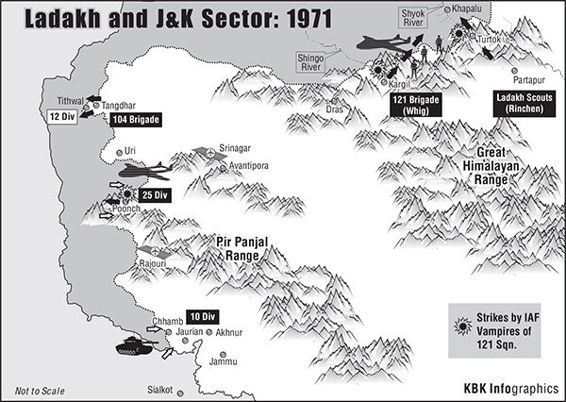
As in 1965, some of the toughest battles in 1971 were fought on the icy heights overlooking Kargil, a town at an altitude of 8,780 ft located on the banks of the River Shingo and a critical stop on the Srinagar–Leh Highway.2Lieutenant General K.P. Candeth, The Western Front: The India Pakistan War of 1971 (Dehradun: The English Book Depot, 1997), p. 47–53. Control over Pt 13620 and Black Rock, as two of the fiercely contested heights overlooking Kargil were called, was again the focus of attention in December 1971. This time, however, it was the peak of winter and with only one division entrusted with the defence of the entire Ladakh sector, it was tough going for Brigadier M.L. Whig and his 121 Brigade. As it attempted to take control of territories that were captured by them in 1965, and then saw them being returned to Pakistan after the Tashkent Agreement, the Indian Army did not anticipate that Pakistan would set up well-stocked posts there and interdict the Srinagar–Leh Highway with well-directed artillery fire.3Kuldeep Singh Bajwa, ‘Kargil Remembered,’ The Sunday Tribune, 27 June 1999,
As in 1948, when Spitfires and Tempest fighters from Srinagar had valiantly supported Thimayya’s breaching of Zojila Pass, the IAF supported the Kargil and Partapur sectors with airdrops of supplies through two weeks, and interestingly, close air support and interdiction by a detachment of obsolete Vampire jets in early December 1971.5Air Chief Marshal P.C. Lal, My Years with the IAF (New Delhi: Lancer, 1986), p. 226–27. In a mail to the author, P.V. S. Jagan Mohan confirmed that Flight Lieutenant Sekhon (later Air Marshal) did indeed operate from Srinagar and provide vital support during the assault.6Email correspondence between the author and P.V.S. Jagan Mohan on 16 July 2014. The exploits of a handful of obsolete Vampire jet fighters of 121 Squadron operating from Srinagar airfield as they knocked out gun positions, strafed dug-in troops and interdicted supply lines in the area was well acknowledged by the Indian Army. Sekhon won his Vir Chakra for his untiring efforts and numerous sorties of offensive and reconnaissance missions that he flew over two weeks.
In a telephonic conversation with the author on 21 July 2014, the air marshal recounted how he was in frequent contact with the dynamic corps commander of 15 Corps, Lieutenant General Sartaj Singh.7Telephonic conversation with Air Marshal Sekhon on 22 July 2014. Sartaj, he recollected, was a daring and innovative field commander who had drawn up plans for the capture of Skardu and the entire district of Baltistan. However, the setback in Chhamb necessitated his presence there as he played an inspirational role in rallying units of 10 Division to offer a suitable riposte between 8 and 12 December. Sekhon went on to add that Sartaj was often seen in knee-deep water waving his baton as he urged his formations to ensure that Pakistan did not get a lodging on the east bank of the Munawar Tawi. Much of the air action in Uri, Poonch and the dangerous Kargil and Mushkoh Valleys of Ladakh have not been recorded and archived in the published history of the 1971 war and my inquiries from the air force station at Srinagar on the exploits of this small group of pilots during the war drew a blank. However, accounts in the war diaries of 121 Brigade acknowledge the excellent support by IAF Vampires.
From Leh, as one travels north across the Khardungla Pass, one reaches the village of Partapur, which lies almost at the confluence of the Shyok and Nubra rivers, both tributaries of the mighty Indus. North-west from Partapur along the Shyok river, one passes the small hamlet of Turtuk before hitting the ceasefire line, and onwards to Skardu, the scene of a bloody siege in 1948 before it fell to raiders from Pakistan. This area too saw bitter fighting in 1971 in freezing conditions. Defended as a sector with barely a battalion worth of troops comprising three companies of hardy Ladakh Scouts and hastily trained but well-acclimatized Nubra Guards (locals from the area), these wonderfully led troops by Colonel Udai Singh and Major Rinchen gave the Karakoram Scouts of the Pakistan Army a bloody nose, as described by General Candeth:
Thus this sector headquarters had in 14 days advanced 22 kilometres and captured approximately 804 sq kms. I doubt whether any other army had ever battled in such appalling conditions and it speaks much for the determination, motivation and physical toughness of our troops and commanders that they were able to carry out their tasks so well.8Lieutenant General K.P. Candeth, The Western Front: The India Pakistan War of 1971 (Dehradun: The English Book Depot, 1997), p. 45–46.
However, after capturing the heights around Kargil and Turtuk in exhausting battles, Sartaj had rather unreasonably hoped for Whig’s troops to link up with the Ladakh Scouts and make a bid to capture Khapalu and Skardu, if the opportunity presented itself. This was not to be as by then the ceasefire had been declared and Whig’s brigade was stretched to the very limits of human endurance. Skardu, though, had its share of action thanks to some daring strikes by three IAF Canberra bombers and a lone An-12 piloted by Wing Commander Vashisht on the last day of the war (3:45 p.m. on 17 December).9Wing Commander Vashisht dropped thirty-six bombs on Skardu with great accuracy and displayed courage and innovativeness of the highest order. See Air Chief Marshal P.C. Lal, My Years with the IAF (New Delhi: Lancer, 1986), p. 303. Also see S.N. Prasad and U.P. Thapliyal, ed., The India-Pakistan War of 1971 (Dehradun: Natraj Publishers, 2014), p. 220. The Ladakh Scouts and 121 Brigade would once again be thrust into the limelight twenty-eight years later as India battled to recover lost ground. For their exploits in the Kargil and Turtok sectors, Whig and Rinchen were awarded Maha Vir Chakras.
As the war reached its climax in the second week of December, the beautiful Srinagar skyscape saw a classic dogfight between a single Gnat of the IAF flown by Flying Officer Nirmaljit Singh Sekhon and a six-aircraft Sabre formation led by Wing Commander Changezi of 26 Squadron PAF. Taking off from Srinagar runway while it was under attack by four of the Sabres, Sekhon not only ensured that the Sabres were not allowed to put in another attack, but also shot down one of them and damaged another one before being outnumbered and shot down by the fifth Sabre. Though he ejected from a crippled aircraft, the height was too low for him to survive. He remains the IAF’s only Param Vir Chakra.10A wonderfully crafted animation video on the Srinagar dogfight was made by Anurag Rana and is available at
Staying in Srinagar, a bizarre incident that reflected the rather conservative mindset that still existed at the time needs to be recounted. It caused the IAF to miss out on an opportunity to cause some damage to Pakistani troop emplacement in the Poonch, Rajouri and Tithwal sectors of Jammu and Kashmir. Air Commodore S.S. Kaushik (retd) clearly recollects that there were fairly large stocks of napalm bombs at Srinagar which the Vampires had planned to drop. He goes on to add that they were asked to cancel their napalm mission at the last moment by the station commander at Srinagar to avoid offending the religious sentiment of the Pakistani troops by ‘causing death by fire’. So, off the bombs went into storage and next day, the storage area was attacked with pinpoint accuracy by PAF Sabres, causing a huge explosion and the death of a few local labourers belonging to the very community that the IAF did not want to offend. Kaushik remarked: ‘That was but the first of many occasions when our armed forces would be asked to fight with one hand behind their backs in Kashmir.’
Limited Success In Shakargarh
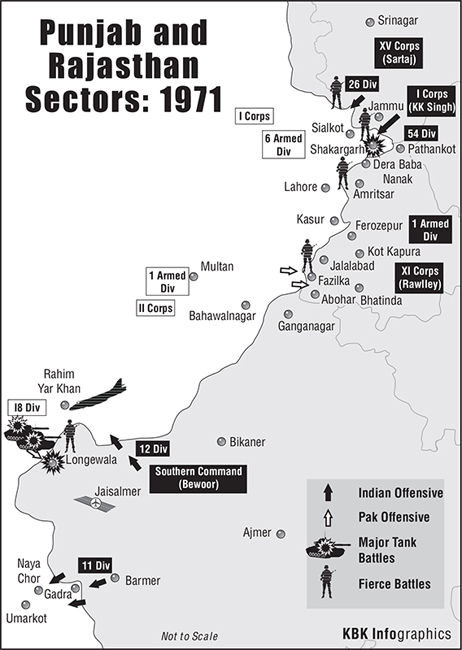
The showpiece operation of the Indian Army was undoubtedly meant to have been the offensive launched in the Shakargarh salient by India’s only offensive corps, 1 Corps, which was commanded by K.K. Singh.11The most detailed Indian perspectives on the ‘much hyped’ Shakargarh offensive are available in Lieutenant General K.P. Candeth, The Western Front: The India Pakistan War of 1971 (Dehradun: The English Book Depot, 1997), p. 97–110 and K.C. Praval, India’s Paratroopers: A History of the Parachute Regiment of India (New Delhi: Thomson Press, 1974), p. 470–76. For a crisp Pakistani perspective, see Shuja Nawaz, Crossed Swords: Pakistan, Its Army, and the Wars Within (Karachi: Oxford University Press, 2008), p. 304–05. Tasked with pre-empting any attempt by Pakistan to threaten the vital road from Pathankot to Jammu from the direction of the salient when there was another offensive expected in Chhamb, the offensive lacked adequate teeth. K.K. Singh just did not have the necessary numerical and firepower superiority, and the need to protect his flanks warranted additional caution. He engaged in much operational discussion with his army commander, Candeth, on reallocating some forces for the defence of his flanks and may have lost the opportunity to launch his offensive at the same time as Pakistan made inroads into Chhamb. While the delayed offensive in the Sialkot sector in 1965 was understandable as 1 Corps was still fetching up into their operational area from peacetime locations and there was the distraction of a concurrent offensive in the Lahore sector, there was no such compulsion in 1971.
Considering that an extensive network of linear defences had come up in the area, K.K. Singh did not have a decisive quantitative superiority in terms of infantry, armour and artillery as compared to 1 Corps of Pakistan. It was insufficient to support his rather ambitious plan of heading for Sialkot as he did not have the required 3:1 superiority that was generally considered as being essential to force a decisive result in a battle of attrition in the plains. A typical example of how divisions were depleted of vital offensive assets to cater for defensive tasks was the detaching of an armoured regiment from the integral armoured brigade, which was attached to 54 Division, for defensive flank protection. As it turned out, when his first division (39 Division) failed to make inroads in the first few days of the offensive, he had to utilize his second division (54 Division) to attempt thrusts into the Shakargarh bulge from the north. Commanded by the aggressive Major General W.A.G. Pinto, 54 Division fought a series of infantry and armour battles with just two armoured regiments and till today Pinto wonders what could have happened had he been given all his armoured regiments for offensive operations. After his retirement General Pinto has settled in his little bungalow on Alexandra Road in the sylvan surroundings of the Pune cantonment. I would walk past it every day and finally mustered up the courage to visit him and take a peek into the life and times of one of the Indian Army’s finest field commanders. His still booming laugh and racy book, Bash On Regardless, exemplify the aggressive spirit that he exuded on the battlefield. In my second interview session with him, he handed me a sheet of paper with a remarkably clear handwritten anecdote and said, ‘Young man, your narrative cannot be devoid of some humour. I have jotted down some light memories; see whether they are of any use.’ It read like this:
The Calm before the storm! We were dug in behind the Border Security Force (BSF), which was manning its Border Out Posts (BOPs) on the International Border. Patrolling had been banned on grounds of secrecy, security and surprise. While heaps of last-minute intelligence trickled down from ground troops, Air Observation reports, IB reports, wireless intercepts, contacts with ambassadors and military attaches of friendly countries through staff channels, one particular message drew my attention and amused me immensely. It read ‘Pak attack imminent, ensure highest operational preparedness.’ I flashed a reply – ‘Preparedness already heightened. Observation Post on the highest branch of solitary Peepul Tree. Cannot climb higher!’ Bang came the rejoinder, ‘Stop being facetious stop ensure strict compliance with orders. Message ends’.
Valour At Basantar
Fierce tank battles raged at Basantar, Zafarwal and the village of Shakargarh, which saw many classic encounters between tanks of the Indian Army’s 16 Armoured Brigade comprising 17 Poona Horse and Hodson Horse (16 Cavalry was the third regiment that was deployed in a defensive posture), and two regiments of the Pakistan Army’s 8 (Independent) Armoured Brigade comprising 13 Lancers and 31 Cavalry with 27 Cavalry in reserve.12For a crisp account of the battle of the Shakargarh bulge from an Indian perspective, see Major General Ian Cardozo, ed., The Indian Army: A Brief History (New Delhi: Centre for Armed Forces Historical Research, 2005), p. 151–53. I was also lucky to lay my hands on an unpublished monograph on the history of India’s 16 (Independent) Armoured Brigade by Brigadier Palsokar. The monograph authenticated much of the research I had already done.
A young second lieutenant of the Indian Army’s Poona Horse Regiment, Arun Khetarpal, displayed courage of the highest order by first knocking off 3–4 Patton tanks and then refusing to abandon his damaged tank since its gun was still firing. He was finally killed when his tank received a direct hit from a tank commanded by Major Khwaja Naser, a squadron commander of 13 Lancers. He was awarded the Param Vir Chakra and remains a source of inspiration even today for young officers of India’s Armoured Corps, while his brigade commander, Vaidya, who later went on to become chief of army staff, was awarded a Maha Vir Chakra. More than thirty years later a poignant meeting between Arun Khetarpal’s father and Brigadier Naser reveals that despite the prolonged enmity between the two countries, deep professional respect for each other exists within the two militaries.
Arun Khetarpal was not the only hero to emerge from the battle of Basantar in the Shakargarh sector. Major Hoshiar Singh, a hard-core infantryman and a company commander with 3 Grenadiers, would live to tell his tale of courage and bravery as the only surviving Param Vir Chakra awardee from the 1971 war. Tasked to capture the ‘Jarpal Complex’ across the Basantar nala (stream or rivulet in Hindi) on 15/16 December as part of 54 Division’s larger plan of capturing the town of Zafarwal, Hoshiar was involved in a bruising battle of attrition over two days as he first captured Jarpal, and then held on to it in the face of repeated infantry and armoured assault by a determined 8 Infantry Division of Pakistan Army. It is in response to the armoured attack in the Jarpal Area by 8 Armoured Brigade that Poona Horse swung into action, only to lose Arun Khetarpal. It was not only the Indians who performed valiantly in the Basantar battle; Colonel Mohammad Akram Raja, the commanding officer of Pakistan’s 35 Frontier Rifles, led a frontal attack with two companies on Hoshiar’s position, only to be met with withering fire from tactically well-positioned Indian troops. Hoshiar had planned well and executed his plan brilliantly. Though wounded during the attack; he continued to motivate his troops to give it all. At the end of almost two hours of fierce fighting, Raja and almost a hundred Pak troops were killed, and many were taken prisoner. After acknowledgement of his valour and bravery by an Indian officer, Raja was awarded the Nishan-e-Jurat, Pakistan’s second highest gallantry award.13Much of this narrative unfolds poignantly in Rachna Bisht Rawat, The Brave: Param Vir Chakra Stories (New Delhi: Penguin, 2014), p. 175–84.
After the war, India did well to post Major Hoshiar Singh to the Indian Military Academy (IMA) as a company commander of Sinhgarh Company. He proved to be a tremendous inspiration for the cadets and turned the company into the champion company for much of his tenure there. I was a young schoolboy and a cadet at the Rashtriya Indian Military College and whenever we visited the IMA and went past Sinhgarh Company, we were told: ‘Look, that is the PVC Company. You know who the company commander is; it is Major Hoshiar Singh!’ So much for inspirational cadet tales!
Engineer regiments of the Indian Army gained prominence during the early battles of WW II where Lieutenant Prem Bhagat was the first Indian officer to be awarded the Victoria Cross. Sappers, as they are called, are among the leading elements that go in ahead of the armour during offensive operations as they strive to clear minefields under withering fire to create lanes for tanks to forge ahead. During the battle of Basantar, 9 Engineer Regiment, a Madras sapper unit, emerged as the most decorated engineer regiment of the war as it cleared innovative Pakistani minefields of varying depth using a combination of manual mine clearance and the new Russian mine trawlers mounted on a T-55 tank chassis. Lieutenant General Pandit recalls that as the CO of the regiment, he led from the front and saw his unit suffer heavy casualties during the battles of Basantar and Zafarwal. The unit suffered thirty casualties including seven officers and was also the most highly decorated engineer unit in the war with one Maha Vir Chakra, three Vir Chakras and a clutch of other awards.14Interview with Lieutenant General B.T. Pandit. Also see Lieutenant General B.T. Pandit (retd), ‘Only Lucky Soldiers Get to See War,’ 16 December 2011, available at [www.rediff.com/news/slide-show-1-only-lucky-soldiers-get-to-see-war/20111216.htm#1](http://www.rediff.com/news/slide-show-1-only-lucky-soldiers-get-to-see-war/20111216.htm#1) (accessed 26 November 2014). He also graciously acknowledged: ‘Pakistan fought the battle of attrition against us well. They laid innovative and unpredictable minefields and exploited our lack of cross-country and night-fighting capability.’ The minefields extended to over 1,600 yards and were designed to ensure that breaching during the hours of darkness would be extremely difficult and the possibility of Indian armour being bogged down was extremely high. Handling their tank trawls skilfully and led admirably well, 9 Engineer Regiment accompanied by 5 Engineer Regiment repeatedly breached tricky and deep minefields during the night to create adequate safety lanes, thereby allowing unrestricted flow of tanks into battle.15From the Madras Engineering Group Archives at the Regimental Centre in Bangalore in a demi-official letter written to the author by Colonel C.S.S. Prakash on 3 May 2014.
Even though Air Chief Marshal Lal in his book has indicated that the IAF provided adequate close air support over Shakargarh in the form of SU-7s from Adampur and Hunters from Pathankot with MiG-21s providing top cover, the IAF effort was more than well matched by the PAF. Recognizing the importance of the battle, the PAF dedicated three squadrons of F-86 Sabres and two squadrons of F-6s to the battle. They flew a total of 296 sorties in the area,16Kaiser Tufail, one of the PAF’s accomplished fighter pilots, writes objectively on India–Pakistan conflicts. His descriptions of the air battles over Shakargarh are quite compelling. They can be accessed at kaiser-aeronautblogspot.in/2010/04/air-support-in-shakargarh-1971-war.html (accessed on 26 November 2014). while the IAF could manage to put in approximately 230 sorties during the same period. An objective analysis of the air battle revealed that the IAF had shown a significant improvement of tactics and procedures, and with the availability of an effective tactical air centre alongside 1 Corps, it had caught up with the PAF when it came to close air support.17Tactical air centres were employed by the IAF for the first time alongside the Indian Army’s corps to act as real-time interfaces for close air support, reconnaissance and other missions in support of the land battle. Yet, in all honesty, Air Chief Marshal Lal acknowledges in his book that though adequate air effort was available, the right kinds of targets were not identified for attack by IAF fighters.18Air Chief Marshal P.C. Lal, My Years with the IAF (New Delhi: Lancer, 1986), p. 240. Attacking minefields by fighter aircraft was one of the examples given by him of wrong targeting. The Sukhois were large aircraft that could be spotted from a great distance, and despite packing quite a punch whenever they delivered their rockets against Pakistani armour, they proved to be quite vulnerable to ack-ack guns and came out second best when engaged by PAF F-86 Sabres and F-6s in aerial combat,19Kaiser Tufail, kaiser-aeronautblogspot.in/2010/04/air-support-in-shakargarh-1971-war.html (accessed on 26 November 2014). For a detailed Indian perspective on losses, also see P.V.S. Jagan Mohan, ‘Indian Air Force Losses in the 1971 War,’
Lost Opportunities In The Desert
Barring a bit of an embarrassment in Kutch in the 1965 war, the Indian Army and IAF had little experience of offensive operations in the desert sector. Two divisions and a brigade (defending Kutch) with limited armour was all that Lieutenant General G.G. Bewoor, the bespectacled GOC-in-C of Southern Command, had to progress operations in the sector. Like Candeth, an illustrious alumnus of RIMC and a future chief, Bewoor had seen extensive action in the 1947–48 operations in J&K while commanding his Garhwal regiment during Thimayya’s spring offensive. This time around he had 11 Infantry Division in the southern desert around Barmer, and 12 Infantry Division in the northern parts of the Thar Desert around Jaisalmer.21Headquarters Southern Command Publication, The Southern Cross (Pune: Command Press, 2012), p. 62. Providing him air cover in the region were six Hunters from the Armament Training Wing, Jamnagar, on detachment at Jaisalmer airfield. He also had fighter aircraft in the form of 10 Squadrons and 220 Squadrons with the indigenously built HF-24s at Utterlai and Jodhpur for close air support, and could even call upon Canberra bombers from Pune, if the need arose. Realizing the threat posed by PAF F-104s, Sabres and Mirage-IIIs based at Karachi, the IAF had a squadron worth of MiG-21s at Jamnagar and a detachment of six aircraft at Utterlai. A lone Pakistani division (18 Division) with some reserve forces in depth opposed the two Indian divisions over an extended frontage of almost 700 km. Surprisingly, there was no PAF squadron to directly support any offensive operation by 18 Division in the Jaisalmer sector despite having the airfield of Jacobabad available for operations. PAF support for defensive army operations in the Barmer sector, though, would be forthcoming and more effective than IAF operations in the sector as the war progressed.
Yet, on the night of 4 December, in a rash decision that spoke poorly of Pakistan’s overconfident operational leadership, its 18 Division launched an armour-heavy offensive with one infantry brigade and two tank regiments towards Jaisalmer without any air cover or preliminary softening up of defences. The operation was a disaster as the armoured thrust was first held up by a company of 23 Punjab at Longewala led by Major Kuldip Singh Chandpuri and then Hunters from Jaisalmer responded early next morning at first light to an SOS from the besieged company locality and played merry hell into the two regiments of Pakistani armour. The air force station at Jaisalmer was commanded by Wing Commander M.S. Bawa, who marshalled his resources admirably during the war. By the end of the day, the IAF Hunters had flown over twenty sorties and knocked off over twenty tanks and numerous light vehicles. They were assisted in no small measure by two gallant air observation patrol (AOP) pilots in the form of Major Atma Singh and Captain Sangha in their light Krishak aircraft as there were no forward air controllers present in the area. The Indian Army and the IAF had scored a major ‘joint’ victory in the desert! The next day (6 December) also saw the Hunters from Jaisalmer causing havoc among the retreating tanks, and by the end of the day, they had destroyed another twenty tanks. Major Chandpuri was awarded a Maha Vir Chakra for his night-long rearguard action against a much larger force, while seven Hunter pilots, along with two air observation pilots of the Indian Army, were awarded Vir Chakras for their sharpshooting. The commander of Pakistan’s 18 Division, Major General Mustafa, was ignominiously dismissed from service after the war. Among the Hunter pilots were Squadron Leaders F.J. Mehta and R.N. Bali and Flight Lieutenants Gosain, Suresh and Jagbir Singh. Surprisingly, the brigade commander who led the Pakistani offensive towards Jaisalmer was later awarded the Sitare-Jurat for his courage under fire when his tanks were subjected to a merciless pounding by the IAF Hunters.
Emboldened by this victory at Longewala, Major General Khambatta’s 12 Division pressed forward and captured a large chunk of territory in Islamgarh on the way to Rahim Yar Khan, a strategic town east of the River Indus and on the railway line running from Bahawalpur to Jacobabad. Led by 13 Kumaon and supported by some aggressive artillery fire, the advance had fair momentum. But with no logistics backup and inadequate air support, and restricted by the ‘hold territory’ policy in the west, Bewoor baulked from advancing further. The division was also slow in blocking the withdrawal of a depleted 18 Division of Pakistan as it retreated from Longewala. One of the major chances of destroying Pak combat potential in this sector was lost!
Further south, 10 Para Commando led by Lieutenant Colonel Bhawani Singh from the princely family of Jaipur captured Chachro in a daring jeep-borne operation.22Ibid., p. 68. It was poised to link up with the main force of 11 Division as it captured Naya Chor and advanced towards Chor. However, the operation halted before the intermediate objective of Chor due to constraints of logistics and the overarching defensive mindset along the entire western front. Interdiction and airfield strikes at Utterlai airfield (the IAF airfield close to the town of Barmer in Rajasthan) by PAF fighters and Canberra bombers from Masroor airbase (Karachi) also contributed to the hold-up in the advance of 11 Division. Without taking away anything from the excellent performance of the MiG-21s in both air defence and ground attack roles (they destroyed the lone PAF radar at Badin in the sind Sector),23Rajkumar and Pushpindar (2013), p. 57–72. the IAF did not have the necessary force ratios. It had two HF-24 squadrons at Jodhpur and Utterlai respectively, a Hunter Squadron divided between Jamnagar and Jaisalmer, a squadron and a half of MiG-21s divided between Jamnagar and Utterlai, and a lone Canberra squadron at Pune. The squadrons between them could not generate enough sorties to achieve a favourable air situation so as to facilitate the speedy advance of the Indian divisions. Though F-104 Starfighters leased by Pakistan from Jordan and based at Masroor attacked Jamnagar and Utterlai as 11 Division advanced, they suffered heavy losses at the hands of IAF MiG-21s of 47 and 29 Squadrons, which performed quite brilliantly in the conflict. Despite losing three aircraft in aerial dogfights, the F-104s did destroy one HF-24 and damaged another as they were about to take off from Utterlai base. Kaiser Tufail rightly assesses in his blog: ‘Had the IAF’s counter-air campaign in the sector been more whole-hearted, Major General R.D. Anand, commander 11 Division may well have been planning his next moves from the district headquarters of Mirpur Khas.’24Kaiser Tufail, ‘Air Support in Thar-1971,’ at kaiser-aeronaut.blogspot.in/2009/10/air-war-in-thar.html.
The Indian Army’s operations in the Khem Karan, Fazilka and Ferozpur sectors of southern Punjab were entrusted to Lieutenant General Rawlley’s XI Corps. Located in the same area at Muktsar was India’s only armoured division. Readers would recollect that Rawlley’s brigade was the lone brigade that offered stubborn resistance in the face of the PLA onslaught in the Walong Sector in 1962. Facing these forces were equally strong formations on the Pakistani side comprising their ‘Southern Strike Force’ comprising a corps including their own 1 Armoured Division which was lying in wait for an opportune moment to strike should India choose to move its armoured division elsewhere. Beyond a few fierce infantry-heavy battles with some air power thrown in around Fazilka, Dera Baba Nanak, Ferozpur and Hussainiwalla,25For a detailed description of battles in the Fazilka, Ferozpur, Hussainiwala and Ganganagar sectors, see S.N. Prasad and U.P. Thapliyal, ed., The India-Pakistan War of 1971 (Dehradun: Natraj Publishers, 2014), p. 172–90. it was attrition warfare all the way in this sector. No major gains were made by any side in the region, and the fact that none of the three armoured divisions got to see any real fighting beyond a few of their regiments being allocated out indicates the rather static, attritionist and defensive mindset of commanders on both sides. To bolster this force, Manekshaw rushed the para brigade from the eastern sector to the Fazilka sector in the last few days of the war to cater for ‘the counter attack from Pakistan’s 1 Armoured Brigade that never happened’. The anticipated mother of all battles between the two armoured divisions remained in the realm of fiction. According to reliable sources, a planned Pakistani offensive south of Fazilka in the Ganganagar sector never materialized as forces had to be diverted to bolster the 18 Division as it retreated towards Rahim Yar Khan.
Peace After Two Weeks Of War
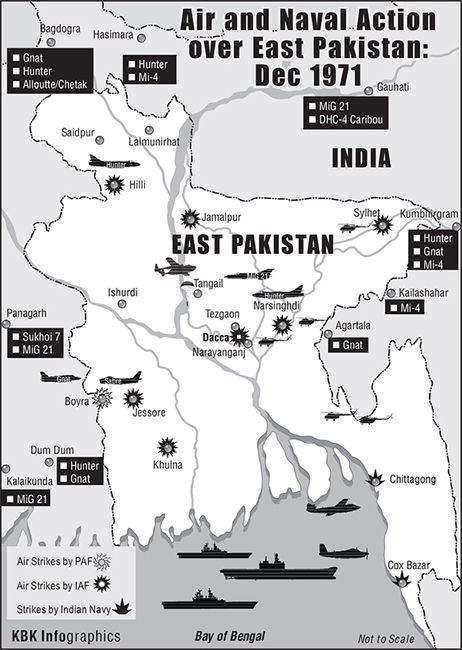
Barely had Governor Malik and his military advisor, Major General Rao Farman Ali, cleared the dust off their clothes and emerged from the debris of the Government House following the IAF attack on 14 December, Yahya Khan ordered the Pakistani forces in the eastern theatre to lay down their arms and surrender as ‘you have now reached a stage where further resistance is no longer humanly possible’.26Major General Fazal Muqueem Khan, Pakistan’s Crisis in Leadership (Islamabad: National Book Foundation, 1973), p. 187. Much has been written about the surrender ceremony and the author has no intentions of revisiting the issue in detail. Suffice it to say that it was a well-orchestrated ceremony in the afternoon of 16 December that was attended by all senior commanders of India’s Eastern Army Command, Naval and Air Force Command, which showcased to the world that India had arrived on the world military stage and could no longer be messed around with.27A detailed description of the surrender ceremony has been written by Lieutenant General Jacob, the chief of staff of Eastern Army Command. See Lieutenant General J.F.R. Jacob, Surrender at Dacca: Birth of a Nation (New Delhi: Manohar, 1977), p. 135–56. Also see S.N. Prasad and U.P. Thapliyal, ed., The India-Pakistan War of 1971 (Dehradun: Natraj Publishers, 2014), p. 414–17.
The ceasefire in the west was less spectacular as Indira Gandhi was only waiting for a decisive outcome in the east before accepting any offer of an olive branch from Pakistan. She took the lead and announced a unilateral ceasefire in Parliament on 17 December. Yahya Khan immediately accepted India’s offer as both countries realized that they could ill afford to continue a needless war.28Ibid., S.N. Prasad and U.P. Thapliyal, ed., The India-Pakistan War of 1971 (Dehradun: Natraj Publishers, 2014).