Part V: Conclusion
Remembering Kautilya
Kautilya, also known as Chanakya and Vishnugupta, was a master strategist who was well-versed in the Vedas (Hindu religious texts) and adept at creating intrigues and devising political stratagems.1L.N. Rangarajan, ed., Kautilya: The Arthashastra (New Delhi: Penguin, 1987).
KAUTILYA AND INDIA’S MODERN WARS
As I crossed the finish line, I wondered how Kautilya, India’s master strategist of ancient times, would have assessed the manner in which India conducted itself during all its wars and conflicts after Independence. Despite India’s spectacular success in 1971, he would have been largely critical, I reckoned. Nevertheless, I thought it would be worthwhile to benchmark how a fledgling modern state prosecuted war and statecraft against some of the principles and templates of war postulated by him around two thousand years ago.
For the uninitiated, Kautilya was said to be a key advisor or minister in the court of Chandragupta Maurya, the founder of the powerful Maurya Dynasty which ruled India between 322 and 185 BC. Kautilya’s claim to fame rests on a series of texts that are believed to have been initiated by him on statecraft under the title Arthashastra. The treatise covers the entire range of strategies, policies, tenets of leadership and governance which a king must follow to ensure that his subjects get to live in a prosperous and secure nation state. Not revered in India as much as Confucius and Sun Tzu are in China, or Clausewitz and Machiavelli in the West, Kautilya is the closest that any Indian strategist has come to propounding realpolitik and understanding military organizations and war as key tools of statecraft. His work seemed to have disappeared for a long time in a patchwork conglomerate of states that India was in the Middle Ages – a fragmented polity that seemed to have reconciled to being dominated by invaders and colonists like the Mughals and the British for almost six centuries. It re-emerged in the early part of the twentieth century in the sleepy south Indian town of Mysore where Shama Sastry, a Sanskrit scholar, set about translating a parchment that was given to him by a fellow scholar.
When this patchwork called India finally did attain Independence, it did so by waging war of a different kind on its colonial masters – a war that was based on satyagraha and ahimsa, and not on structured violence that the world commonly knew as war. Interestingly, Nehru’s dilemmas about the manner in which independent India would conduct statecraft seem to have deepened after he read Shama Sastry’s translation of Arthashastra; the ruthless wielding of power and the overwhelming dominance of the state over the individual seems to have disturbed him. These dilemmas were then articulated by him in a series of essays written in the 1930s under the pseudonym of Chanakya, which clearly indicated his discomfort with the realpolitik of Kautilya.2An excellent commentary on Kautilya by Prof. Sunil Khilnani is available on a BBC 4 podcast under the series Incarnations: India in 50 Lives. Though a number of researchers have indicated that India’s post-Independence obsession with idealism, liberalism and morality as the main pillars of statecraft meant that Kautilya was consigned to the periphery of strategic thinking, one of his few supporters was K.P.S. Menon, independent India’s first foreign secretary. He once noted in 1947 that ‘realism of Kautilya is a useful corrective to our idealism in international politics’.3Ashok Kapur, India’s Nuclear Option: Atomic Diplomacy and Decision Making (New York: Praeger Publishers, 1976), p. 77.
As a result of independent India’s rather pacifist strategic orientation, war as a proactive tool of statecraft remained a peripheral tool for decades till Indira Gandhi discovered its importance in 1971. Understanding war as more than mere combat – as a complex and interconnected set of activities across layers of human interaction – Kautilya looked at hard power as exercised by the military as an important element of statecraft.4Vinay Vittal, ‘Kautilya’s Arthashastra: A Timeless Grand Strategy,’ from a thesis submitted at the School of Advanced Air and Space Power Studies, Maxwell AFB, June 2011. Its effectiveness, however, depended on the manner in which the king used it along with diplomacy and covert operations. Avoidance of war, according to Kautilya, was the ultimate test of the efficiency of a king and his army. I guess they call it deterrence these days! Let us look at a few critical principles of employment of the military as proffered by Kautilya and see whether India’s military has looked at them with some seriousness. I have heard of seminars being conducted from time to time on the relevance of Kautilya in modern statecraft, but very rarely has there been any critical dissection of Indian statecraft in the Nehruvian era against Kautilyan principles of hard-nosed realpolitik. This was only natural because the liberal and altruistic flavour of modern Indian democracy did not see eye to eye with it. Many of the principles of Arthashastra support what we could call today enlightened autocracy. However, much of his treatise also endorses the sustenance of a disciplined democracy, the likes of which have sprung up in countries like Singapore and Switzerland. But that is straying from the military dimension of Arthashastra.
IMPORTANT SOURCES
The primary source of my offering is the book Kautilya: The Arthashastra, edited, rearranged, translated and introduced by L.N. Rangarajan, a diplomat and scholar of the highest pedigree. It is a difficult read, but instructive and illuminating, as one grapples with the subtle nuances of statecraft in an era long gone by. Some military tenets that I felt were relevant to modern warfare as experienced by the Indian armed forces in recent times are discussed in subsequent paragraphs. Two other excellent papers on Kautilyan thought have proved to be immensely helpful. The first is a well-written dissertation on Kautilyan strategy by Wing Commander Vinay Vittal (now group captain) for his master’s degree at the School for Advanced Air and Space Power Studies, United States Air Force Academy.5Ibid. The second paper is a robust academic piece in the Journal of Military History, January 2003, by Professor Roger Boesche, a professor of politics and history in the US, entitled ‘Kautilya’s Arthashastra on War and Diplomacy in Ancient India’.6Roger Boesche, ‘Kautilya’s Arthashastra on War and Diplomacy in Ancient India,’ Journal of Military History, Vol. 67 (January 2003): p. 9–38. Both these studies do not refer to any of India’s modern conflicts and address only Kautilya’s thought. The following paragraphs attempt to benchmark much of what has happened in contemporary Indian military history against some of his ancient tenets.
SOME TENETS
Higher Leadership
Comparing Kautilya’s treatise with Machiavellian radicalism in the realm of realism as a tool of political strategy, Max Weber, the famous German political philosopher of the late nineteenth and early twentieth centuries calls Machiavelli’s The Prince harmless.7Ibid., p. 9. Kautilya often writes on the ‘responsibilities of a leader in defending his subjects from external aggression’. Unlike Roosevelt, Churchill and Mao, Nehru’s approach to the role of force and the military in statecraft demonstrated ambivalence and reluctance with a touch of ‘forced realism’ when pushed against the wall. Writing to me on this in early 2015 as part of a critique on my book, a young and perceptive group captain very incisively wrote:
Also, Nehru’s remark about not needing any Army makes sense to me after reading his Glimpses of World History. Despite his breadth and depth of history, his anti-military bias shows up in his offhand remarks to Indira throughout the book. I found it very surprising that despite his intellect showing through in his analyses, he was blind to the reality of Force as a permanent catalyst for the flow of history.
While Churchill and Mao had military experience that empowered them to take decisive military action during times of crisis, Roosevelt was a keen student of military history and strategy and had a core group of trusted military officers like Eisenhower and George Marshall to help him navigate through WW II. Nehru had no such interest – his judgement about matters military in fact was clouded by his experience with India’s non-violent struggle for independence to such an extent that he started believing in it as a tool for the creation of a new international order based on altruism and idealism. Rather than understanding military strategy and war fighting, he devoted much of his focus towards civil–military relations and reducing the risks of a military takeover.8Steven Wilkinson, Army and Nation: The Military and Indian Democracy (Cambridge, Massachusetts: Harvard University Press, 2015), p. 15. Many of Nehru’s admirers assert that he did after all use force extensively when peaceful attempts at conflict resolution failed, but all these applications were reactive rather than proactive, be it in J&K (1947–48), Hyderabad (1948) or Goa (1961). Reactive deterrence of the kind that India displayed by rolling out the Forward Policy in 1961 without adequate coercive capability became a cornerstone of India’s national security posture for years to come!
Operational Preparation for War
Kautilya is emphatic when he says that an army that has marched for days and is tired and hungry before battle is half defeated already. He also refers to how when troops are directly inducted into battle without any acclimatization, it adversely impacts the way they fight. In October 1947, fresh and highly motivated troops of the Sikh and Kumaon Regiments were airlifted to Srinagar and fought off numerically superior raiders from Pakistan because they were better led, well motivated and battle-hungry as they fought for a cause. In the case of 7 Brigade at Namka Chu in 1962, Brigadier Dalvi and his men were exhausted by the time they occupied makeshift defences. Similarly, the Chhamb brigade prior to the 1971 war was geared up for offensive operations. When they were suddenly asked to fight a defensive battle instead, they floundered because they did not have enough time to prepare well-fortified defences. One of Kautilya’s tenets in the build-up before war states: ‘Till the enemy’s weakness is known, he should be kept on friendly terms.’9Vinay Vittal, ‘Kautilya’s Arthashastra: A Timeless Grand Strategy,’ from a thesis submitted at the School of Advanced Air and Space Power Studies, Maxwell AFB, June 2011.
This is exactly what Mao Zedong and Zhou Enlai did with India for almost seven years after the Panchsheel Agreement was signed between the two countries. China used that time to build an unassailable power differential vis-à-vis India before striking at a time and point of its own choosing.
Arthashastra talks about an army that is not abandoned in war and left leaderless without reinforcements. The story of India’s defeat in the Eastern Sector in 1962 is replete with examples where these principles were abandoned as the corps commander, Lieutenant General Kaul, fled the battle scene to recuperate from a mysterious illness in Delhi. In Ladakh, however, reinforcements for the defence of Leh and Chushul and decisive leadership by Lieutenant General Daulat Singh, the army commander, and Brigadier ‘Tappy’ Raina made the Chinese think twice before pushing forward in Phase II of the battle. They settled for a clear victory in the east and stopped short of complete victory in the west because Mao upheld some of Sun Tzu’s tenets that called for an avoidance of a complete humiliation of the enemy. Chanakya also clearly said in his treatise: ‘It is better to allow an army to withdraw than perish in a frontal battle. It should not be allowed to be sandwiched between a frontal enemy and an enemy in the rear.’10L.N. Rangarajan, ed., Kautilya: The Arthashastra (New Delhi: Penguin, 1987), p. 640.
The debacle at Namka Chu was because of the vulnerability of 7 Brigade to a frontal assault and its subsequent encirclement. The Sela garrison too faced the same contingency and came up short on strategies to counter it despite numerous accounts of individual gallantry and the presence of a battle-proven field commander in the form of Brigadier Hoshiar Singh.
Calamities
In its own subtle way, Arthashastra very succinctly deals with the vagaries of the seasons, weather and logistics, and their impact on military organizations and the conduct of war. Rather aptly called calamities, the treatise looks at almost thirty of these calamities that deal with a variety of issues related to human hygiene, environment and morale. An interesting calamity that Kautilya refers to is the cutting of an army’s supply of grain,11Ibid., p. 642. and how if grain is brought in from under the enemy’s nose, it could act as a significant morale booster. In the early spring of 1948, Brigadier Pritham Singh, the Poonch garrison commander during the almost year-long siege of the town, realized that food stocks were dwindling rapidly and that the aerial supplies were not going to be sufficient to sustain the civil population through the harsh winter. To supplement his grain stock, Pritham Singh organized audacious raids against enemy posts in the hills around Poonch with the aim of bringing back as much as wheat, rice and other staple food like potatoes and lentils. Emboldened by the success of this operation, he then encouraged villagers to farm their lands around Poonch during hours of daylight under armed escort, withdrew them into the garrison by evening, set up ambushes by night, and dared the enemy to upset this plan. This clearly rattled the enemy and lifted the morale of the nearly 40,000 civilians in Poonch when the grain was finally harvested months later.12Lieutenant Colonel Maurice Cohen, Thunder over Kashmir (Bombay: Orient Longman, 1955), p. 35. Over two decades later, Manekshaw clearly took note of many of these calamities as he prepared for the 1971 war. He ensured that the fighting season was right by doing his staff checks correctly and resisted pressure from Indira Gandhi to commence hostilities before the onset of the monsoon.
Covert Operations
Kautilya strongly advocated what he called covert activities as a means of degrading the fighting potential of the adversary before he actually did battle. He said, ‘Miraculous results can be achieved by practising the methods of subversion.’ He advocated what he called clandestine war (Gudayuddha), using covert methods to achieve the objective without actually waging a battle. To engage in clandestine war, he advocated the use of agents, analysts, double agents, allies, vassal kings, tribal chiefs and supporters of the enemy.13L.N. Rangarajan, ed., Kautilya: The Arthashastra (New Delhi: Penguin, 1987), p. 676, from the dissertation by Vinay Vittal.
Military intelligence operations were an intrinsic element of the Crown’s strategy to keep track of its frontiers, particularly in the early part of the twentieth century when the Russian Empire emerged as a strong competitor in the ‘Great Game’ that was being played for control of Central Asia. The other role for British Military Intelligence in India was to keep close track of the activities of the leaders of India’s freedom movement. Many arrests, incarcerations and deaths were attributed to the activities of intelligence operatives of the Crown. Soon after Independence Nehru practically demolished all structures of military intelligence and handed over the conduct of covert warfare to the Intelligence Bureau (IB), a new organization that was not really geared up for any meaningful covert operations in hostile territory. Military intelligence is vital for creating a multifaceted mosaic of likely battle spaces, which then allows a military commander to assess enemy deployments and plan military operations. Penetration of enemy lines and operational areas for intelligence gathering is best done by agents with a military background, much like what British Intelligence achieved behind German lines in France during WW II. With this arm barely functional in the 1950s, India’s strategic planners were virtually blind to what was happening in Aksai Chin and Tibet and had to make do with scanty IB reports.
Indira Gandhi used this form of warfare to great effect before conventional military operations commenced in East Pakistan in December 1971. Not only did she employ the R&AW for this purpose, she assigned similar covert tasks to the Indian Army as the possibilities of armed encounters during the process of intelligence gathering increased when India and Pakistan closed in to do battle. Realizing very astutely that she needed to buy time to allow her three chiefs to prepare their forces for conventional war, she needed to exert pressure on the East Pakistan military establishment. This, she hoped, would impose some check on the mass killings, reduce the flow of refugees into India, and exert constant psychological pressure on the Pakistan military. This was where the R&AW and co-opted officers from the Indian Army and Indian Air Force exploited the wave of anger amongst the East Bengalis towards their West Pakistani rulers, and used it to train the Mukti Bahini or Mukti Fauj. This covert force exerted pressure on the Pakistani military in every way for over six months (May–December 1971). The two major successes of this initiative were psychological degradation of the enemy and the building of a good intelligence picture, both of which contributed significantly to the success of the December campaign. Readers would recollect having read earlier in the book that a signals officer of the Indian Army infiltrated into the Tangail area well before the airborne operation to provide operational intelligence from the area.
Operational Flavour
Kautilya studied not only higher strategy but delved deep into operational art and even battlefield tactics, offering perspectives that have stood the test of time. His three maxims of generalship encompassed professional excellence and knowledge of strategy and tactics, individual warrior skills; and an understanding of all the wings of the military and their integration (what we call today ‘jointmanship’).14Rangarajan refers to them as qualifications of the chief of defence staff and puts them slightly differently. See L.N. Rangarajan, ed., Kautilya: The Arthashastra (New Delhi: Penguin, 1987), p. 647. Kautilya’s understanding of the importance of chariots is akin to the attributes of modern-day armoured fighting vehicles. He looked at chariots not only as offensive and manoeuvre elements that can break up the enemy and make an ‘awesome noise’, but also as defensive elements that can ‘protect the army’. The employment of the Indian Army’s 2 Independent Armoured Brigade in the battle of Assal Uttar (Khem Karan sector) in the 1965 war was a classic ‘defensive’ deployment of armour that was subsequently converted into offensive action. Staying in the sector and giving due credit to the enemy, Pakistan’s initial success at Khem Karan was a result of Major General Gurbaksh Singh’s 4 Mountain Division being surprised by the emergence of Major General Nasir Ahmed’s 1 Armoured Division behind the lead assaulting division, 11 Infantry Division. Kautilya offers his perspective: ‘The conqueror may conceal a strong force behind a weak force and when the weak force has penetrated the enemy ranks, reinforce the attack with the strong one.’
Staying with the 1965 war, Kautilya writes that ‘any force which has to fight facing the sun or the wind shall be attacked’. When IAF Vampire jets rushed to Chhamb on the evening of 1 September, they were flying westwards into the sun and were easy picking for the PAF Sabres waiting over the battle area.
Motivation, Inspiration and Leadership
Inspiring and motivating troops to willingly walk into the ‘jaws of death’ for their nation, their regiment or their leader is one of the most important tasks assigned to leadership prior to battle. Kautilya says, ‘The conqueror shall collect his forces and say to them: “I am as much a servant of the state as you are; we shall share the wealth of this state. Attack these, mine enemies.”’15Ibid., p. 672. India’s commanders have been no less inspiring prior to many of their successful battles. Brigadier Mohammad Usman, one of India’s finest battlefield commanders in the 1947–48 conflict with Pakistan and the senior-most Indian military officer to lay down his life in the line of duty during that conflict, delivered one of the most inspiring pre-battle orders prior to his brigade’s successful assault on Jhangar in March 1948. The officers received the message in English, while the men received it in Hindi. It read:
Comrades of 50 Parachute Brigade Group, Time has come when our planning and preparation for the recapture of Jhangar has to be put to test. It is not an easy task but I am confident of success – because our plan is sound and our preparations have been good. More so, because I have complete confidence in you all to do your best to recapture the ground we lost on 24 December and to retrieve the honour of our arms. The eyes of the world are on us. The hopes and aspirations of our countrymen are based upon our efforts. We must not falter – we must not fail them.16Major General V.K. Singh, Leadership in the Indian Army: Biographies of Twelve Soldiers (New Delhi: Sage Publications, 2005), p. 171–72.
So forward friends, fearless we go to Jhangar. India expects everyone to do his duty.
Similarly, during the early days after Pakistan’s surprise attack in Chhamb in 1965, the morale of IAF pilots in Pathankot was pretty low and one of the catalysts for a turnaround was an inspirational talk given by a young wing commander, Johnny Green, who urged all pilots to ‘conquer your fears and seek battle with the Sabres’. By the end of the war, the Gnats came to be known as ‘Sabre Slayers’ and carried that reputation into the 1971 war.
While visionary higher leadership and strategic acumen were in short supply many a time during India’s early wars after Independence, these were finally demonstrated in full measure in the 1971 war. There has, however, been no shortage of inspirational, operational and tactical leadership on the battlefield, in the air or on the high seas. Thimayya, Usman Somnath Sharma, Mehar Singh and others in 1948; Subedar Joginder Singh, Major Shaitan Singh and the numerous unsung transport and helicopter pilots in 1962; Lieutenant General Harbaksh Singh, Lieutenant Colonel Tarapore and the bunch of Gnat pilots in 1965; and finally, Lieutenant Generals Sagat Singh and Sartaj Singh, Group Captains Mally Wollen and Chandan Singh, Second Lieutenant Arun Khetarpal, Major Hoshiar Singh, Lance Naik Ekka, Flying Officer Sekhon, Captain Mulla and Commander Babru Yadav in 1971, all displayed heroism and leadership comparable to the best any nation had to offer at the time. Kautilya would have approved!
Writing in the The Times of India, Henry Kissinger, considered by many to be the doyen of twentieth-century realpolitik, argues that ‘… for Kautilya, power was the dominant reality. It was multidimensional, and its factors were interdependent.’17Ibid. Emphasizing the central theme of the treatise, Kissinger goes on to add, ‘The Arthashastra sets out, with dispassionate clarity, a vision of how to establish and guard a state while neutralizing, subverting, and (when opportune conditions have been established) conquering its neighbours. The Arthashastra encompasses a world of practical statecraft, not philosophical disputation.’18Henry Kissinger, ‘The World According to Gita,’ The Times of India, Pune, 21 November 2014, p. 18. The article is the lead article on the editorial page. Barring the conquering bit, which is out of fashion in modern geopolitical strategy, the rest remains ever so relevant today.
When a nation and its people accept and acknowledge that force application, however undesirable it may seem, is an intrinsic element of statecraft and critical to protecting what is dear to them, military history automatically fits into the main historical discourse. As a result its study will always be continuous and important to policymakers. That is how I reckon Kautilya would have approached the study of military history. Comparing Machiavelli, Sun Tzu and Kautilya, Professor Boesche argues:
And thus compared to Kautilya and Sun Tzu, Machiavelli’s writings on warfare are tired and tedious, filled with nostalgia for long-dead legions that once gained glory. He wanted the public battlefield, the grand spectacle, fame for some and cowardice for others. Sun Tzu and Kautilya did not care a whit for glory and fame. They wanted to win at all costs and to keep casualties—on both sides—to a minimum. Said Sun Tzu, ‘For to win one hundred victories in one hundred battles is not the acme of skill. To subdue the enemy without fighting is the acme of skill.’ They were also prepared to win in ways Machiavelli would regard as dishonourable and disgraceful—assassination, disinformation, causing quarrels between ministers by bribes or by means of jealousy over a beautiful woman planted as a secret agent, and so on. Machiavelli—who offers no systematic discussion of even guerrilla warfare—would have been easily outmatched by generals reading either Sun Tzu or Kautilya.19Ibid. 20. Roger Boesche, ‘Kautilya’s Arthashastra on War and Diplomacy in Ancient India,’ Journal of Military History, Vol. 67 (January 2003): p. 37. [Index](part0002.html#INInd) Abbotabad Abdali, Ahmad Shah Abdullah, Sheikh Abdulm Salam Abyssinia (Ethiopia) Adampur airbase, Jalandhar Advanced Flying School, Ambala Afghanistan Foreign Terrorists (FTs) operational campaigns Russian invasion Wars, First and Second (1839 and 1880) Third (1919) Afridis and Mahsuds Afrika Corps Agnew Ahluwalia, Air Vice Marshal Harry Ahmed, Major General Nasir Ahoms Ahsan, Admiral S.M. Air House – 23 Akbar Road Akbar, Emperor Akhaura Battle Akhnur sector Aksai Chin, China’s build up Alamein, Battle of Al-Badr Alexander Alexander, General Ali, Lubna Abid Ali, Major General Rao Farman Alibaug Allied forces Al-Qaeda Amin, Major (retd) Agha Humayun Andaman and Nicobar Islands captured by Japanese Andaman Sea Andhra Hindu Mahasabha Anglo-American machinations in Tibet Anglo-Burmese War (1826) Anglo-Maratha War Anglo-Sikh (two) wars (1848–49) Sikh resistance after Angre, Kanhoji Angre, Tukoji Angre, Tulaji Anjadiv Anti Submarine Warfare (ASW) Anupgarh Arabian Sea Arakan Coast of Burma Ardgah Arjan Singh, Squadron Leader Arjuna Armed Forces Nationalisation Committee Arthashastra Arun Prakash, Admiral Arunachal Pradesh Asaf Jah VII, Sir Mir Osman Ali Khan Siddiqui, Nizam of Hyderabad Army of and Police Action richest man in the world control over rural population Standstill Agreement with Government of India sought United Nations’ intervention, 174 surrendered Asaf Jahi dynasty Assal Uttar Battle counter attack at Assam Regiment Assam Rifles Atkinson, Rick Atlantic and Burma, action of Indian Navy Atlee, Clement Atma Singh, Major General Auchinleck, Field Marshal Claude Aurora, Lieutenant General Jagjit Singh Awami League Axis powers Azad Hind Fauj See Indian National Army (INA) Azad Kashmir See Pakistan Occupied Kashmir Babar (force) Babur Badgam Battle Baghdad Pact, 262Bakshi, Major Zorawar Chand Balaji Rao defeated the Nizam of Hyderabad (1927) Baltistan See Gilgit and Baltistan Baluchis Bangladesh, formation Banihal Pass Bannu Brigade Barahoti Pass Baralacha Pass Baramulla Barty, Dennis Basantar battle Battle Field Interdiction Bay of Bengal, US Seventh Fleet Bayly, Christopher Beg, Yakub Bengal Sappers Benghazi battle, Libya Bewoor, Lieutenant General G.G. Bhagat, Lieutenant Premindra Singh Bharat Kumar, Air Marshal (retd) Bhatia, Air Marshal K.L. Bhindranwale, Sant Jarnail Singh Bhonsale, J.K. Bhopal Bhopal Infantry Bhutan-Tibet-Arunachal border Bhutto, Shah Nawaz Bhutto, Zulfiqar Ali Biddle, Tami Davis Bihar Regiment Bijapur, Sultan of Bipin Chandra Bishnoi, Wing Commander Black Formation Blackett, Prof Blainey, Geoffrey Blake, Wing Commander Mickey Blenheim bomber Boer War Boesche, Roger Bombay Marine Bomdila Border Security Force (BSF) Bose, Rash Behari Bose, Sarmila, Dead Reckoning Bose, Subhas Chandra Bose, Sugata Bucher, General Roy Boyra, Battle of Bren Carriers Brigade of Guards Britain, Battle of British, British Empire/Raj Army and Asaf Jahi dynasty, relations Chiefs of Staff Committee colonial expansion in India gained control over Deccan Plateau after defeating Marathas ‘Divide and Rule’ policy imperialism India’s non-violent ousting Indian composition of military leadership Military Intelligence military leadership Operations Research post-war political leadership British Indian Army communal, caste and race polarization Brooke, Alan Burma Japanese invasion Burma Campaign (1944–45) Burzil Range Cambrai Battle Canberra Candeth, Lieutenant General K.P. Cardozo, Major Ian Cariappa, Field Marshal K.M. Cariappa, Flight Lieutenant Nanda Casualty Evacuation Missions (CASEVAC) Cease-fire agreement Ceasefire Line (CFL) Central Intelligence Agency (CIA) Central Military Commission Central Provinces Central Treaty Organization (CENTO) Centurion tank Chaklala Chandan Singh, Group Captain Changanchenmo River Valley (spl vari) Change Manga Forest Chaudhuri, General J.N. Chavan, Y.B. Chawinda dogfight over Che Guevara Chen Yi, Marshal Chhamb sector guns boom Indian Air Force over Chiang Kai Shek Chillianwala Battle (1849) China and Burma, logistics links Communist Confucian and Tibetans, animistic and monastic, cultural differences operational art Pan-Asian hegemony revolutionary movement Tibet issue India-war (1962) See India-China war Chitralis Chittagong sector Chola empire Cho La Chopra, Samir Chou-en-Lai See Zhou Enlai Christison, Lieutenant General Philip Chu Han boundary Chumbi valley Churchill, Winston Chushul Battle resistance at Citino, Robert M. Civil Volunteer Reserve Force civil-military relations Clausewitz Cloghley, Brian Close Air Support (CAS) and Interdiction operations Cloughley, Brian Coastal Defence Flights Coastal Forces in Burma Theatre coastal fortifications Cohen, Major Maurice Cohen, Stephen Cold War collective security as a state policy colonialism Combat Air Patrol command and control structure Commission for Non-Commissioned Officers communal violence Communist Party of India (CPI) Confidence Building Measures (CBMs) Confucius Congress seizure of Goa Cooke, Flight Lieutenant Alfred Coral Sea, Battle of Counter-Insurgency and Counter-Terrorism operations covert operations Crown dominated the frontiers Cunningham, George Curzon, Lord Dacca Da-Gama, Vasco Dalai Lama Dalrymple, William Dalvi, Brigadier J.P. Dalvi, Michael Daly College, Indore Das, Sarat Chandra Datta, Major General Daulat Beg Oldie (DBO) Daulat Singh, Lieutenant General David, Lieutenant Noel Dayal, Major Ranjit Singh Deccan Plateau defence budget Defence Committee of the Indian Cabinet Defence Services Partition Committee Defence Services Staff College (DSSC) Dera Baba Nanak (DBN) air-land battle valour at Devayya, Flight Lieutenant Tubby Dewan, Air Marshal Dhillon, Brigadier Gurbinder Dhillon, Lieutenant General Chanan Singh Diego Garcia Dilawar, Squadron Leader Distinguished Service Crosses Dogra (Hindu) soldiers, Dogras Tibetans and Chinese, treaty Dograi, Battle Duff, James Grant, History of Mahrattas Duleep Singh, Maharaja Dulles, John Foster Dunne, Major General P.O. Durrani kingdom Dutch East Indies (modern Indonesia) Dwaraka Dyer, Brigadier General East Bengal Rifles (EBR) East India Company (EIC) Army East Pakistan Armed Forces Eden Commission (1879) Egypt Eisenhower, Dwight D. Ekka, Lance Naik Albert Elmhirst, Air Marshal Thomas Engineer, Squadron Leader Aspy Merwan Engineer, Jehangir Engineer, Minoo ethnic and religious bigotry ethnic cleansing European sea power Exercise Peace, as the operation to liberate Junagadh Falaise, Battle of Fazilka Fighter Leaders’ School First War of Independence (1857) Flag Officer Commanding Royal Indian Navy (FOCRIN) Foreign Terrorists (FTs) of Afghan and Pashtun Forsyth, Douglas Forward Air Controllers (FACs) Forward Defensive Line Forward Line of Own Troops (FLOT) Forward Policy (1961) Fourth Generation Warfare France during World War II free India, procrastination Freedman, Sir Lawrence freedom struggle Fricker, John fundamentalist ideologies Galbraith, John Kenneth Galwan Valley Ganapathy, Flying Officer Gandhi, Indira lost opportunity to solve the Kashmir issue standing up to the United States Gandhi, M.K. Gangasagar battle Ganguly, Sumit Garhwal Rifles Garver, John Gautam, Wing Commander Gaylor, John general elections (1967) (1971) (2014) geographical boundaries geopolitical instability geopolitical landscape geopolitics George VI, King German and Japanese naval build-ups World War I Ghandhi, Flight Lieutenant Ghaznavi (force) Gilgit and Baltistan (Northern Autonomous Region) Gilgit Scouts Gill, John H. Gill, Lieutenant General Inder Singh Gill, Major General Gurbaksh Singh, (spl vari Gurbux) Gill, Squadron Leader Padam Singh Gnat Goa, Daman and Diu freedom movement lethargic response of Government of India liberation movement Portuguese legacy seizure of (evacuation from Portuguese) Gobind Singh, Guru Gonsalves, Major General Ben Goodman, Wing Commander William Gorkha Regiments Gorkha Rifles Gorkha War (1816) Gorkhas Gosain, Flight Lieutenant Gracey, General Great Game Great Wars Greene, Wing Commander Johnny Grenadier Regiment Guadalcanal, Battle of Guha, Ramachandra India After Gandhi Patriots and Partisans Gujarat Battle Gulab Singh, Raja Gulati, Squadron Leader Baldev Raj (retd) Gurdial Singh, Brigadier Gush, Commander A.W. Haider Ali Haider, S. Sajad Haji Pir Pass Halwara Hari Chand, Major Hari Singh, Maharaja of Kashmir Harolikar, Lieutenant Colonel A.B. Harper, Tim Hawai Sepoys Hayde, Lieutenant Colonel Desmond Heavy Vehicle Factory Henderson Brooks Report Hindustan Aeronautics Limited (HAL) Hiranandani, Vice Admiral Holstag, Jonathan Hoshiar Singh, Major Howard, Michael Hughes, Flight Lieutenant Arthur human intelligence (HUMINT) humanitarian crisis in east Pakistan Hunter Hurricabe fighters Hussain, Flight Lieutenant Amjad Hussain, Flying Officer Q.A. Hussain, Major General Ibrar, (spl vari Abrar) Hussain, Mumtaz Hyderabad Hindu population liberation of indecisiveness over multi-pronged offensive Nizam of See Asaf Jah VII police action State Forces Ibrahim, Sardar Ichogil Canal Iliad Imphal, Battle of See also Kohima India-China conflict (1962) and Aksai Chin defeat offensive air power not used Tibet issue India-Pakistan War (1947–48) drags on gun fall silent holding on to Kashmir politics and religion dictated surprise and riposte war drags on India-Pakistan War (1965) India and Pakistan, military equation opening moves, Kutch to Kashmir Operation Gibraltar and Grand Slam operational stalemate strategic revival India-Pakistan War (1971) destination Dacca India prepares, Pakistan stumbles what means to India and Pakistan leadership opening the Western Front operational takeaways from Indian perspective release of Pak prisoners shaping the Eastern Front South Asia in turmoil India-Bhutan-Tibet border India-Burma-Tibet tri-junction Indian Air Force (IAF) attitudes India-China war (1962) India-Pakistan war (1965) over Chhamb response to Pakistan initiative India-Pakistan war (1971) bombing campaign in Dacca run-up to independence tribal control World War II Indian Air Force Volunteer Reserve Force (IAFVR) Indian armed forces and India-China War (1962) and India-Pakistan War (1947–48) and India-Pakistan war (1965) and India-Pakistan (Bangladesh Liberation) war (1971) and Indian National Army (INA) and Indian society, relations liberation of Goa, Daman and Diu from Portuguese and liberation of Hyderabad colonization of Angola and Mozambique colonization of Goa, Daman and Diu deployment in Ladakh stagnation Indian Army British legacy, restructuring and professionalism entering into twentieth century Indian or colonial diversity downsizing Eastern Army Command and India-China War (1962) India-Pakistan war (1947–48) India-Pakistan war (1965) India-Pakistan war (1971) in Iraq in WW I officers and men Southern Army Command transition, adjustment and freedom Western Army Command Indian Corps Commander Indian Military Academy (IMA) Indian military, stagnation Indian National Army (INA) Indian Naval Air Squadron (INAS) Indian Navy Air Force synergy British legacy Carrier Battle Group dilemma Eastern Naval Command flying the Indian ensign offensive on Karachi run-up to independence Western Naval Command Indian Ocean Indian parliament, terrorist attack (2001) Indian Peacekeeping Force (IPKF) India-Nepal-Tibet tri-junction Indo-Soviet Treaty of Peace and Friendship (1971) Indo-Tibet border Indus River Indus Valley Civilization Infantry Brigade INS Angre INS Beas INS Betwa INS Brahmaputra INS Delhi INS Khukri INS Vikrant intelligence agencies Intelligence Bureau (IB) intelligence gathering about Goa International Border (IB) with Pakistan International Conference on Portuguese colonialism, New Delhi (1961) international relations inter-state wars and insurgencies inter-war years Italy Indian Army, into Ittehad-ul-Muslimeen, (spl vari) Ivan Chen Jacob, Lieutenant General Jadhav, Havildar Maruti Jagan Mohan, P.V.S. Jagjivan Ram Jahangir, Mughal emperor Jaisalmer Jalamaiva Yasya, Balamaiva Tasya Jallianwala Bagh massacre Jammu and Kashmir (J&K), Kashmir issue accession to Indian Union assembly elections (1950) Hindu Dogra rulers massacre of Hindus insurgency internationalization of conflict military action State Forces communal divide subversion in tribal invasions Kashmir Liberation Committee Jamnagar Jan Sangh Janjua, Major General Iftikhar Japan Army assault on Akyab formations forces in Burma prisoners of war camps Zero fighters Jasjit Singh, Air Cmde Jaswant Singh, Major General Jat Regiment Jat warriors, Jats Jatar, Squadron Leader Dinky Jaurian Sector Jellicoe, Lord Jhangar, battle Jihad Jinnah, Muhammad Ali Jodhpur Joginder Singh, Subedar Johnson, Alastair Iain Joint Bomber Conversion Unit (JBCU) Joint operations, the X-factor in the East joint war fighting Junagadh declared the accession to Pakistan liberation of military action against Nawab of Kalaikunda Kalian Singh Kangaw Battle Kao, R.N. Kapila, Flight Lieutenant Vinay Kaplan, Robert D. Karakoram range Karam Singh, Inspector Kargil sector garrison (1947–48) conflict with Pakistan (1999) Karnad, Raghu Karnataka Kashgar Kashmir See Jammu & Kashmir Kasur Katari, Commander R.D. Kaul, Lieutenant General B M Kaushik, Air Commodore S.S. (retd) Kautilya and India’s modern wars Kautilya: The Arthashastra (Ed. L.N. Rangarajan) Kavina, Lieutenant Commander Bahadur Keating, Kenneth Keay, John Keegan, John Keelor, Flight Lieutenant Denzil Keelor, Flight Lieutenant Trevor Keynes, John Maynard Khalid (force) Khambatta, Major General Khampa rebellion, Eastern Tibet (1959) Khan, Air Marshal Asghar Khan, Air Marshal Nur Khan, Amanullah Khan, Captain Shahnawaz Khan, Filed Marshal Ayub Khan, Liaqat Ali Khan, Major General Akbar Khan, Major General Tikka Khan, Nisar Ahmad Khan, Rahim Yar Khan, Sepoy Khudadad Khan, Yahya Khan, Zafarullah Khardung La Khem Karan Battle Khera, P.N. Khetarpal, Second Lieutenant Arun Khusal Chu, Wazir Mian Khuswant Singh, History of Sikhs Kiani, Mohd Zaman Kings Commission Kings Commissioned Indian Officers (KCIO) Kishanganga-Tithwal sector Kishen Singh Kishtwar range Kissinger, Henry Kitchener, Lord Kler, Brigadier Hardev Kohat Kohima Battle Kohli, Admiral S.N. Kongka La Pass Korean Peninsula Korean War Krishnan, Admiral Kulkarni, Uday S., Solstice at Panipat: 14 January 1761 Kulwant Singh, Major General Kumaon Regiment Kumaonis Kunjali Marakkars Kunlun Range Kuruvilla, Rear Admiral Kushal Chand, Captain Kutch, Maharaja of La Bassee Ladakh Scouts Ladakh air brigade to Leh and defence of Ladakh border management and India-China conflict of 1962 and Tibet, early posturing Ladakh-Tibet boundary Lahore and 1965 War 1971 War Lahore treaty (1809) Lal, Air Chief Marshal P.C. My Years with the IAF Lamb, Alistair Lambeth, Benjamin Lane, Timur Laser Guided Bombs (LGBs) Lashkars Lassawala, Lama Guru Sahib late medieval Indian ethos Latif, Air Chief Marshal Lazarus, Flying Officer Don leadership in India British colonial Hyderabad, liberation of and India-China war (1962) and India-Pakistan war (1947–48) and India-Pakistan war (1965) and India-Pakistan war (1971) of Sikhs leadership in Pakistan and India-Pakistan war (1947–48) and India-Pakistan war (1965) and India-Pakistan (Bangladesh liberation) war (1971) Lee, Wing Commander Asher Leh Leh-Kargil-Dras sector Lhasa and Tawang monasteries, religious interaction Liberation Tigers of Tamil Eelam (LTTE) Line of Actual Control (LAC) Line of Control (LoC) Lockhart, General Rob Lohia, Ram Manohar Long Range Penetration Groups, Burma Longju Lutyens, Edward Machiavelli, Niccoló Madras Engineering Group (MEG) Madras Presidency Mahabatkhan Rasulkhanji, Nawab of Junagadh Mahabharata Mahar Regiment Mahars Mahsuds Majumdar, Flight Lieutenant K.K. (Jumbo) Malacca straits Malaya Malgaokar, Lt Col (retd) Manohar Malik, Hardit Singh Malik, Major General Akhtar Hussein Malse, Air Marshal Mamgain, Flying Officer Manbir Singh, Flight Lieutenant Manchus of Qing Dynasty Manekshaw, Field Marshal Sam Mankekar, D.R. Manmohan Singh, Brigadier Mao Zedong, role in India-China conflict (1962) Maratha Empire, Marathas nationalism and Nizam of Hyderabad, fight under Peshwa Balaji Rao resurgence at sea See also Sikhs Maratha Light Infantry Maritime Air Operations maritime resistance to British expansion maritime trade linkages Marshall (spl variation Marshal. Full name ?) Masillamani, Squadron Leader Mason, Philip Massey, Flight Lieutenant Roy Masud, Air Commodore Zafar Mathews, Lieutenant General Thomas Maurya, Chandragupta Maxwell, Neville Mayadev, Flight Lieutenant McMahon Line McMahon, Sir Henry Megh Singh, Lieutenant Colonel Meghdoot Force Mehar Singh, Air Commondore Mehta, Lieutenant General Shamsher (Shammi) (retd) Mehta, Squadron Leader F J Menon, V.K. Krishna Menon, V.P. Mersa Mathruh Battle (1942) Mesopotamia campaign (1915–16) Messervy, General Frank MiG-21 Military balance decisiveness history, neglect of intelligence organization and war as tools of statecraft violence against the Japanese and the Kuomintang the way ahead Western perspective Mirpur Mizo insurgency Mobile Observations Posts (MOPs) Mohan Singh, General Mohanty, Arun Mongol invaders Monte Casino (where an Indian division performed) Montgomery, Field Marshal Moolgavkar, Air Chief Marshal Moorcroft motivation, inspiration and leadership Motor Launched Flotillas Mountbatten, Lord Mughals, Mughal Empire army decline inefficiency as invaders Mujahids Mukerjee, Air Commondore Subroto Mukherji, Captain D.N. Mukti Bahini and covert operations Mulla, Captain Mahendra Nath Mullick, B.N. Mumbai: terrorists’ attacks (2008) Munnawar Tawi RiverM (spl variation) Muntho Dalo Murdeshwar, Group Captain Manna Murray, Brigadier Williamson Murtuza (force) Musa, General Mohammed Mushkoh Valley Muslim(s) and Hindus, religious violence of Hyderabad invaders of India of Kashmir Punjabi See also Razakars Muslim League Mutual Defence Assistance Agreement Muzzafarabad Mysore Army Third War (1817–1818) Mystere Nadir Shah Nadkarni, Admiral Jayant Nagra, Major General G C Nair, Brigadier Nambiar, Lieutenant General Satish Namka Chu Nanda, Admiral S.M. Nanda, B.R. Napoleonic wars, Napoleon Narain Singh, Lieutenant Colonel Naser, Major Khwaja Nath, Captain Rajendra Nath, Wing Commander Jaggi Nathu-la pass National Army War Museum National Atlantic Treaty Organization (NATO) National Conference (NC) National Defence Academy (NDA) National War Memorial nation-state relations Naval dilemma Navina, Bahadur Karim Nawaz, Shuja Neb, Flying Officer Negi, Naik Darwan Singh Nehru, Jawaharlal death and the liberation of Goa and Hyderabad’s merger with Indian union and India-China war (19962) and the Indo-Pak war of dilemmas about Indian statecraft demolished military intelligence structures Nehru, Motilal Neuve Chapelle Battle, (variation on same page) Niazi, Lieutenant General A.A.K. (Tiger) Nixon, Richard non-alignment policy Normandy Army Normandy, Battle of Noronha, Squadron Leader North East Frontier Agency (NEFA) North West Frontier Province (NWFP) operational campaigns insurgencies Nusrat (force) Offensive Defensive Strategy Omdurman, Battle of Omissi, David Operation Blue Star Operation Brass Tacks Operation Desert Hawk Operation Dracula Operation Gibraltar Operation Grain Operation Grand Slam Operation Gulmarg – Secret Operation Leghon Operation Market Garden Operation Parakram Operation Polo Operation Vijay (1961, eviction of Portuguese from Goa, Daman and Diu) Operation Vijay (battle of Jhangar) operational leadership Operational Ready Platform (ORP) organizational cohesiveness OSA boats Osmani, Colonel M.A.G. Out of Area Contingency Operations Pakistan China, strategic pact infiltrations and ceasefire violations Kashmir strategy military adventurism military brinkmanship as a state policy People’s Party (PPP) proxy war as state policy supported Portugal in Goa conflict Pakistan Armed Forces Pakistan Air Force (PAF) Pakistan Army, 5 Pakistan Frontier Rifles Pakistan Navy Pakistan Occupied Kashmir (PoK) (Azad Kashmir) formed by Poonchi Muslims Pakistan Special Forces Pakistan Special Frontier Force (SFF) Palestine Palit, Major General D. K. (Monty) Palsokar, Brigadier R.R. (retd) Panchsheel Agreement failure with China Pandit, Lieutenant General B.T. Panipat Battle, Third (1761) Pannu, Lieutenant Colonel K.S. Parab, Lieutenant Colonel Harishchandra Sakharam Parachute Regiment Paranjpe, Brigadier Parker, Air Marshal Cecil Partapur Partition Council Partition of Indian subcontinent and plotting sectarian violence Pasricha, Vice Admiral Vinod (retd) Patel, Sardar Vallabhbhai Pathania, Major General A.S. Pathans of Kashmir Patney, Air Marshal Vinod Pattan Battle Peel Commission (1859) People’s Liberation Army Air Force (PLAAF) Persian Gulf Peshwa rulers of Pune, Peshwas Phillaur Phillora See also Chawinda Pinto, Air Marshal Erlic W. Pinto, Lieutenant General W.A.G. Pir Panjal range PNS Ghazi political opportunism politico-military relationship Polo Air Task Force Pondicherry Poonch Brigade Poonch Garrison Command Poonch saga of valour Poonchi Muslims Portuguese colonization of Goa, Daman and Diu sea power Praja Socialist Party (PSP) Prasad, Major General Niranjan Prasad, S.N. Prince of Wales Royal Indian Military College, Dehradun princely states Pritham Singh, Brigadier Provisional Government of Azad Hind proxy war strategy of Pakistan Pujji, Squadron Leader Mohinder Singh Punjab Boundary Force Punjab Frontier Force Punjab Regiment Qadam Qadam Badaye Ja Qing Dynasty Quit India civil disobedience movement R Class destroyers (Rajput, Ranjit and Rana) radar warning receivers (RWR) Raghavan, Srinath Raghavendran, Air Marshal Rai, Jyoti and Patwant Singh, The Empire of the Sikhs Raina, General T.N. (‘Tappy’) Rajaram, Air Marshal Rajendra Sinhji, General Rajkumar, Air Marshal Philip Rajouri Rajput Regiment Rajputana Rifles Rajputs, Rajput warriors seized Diu Randhir Singh, Air Marshal Rangarajan, L.N. Rangdom Gompa Ranjit Rai, Lieutenant Colonel Dewan Ranjit Singh, Maharaja of Punjab Rao, Major General K.V. Krishna Rashtriya Indian Military College (RIMC) Rashtriya Rifles Rathore, Lt Col Rajyvardhan Singh Rathore, Major J S (retd) Ratnu, Wazir Rawat, Pandit Nain Singh Rawlinson, Lord Rawlley, Lieutenant General N.C. Razakars realpolitik Rear Airfield Maintenance Organisation, Palam Reconnaissance, Indian statecraft and Chinese intransigence regimental system Rehman, Sheikh Mujibur Rehman, Zia-ur Research and Analysis Wing (R&AW) Rezangla Rikhye, Ravi Rizvi, Kasim (spl vari Qasim Razvi) Roberts, Lord Rohtang Pass Rommel, Field Marshal Erwin Roosevelt, Franklin Rose, L.E. Rosen, Stephen Ross, Robert S. Roy, Indra Lal Roy, Vice Admiral Mihir, War in the Indian Ocean Royal Air Force (RAF) Royal Desert Air Force Royal Flying Corps (RFC) Royal Indian Air Force (RIAF) Royal Indian Army Supply Corps Royal Indian Marine (RIM) Royal Indian Military College (RIMC) Royal Indian Naval Volunteer Reserve (RINVR) Royal Indian Navy (RIN) downsizing and retrenchment revolt World War II Task Force Royal Jordanian Air Force Royal Military Academy, Sandhurst Royal Navy Rubinoff, Arthur Rudra, Major General Ajit Anil ‘Jock’, (spl vari Jick) Russell, Lieutenant General Dudley Russian Empire Sabre Slayers Sagat Singh, Lieutenant General Salauddin (force) Salazar Sambhaji, Maratha Prince Sampuran Bachan Singh, Lieutenant Colonel Samson, Vice Admiral Sandhu, Flight Lieutenant A.J.S. Sangha, Lieutenant Colonel G.S. Sant Singh, Brigadier Sapper (Engineer) Regiment Sarila, Narinder Singh Sastry, Shama Satyagraha movement Satyendra Singh, Rear Admiral Schanberg, Sydney Se La, collapse of Sea Control and Protection of Commerce Sea Denial Sea Hawks and Alizes Sea Lines of Communications (SLOCS) sea-land battle (1604) Sehgal, Squadron Leader Prem Sekhon, Flying Officer Nirmaljit Singh Sen, Eroll Chunder Sen, Lieutenant General L.P. Shah, Squadron Leader Zafar A. Shaitan Singh, Major Shakargarh Battle limited success Shaksgam Valley, ceded to China by Pakistan Shalateng Battle Shankar, Air Vice Marshal Milind Shankar, Engineer Sharma, Flight Lieutenant S.C. Sharma, Lieutenant General Nirbhay Sharma, Major Somnath Shastri, Lal Bahadur Sherman tank Shivaji, Maratha king Sholapur-Hyderabad highway Shyok river Siachen Glacier Sialkot sector tank battle Siddiqui, Tiger Signals Training Centre (STC) Sikhs, Sikh warriors assimilation into British Indian Army military resistance to British expansion Sikh Light Infantry Sikh Regiment Sikkim Sikkim-Tibet border Simla Agreement Simla Conference (1972) Simla Conference with Tibet and China (1914) Singapore fall of (1942) Singh, Brigadier K.K. Singh, General V.K. Singh, Lieutenant General Harbaksh Singh, Lieutenant General Sartaj Singh, Lieutenant Yadunath Sinha, Major S.K. Sinhgarh Company Sinkiang See Xinjiang Sirijap complex Skardu battle Skeen Committee Slim, Field Marshal William ‘Bill’ Defeat into Victory Somme and Flanders, Battle of South Asia in turmoil South-East-Asia South East Asian Treaty Organisation (SEATO) Soviet Union advances towards Indian Ocean and Persian Gulf expansion into Central Asia Spangur Gap Sparrow Control Sparrow, Major General Rajinder Singh Special Services Group (SSG) Spitfires Spiti Valley spring battles in the vale Sri Lanka Indian intervention Srinagar-Leh highway Standard Operating Procedures (SOPs) Standstill Agreement statecraft relevance of Kautilya reconnaissance, Indian statecraft and Chinese intransigence strategic revival Subrahmanyam, K. Sukhoi Sun Tzu Sundarji, General Krishnaswamy Supremo Syndrome Surender Singh, Naik Suri, Group Captain Roshan Swaraj Prakash, Captain Swaran Singh, Sardar Sylhet Tactical Air Centre (TAC) Tactical Battle Area (TBA) Tactics and Combat Development Establishment (TACDE) Tang dynasty Tara, Major Ashok Tarapore, Lieutenant Colonel Ardeshir B Tariq (force) Tariq, General See Khan, General Akbar Tashkent Agreement (1966) Tawang Tedder, Air Marshal Thagla Rigde Thakur, Ram Singh Thambi’ engineers Thangaraju, Major Thapa, Major Dhan Singh Thapa, Major Sher Jung Thapan, Lieutenant General M.L. Thapar, Flying Officer Anil Thapar, General P.N. Thapar, Romesh Thapar, Romila Thapliyal, Major General S.V. Thapliyal, U.P. Thant, U. Theograj, Brigadier Thimayya, General K.S. Thorat, Lieutenant General S.P.P. Tibet and Aksai Chin British fascination/interest and British India, boundaries cartographic details by Nain Singh Rawat Chinese annexation/capability build-up history from Indian perspective and India-China conflict of 1962 Lamas McMahon Line Russian ambitions and Turkestan, wool trade Tibetan Autonomous Region (TAR) Tibet-Sikkim and Bhutan, tri-junction Tibet-Sinkiang highway Tibetan Tourism Authority Tiger Hill Tipu Sultan Tithwal Tiwary, Air Vice Marshal A. K. Tobruk battle, Libya Tochi Scouts Toofani Topa Ridge Battle Toynbee, Arnold Travancore Truman, Harry Trumbull, Robert Tsar armies captured Tashkent and Samarkand Tufail, Kaiser Turkestan Uban, Major General S.S. Umrao Singh, Lieutenant General United Nations (UN) and the Kashmir issue brokered ceasefire (1948) mediation Military Observer Group (UNMOG) Peacekeeping force in Korea resolution condemning Pakistani atrocities in Bangladesh Security Council Resolution on Kashmir Tribunal United States (US) Air Force indifference towards human rights violation in East Pakistan Military Assistance Programme (MAP) to Pakistan Navy post World War II Seventh Fleet in Bay of Bengal Uri sector Usman, Brigadier Mohammed Vajpayee, Atal Bihari Vampire Vas, Lieutenant General Eric A. Vashisht, Wing Commander Verghese, B G Vietnam conflict Vijayanta Vittal, Wing Commander Vinay Vivekananda Vultee Vengeance Dive Bombers Wajed, Sheikh Hasina Walong battle stubborn resistance at war, avoidance of operational preparation for Wavell, Field Marshal (Lord) Archibald Weber, Max Weigley, Russell, (spl vari Weigly) Welinkar, Lieutenant Srikrishna West Coast of India Whig, Brigadier M.L. Wilkinson, Steven Williams, Squadron Leader Arnold Wilson, Harold Wollen, Group Captain Mally World War I World War II financial burden role of Indian Army role of Indian Air Force Wortzel, Larry M. Xinjiang (Sinkiang) Yadav, Commander Babru Yarkand Yeager, Colonel Chuck Younghusband, Francis Ypres Battle Zafarwal Battle Zaidi, Akbar S. Zamorin (Hindu rulers) of Calicut Zanskar range Zhou Enlai Zorawar Singh, General Zojila Battle (spelling variation Zojila) [ACKNOWLEDGEMENTS](part0002.html#INAck) This book is the result of one simple idea: I wanted to share an important and less-written-about facet of contemporary Indian history with more than merely the military fraternity in mind. I am grateful to all the veterans who welcomed me into their homes and shared their experiences of war, both good and bad. I am particularly grateful to the late Air Chief Marshal Moolgavkar, Admiral Nadkarni, Admiral Arun Prakash, Lieutenant General W.A.G. Pinto, Lieutenant General Thomas Mathew, Lieutenant General B.T. Pandit, Lieutenant General Satish Nambiar, Lieutenant General Shammi Mehta, Air Marshals Patney, Pingale, Rajkumar, Bhatia and Sekhon, Vice Admiral Pasricha, Group Captain Murdeshwar, Wing Commander Mayadev, Commander Kavina and many other veterans for their narratives, support and words of encouragement. There were others too from across the country who shared their experiences. My gratitude goes out to them. Any endeavour such as this needs periodic boosters to propel it far enough; Prof. Sugata Bose, Dr Ramachandra Guha and Admiral Arun Prakash provided those. While Prof. Bose was the first one to see value in the project in late 2012, Dr Guha was the first to read the entire manuscript in 2014 and approve of its broad contours. I am indeed privileged to have spent time with these most accomplished historians. Words cannot express my gratitude to Admiral Arun Prakash for urging me to follow my passion and not get bogged down by a few career setbacks. Prof. Rana Mitter from Oxford, Brigadier Palsokar, Squadron Leader Rana Chhina and Group Captain Ashish Singh offered insightful and incisive critiques after my first draft. These allowed me to make relevant mid-course changes. Lieutenant General Satish Nambiar, Air Marshal Patney and Air Marshal Reddy went through my final draft and offered highly constructive suggestions. I am also grateful to the Photo Division of the Ministry of Defence, the Armed Forces Films and Photo Division, archives from The Hindu, numerous regimental centres, squadrons and war colleges from where I managed to collect an excellent repository of photographs and records of action. Rana Chhina, P.V.S. Jagan Mohan and Air Vice Marshal Vikram Singh were extremely kind in sharing their vast repository of rare photographs and filling gaps in my narrative. To the Indian Army for having taken me into their fold at Pune for over two years during which time the book was written, and for having respected me as a professional, I can only offer my dedication in the form of this book. I am indebted to the Indian Air Force for clearing the book. Had it not been for Air Chief Marshal Raha, the Chief of Air Staff, and Air Marshal Dhanoa, the vice chief, this book may not have seen the light of day. The National Defence College was the perfect place where I could give the finishing touches to this book and Lieutenant General Ghei, the commandant, has been most supportive of my endeavour. Krishan Chopra, Siddhesh Inamdar and Bonita Vaz-Shimray at HarperCollins brought the narrative to life and helped me clear the minefield of publishing. The ever-cheerful warrant officer, Sahoo, the head of my office staff in Pune and Delhi, ensured that I never got hassled by routine administrative work. I am indebted to my parents for encouraging a spirit of inquiry and challenging me to keep my passion for history alive. My wife Mowthika was a pillar of strength during these past three years of uncertainty. She handled the choppy waters with the dexterity of an experienced navigator on the high seas. My girls Shruti and Meghna jokingly called me a bipolar father during this critical period for them as teenagers. This book would not have been possible without their resilience and fortitude. [Photographic Inserts](part0002.html#INInsert) WW I 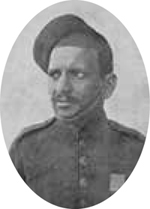 Naik Darwan Singh Negi, Garhwal Rifles, Victoria Cross (VC), WW I, 23 November 1914. 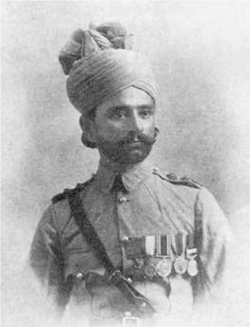 Sepoy Khudadad Khan, the first Indian to win the VC in WW I, 31 October 1914. 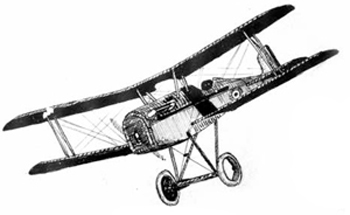 British SE5 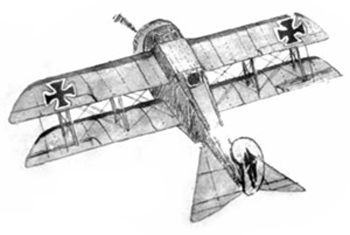 German Fokker 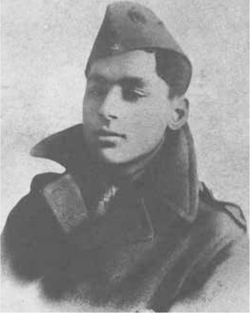 Lieutenant Indra Lal Roy, Distinguished Flying Cross (DFC). He also sketched brilliantly, two samples of which are shown above. 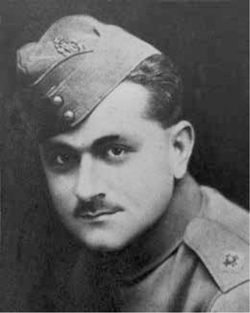 Lieutenant Welingkar, Military Cross. He was the second Indian pilot to be killed in WW I. 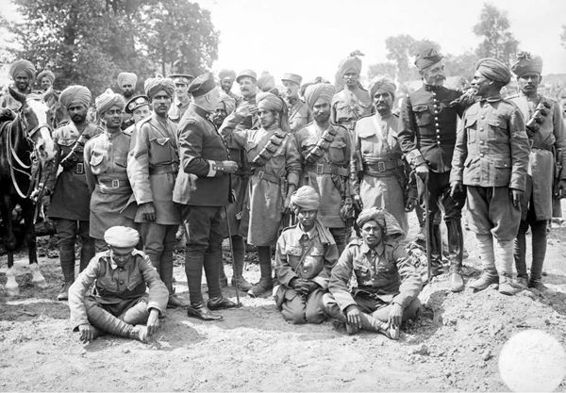 Indian soldiers with Colonel Bartoli of the French army, Pas-de-Calais, Northern France, 1915. 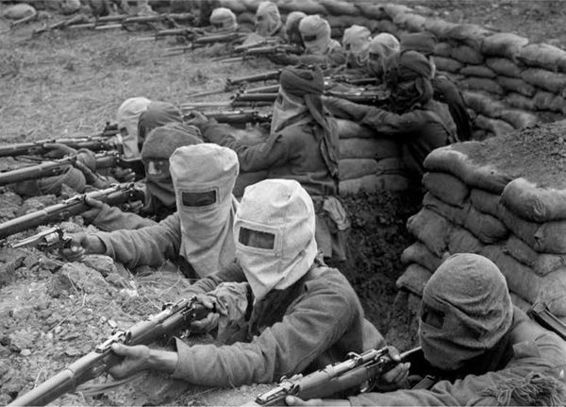 Indian troops practise a drill with gas masks prior to the second battle of Ypres, April-May 1915. WW II 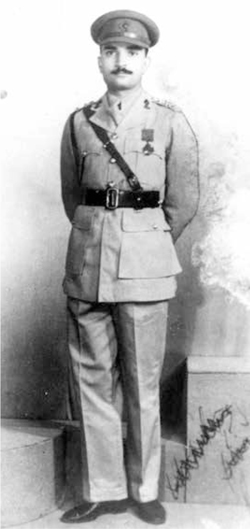 Second Lieutenant Bhagat, the first Indian to be awarded the VC in WW II. 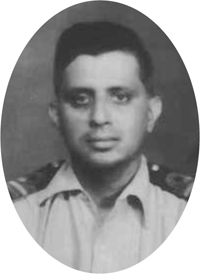 Commander D.N. Mukherji, the first Indian naval officer. 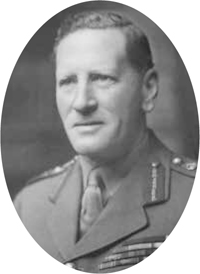 Field Marshal Auchinleck – Friend of India. 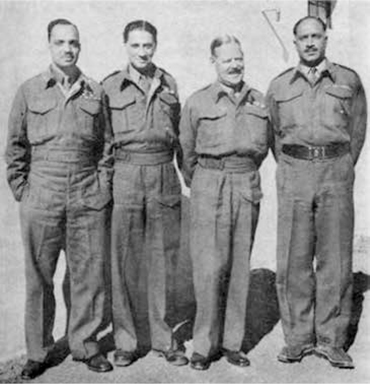 Battalion Commanders of the All Indian 51 Infantry Brigade. (L to R) Lieutenant Colonels Thorat and Sen, Brigadier Hutton (Brigade Commander) and Lieutenant Colonel Thimayya. 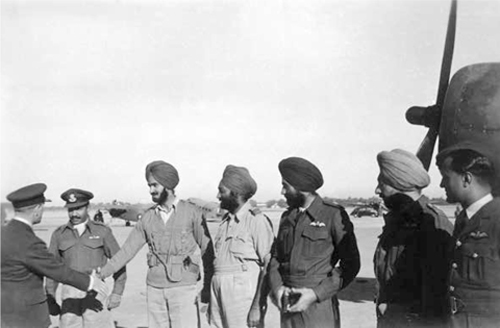 IAF Squadron Commanders in Burma (from L to R) Niranjan Prasad, Prithipal Singh, Mehar Singh, Arjan Singh, Majithia and Hem Chaudhuri. 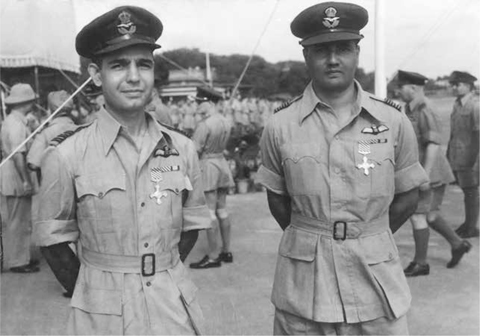 IAF’s two early DFCs, Aspy Engineer and the legendary K.K. (Jumbo) Majumdar. 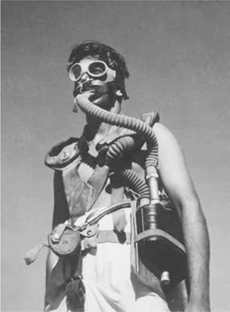 An Indian diver kitted for action. 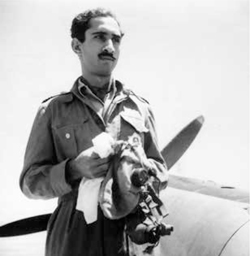 Flight Lieutenant Nur Khan, later Chief of Pakistan Air Force. 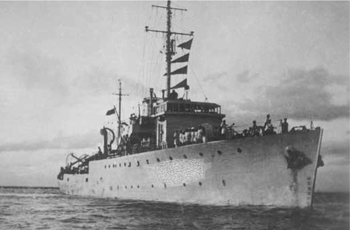 A Royal Indian Navy ship in the Bay of Bengal. 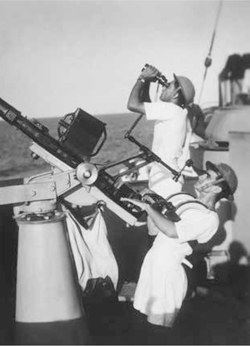 A Royal Indian Navy ack–ack crew in action. 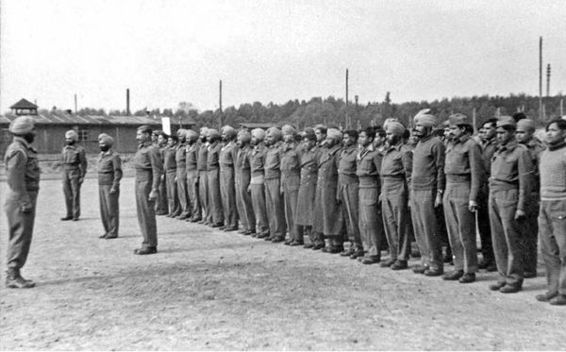 Havildar (later Lieutenant Colonel) Chanan Singh Dhillon of 41 Field Park Regiment, British 8th Army, commanding a Muster Parade. 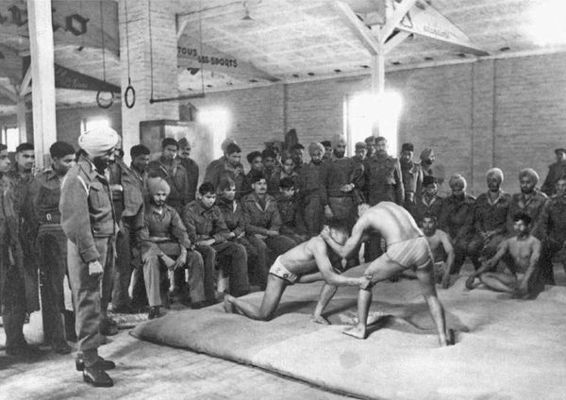 Refereeing a wrestling bout at a prisoners of war camp at Limberg (near Frankfurt). 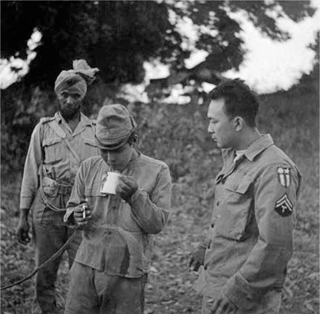 A Sikh soldier guarding Japanese prisoners of war in Burma. 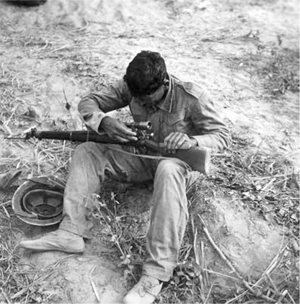 A Rajput Regiment sniper cleaning his rifle. 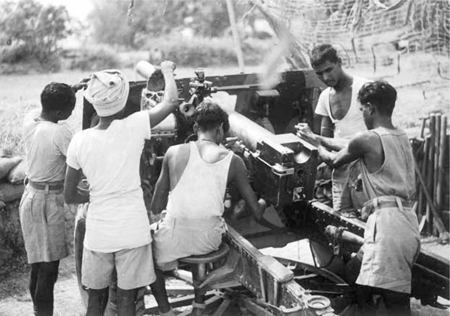 Tamil gunners of 5th India Field Battalion in Burma, April 1942. 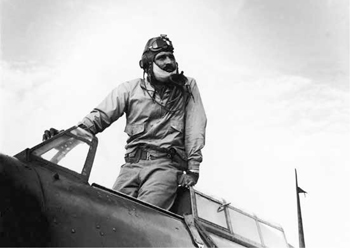 Squadron Leader Arjan Singh, DFC, 1 Squadron, in Imphal, May 1944. 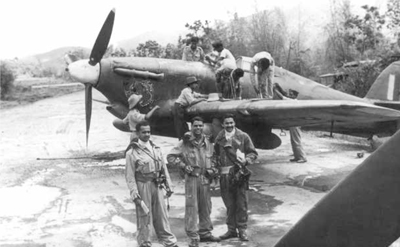 Flight Lieutenant Rajaram, DFC, flight commander, with aircrew and technicians of 1 Squadron, Imphal, 1944. 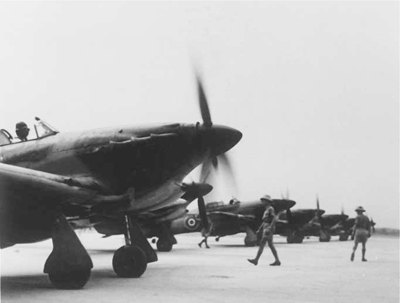 Hurricanes of 6 Squadron, IAF, Cox’s Bazaar, Burma theatre. 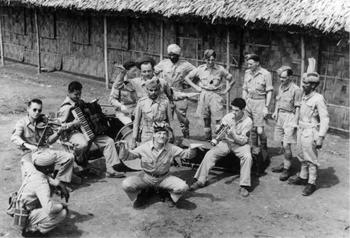 Indian, American and British troops, north Assam, 1943. 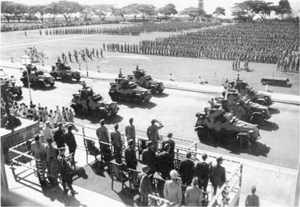 Netaji Subhas Chandra Bose reviewing a mechanized unit of the INA in Singapore. 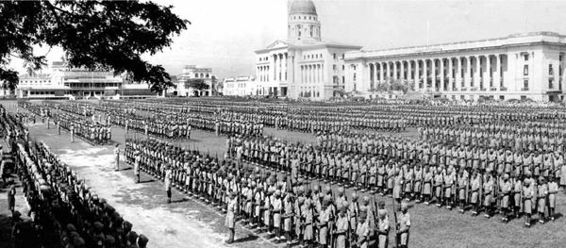 INA parade in Singapore, July 1943. PLATE SECTION 2 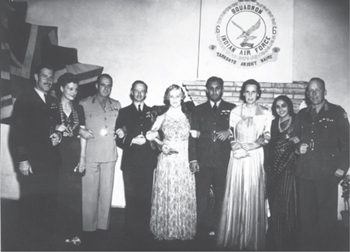 Wing Commander Subroto Mukerjee (fourth from right) and Mrs Sharada Mukerjee (second from right) at a social function after WW II. J&K, 1947–48 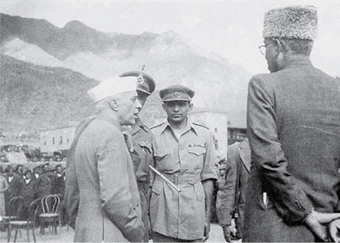 Jawaharlal Nehru discussing military plans in the Poonch/Rajouri sector with Brigadier Usman (centre) as Sheikh Abdullah (right) looks on. 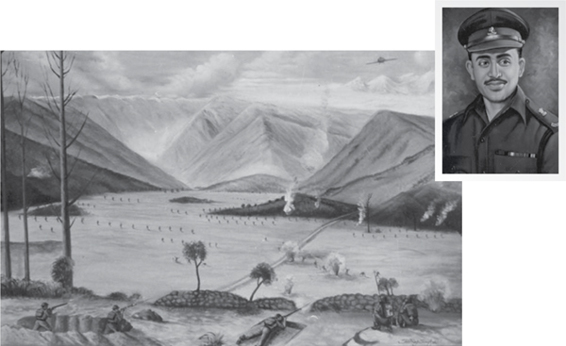 A painting of the Battle of Badgam (3 November 1947) and a portrait of Major Somnath Sharma, who was posthumously awarded independent India’s first Param Vir Chakra (PVC). 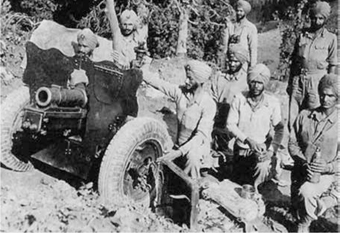 Gunners of Patiala State Forces in support of 1 Sikh at Pattan, October 1947. 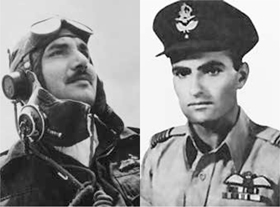 Wing Commanders K.L. Bhatia (left), hero of the Srinagar airlift, and Moolgavkar (right), orchestrator of air operations in Srinagar, were awarded the Vir Chakra and Maha Vir Chakra respectively for their exploits. 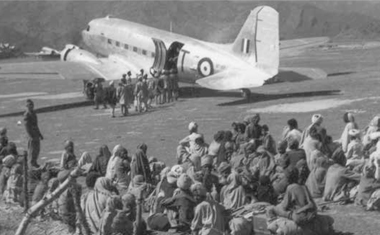 Dakotas of 12 Squadron evacuating civilians from the besieged Poonch. 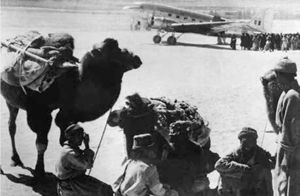 Villagers in Leh look on as Dakotas of 12 Squadron fly in supplies. 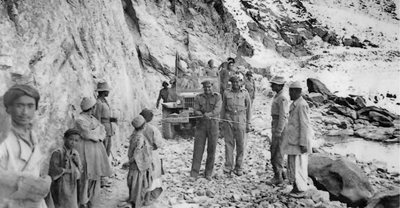 Major Thangaraju of the Madras Sappers opening the Zojila Pass, 1948. 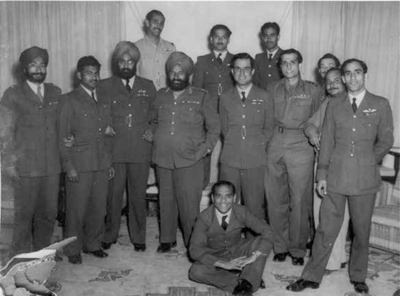 Air Commodore Mehar Singh (third from left), Major General Kulwant Singh (fourth from left), Wing Commander M.M. Engineer (fifth from left) and officers of 12 Squadron. 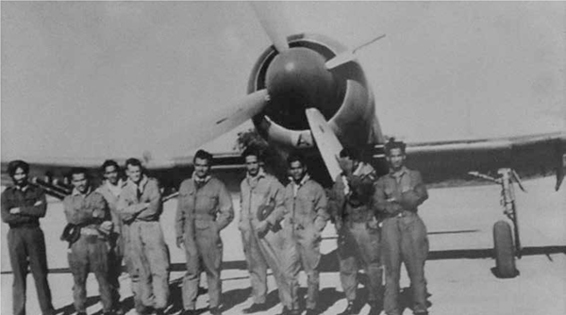 Pilots of 8 Squadron with their flight commander, Mickey Blake, Vir Chakra (fourth from left). 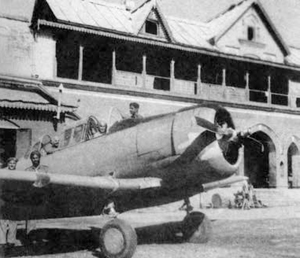 Hiding a Harvard aircraft from enemy shelling in a Poonch courtyard, mid-1948. Hyderabad 1948 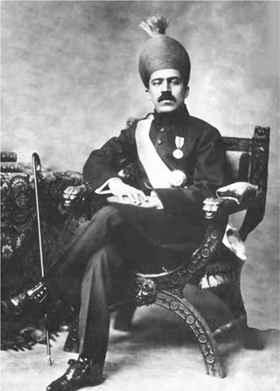 Mir Osman Ali Khan Bahadur, the Nizam of Hyderabad. 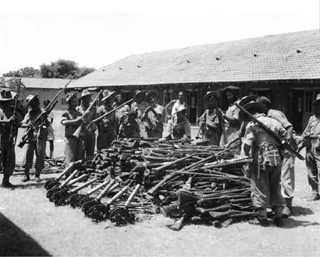 Arms haul from retreating Razakars. 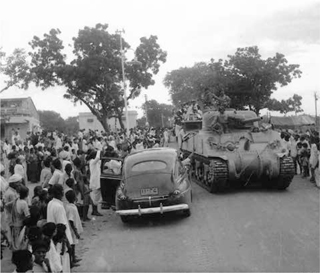 Stuart Tanks of 1 Armoured Division en route to Hyderabad. 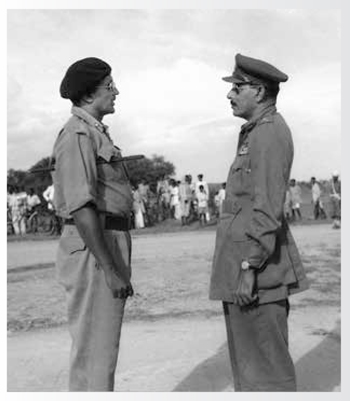 Major General E.L. Edroos (right) surrendering to Major General Chaudhuri in Hyderabad on 16 September 1948. Goa 1961 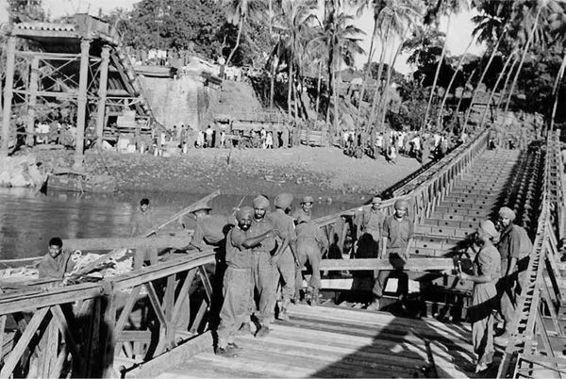 Bombay Sappers laying a bridge across the Mandovi during Operation Vijay, December 1961. 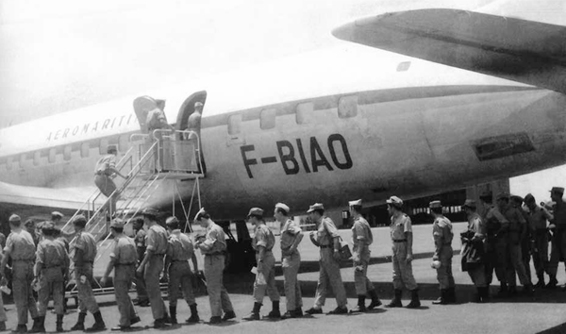 Portuguese prisoners of war being repatriated to Portugal in December 1961. 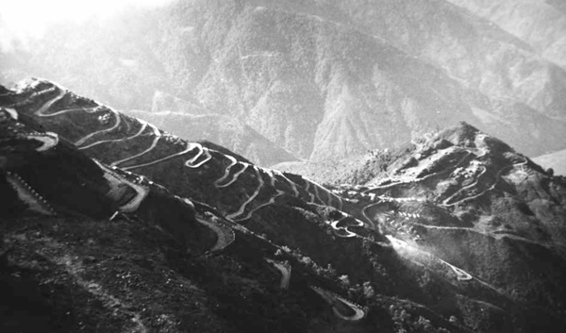 The Younghusband Route into Tibet via Jelepla in Sikkim. 1962 war 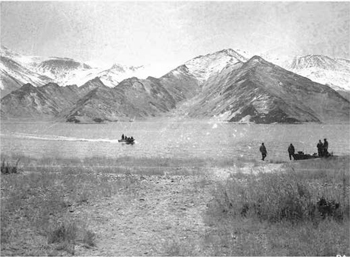 Gorkhas at Pangong Tso in October 1962. 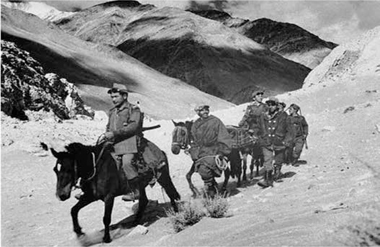 A mule patrol of Ladakh Scouts around Daulat Beg Oldi (DBO). 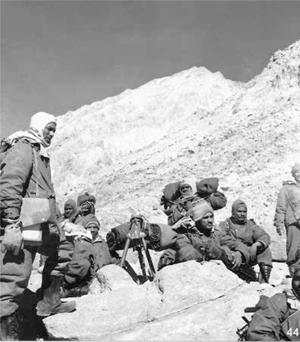 5 Jat Regiment during their valiant withdrawal from DBO along the frozen Shyok river. 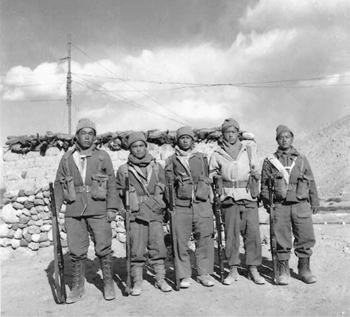 Gorkha survivors from the Sirjap outposts along Pangong Tso.  IAF Packets on a forward dropping mission in eastern Ladakh. 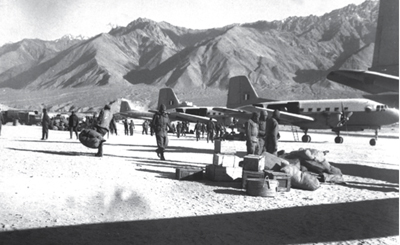 IL-14s and other IAF transport aircraft at Chushul before Phase II of the war, late October 1962. 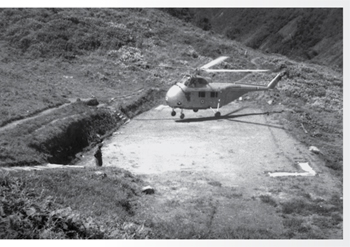 An IAF helicopter at a forward helipad in Tawang sector. 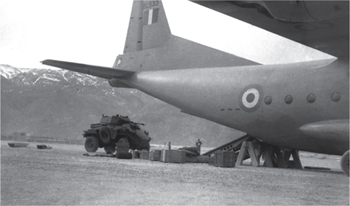 Armoured vehicles being offloaded from an An-12 at Chushul, November 1962. 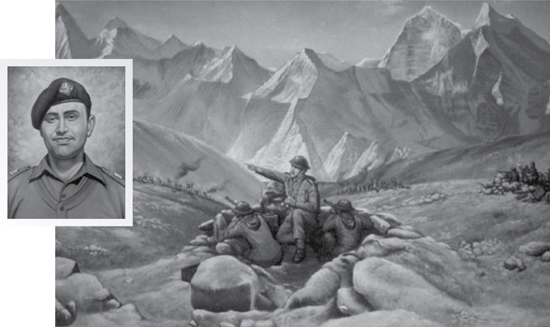 A painting of 13 Kumaon at Rezangla, where Major Shaitan Singh (portrait) was posthumously awarded a Param Vir Chakra. PLATE SECTION 3 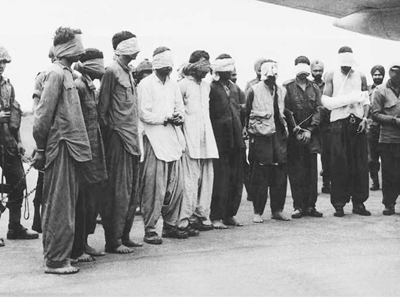 Captured Pakistani raiders during Operation Gibraltar, August 1965. 1965 war 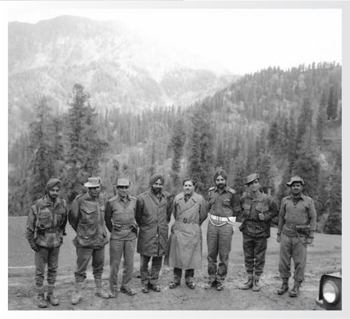 Major Ranjit Singh Dayal (fourth from left) and his team from 1 Para with Brigadier Zorawar Bakshi, Brigade Commander of 68 Infantry Brigade. 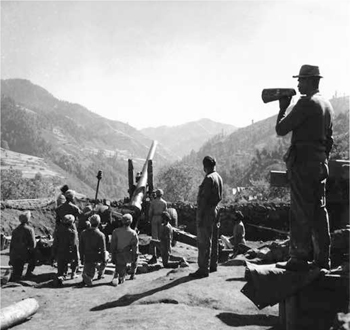 Indian Howitzers in action in Haji Pir after its capture. 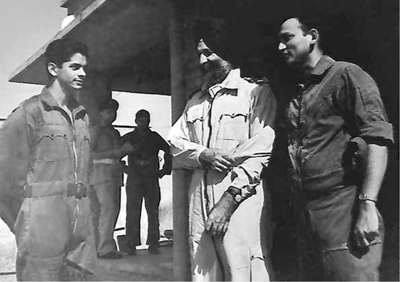 Sabre killers from Halwara, Flying Officer Neb (left) and Flight Lieutenant Rathore (right) with the Air Chief, Arjan Singh, September 1965. 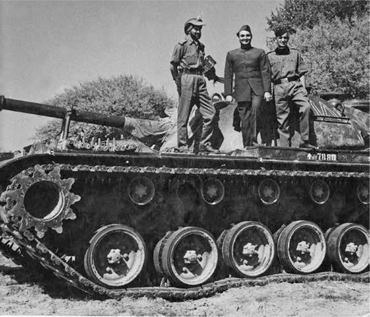 Dr Karan Singh, Governor of J&K, flanked by Major General Sparrow (left) and Lieutenant General Dunne atop a destroyed Palton tank in Sialkot sector. 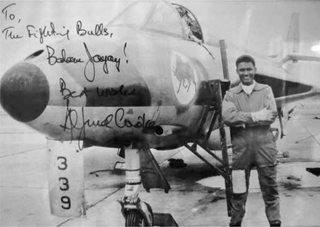 Flight Lieutenant Alfred Cooke from 14 Squadron next to the Hunter in which he shot down two PAF Sabres in a classic dogfight over Kalaikunda. 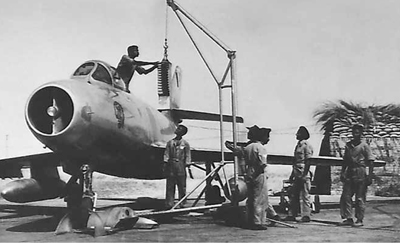 Rearming Mysteres of 1 Squadron at Adampur, September 1965. 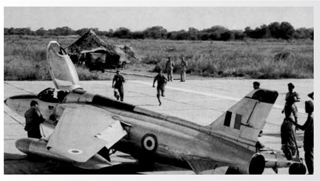 A Gnat scramble at a forward base, September 1965. 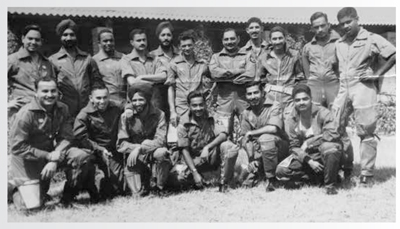 Ground attack boys of 1 Squadron at Adampur with their commanding officer, Wing Commander O.P. Taneja (standing fifth from right). 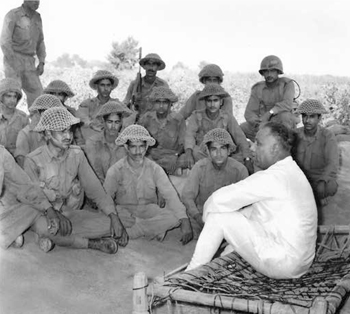 Defence Minister Y.B. Chavan with troops of 3 Jat after the Battle of Dograi. 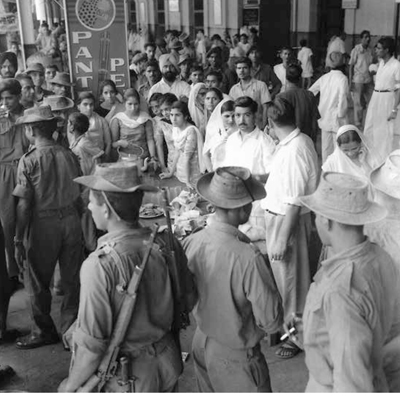 A canteen for arriving troops set up by the citizens of Amritsar at the city railway station. 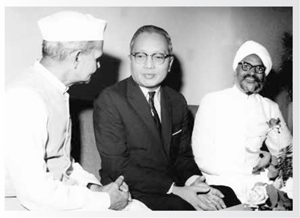 Lal Bahadur Shastri with UN Secretary General U. Thant (centre). 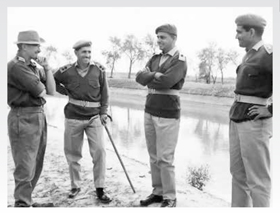 A senior Indian Army officer shares a light moment with his Pakistani counterparts on the Ichogil Canal after the ceasefire. 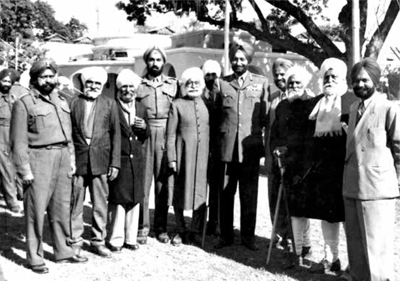 Lieutenant General Harbaksh Singh (fourth from left) with veterans of 1 Sikh just after the 1965 war. 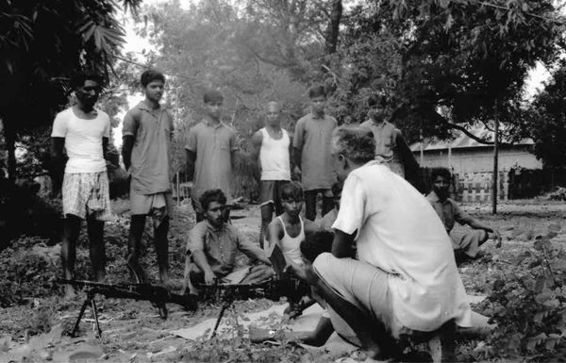 Training the Mukti Bahini somewhere in the Eastern theatre. 1971 war 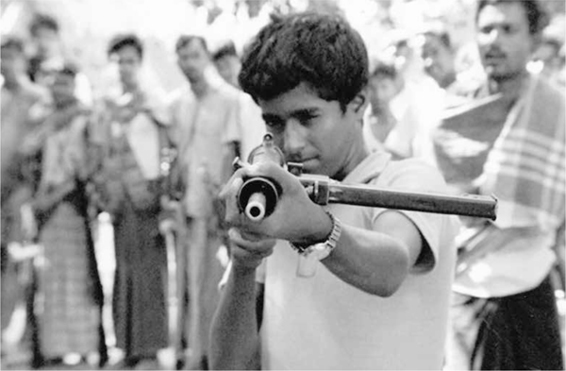 A young Mukti Bahini fighter displays his marksmanship. 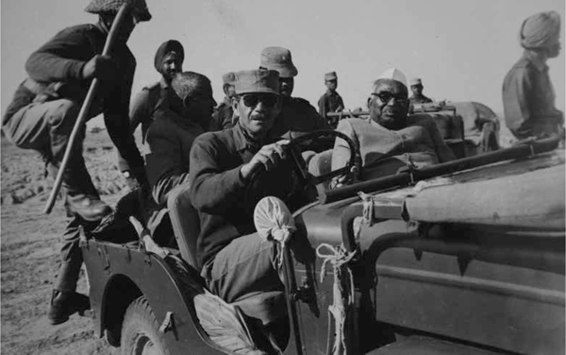 Defence Minister Jagjivan Ram being driven around the frontline by Major General Pinto. 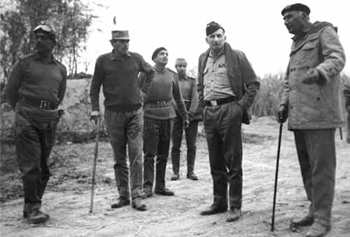 General Manekshaw (centre) with Lieutenant General K.K. Singh (right) and Major General Pinto (second from right) in Shakargarh. 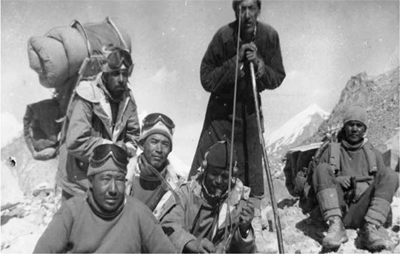 Ladakh Scouts after the capture of Turtuk, December 1971. 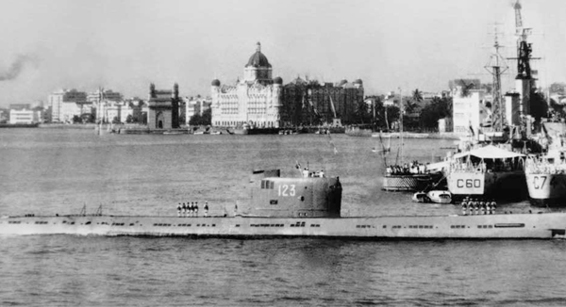 Foxtrot Class submarine INS Kalavari entering Mumbai against the backdrop of the iconic Taj Mahal Hotel. 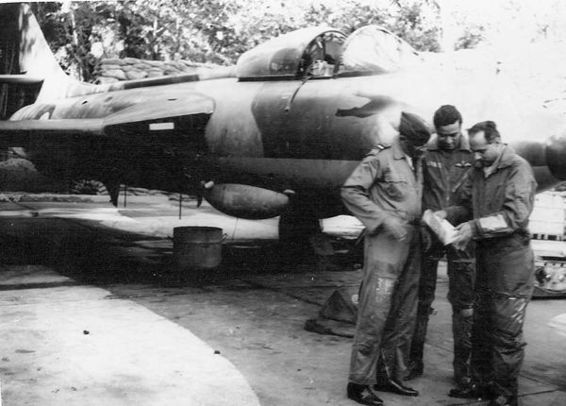 Wing Commander Kaul (right), the commanding officer of 37 Squadron, briefing his No. 2, Flying Officer Masand, prior to a recce mission. 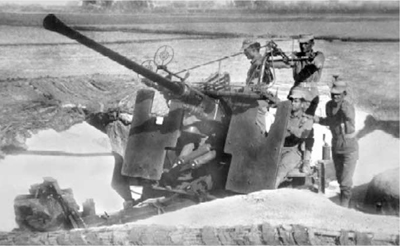 Air Defence Gunners in action around Amritsar, December 1971. 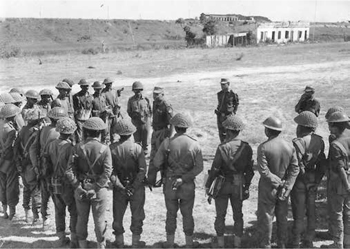 Lieutenant General Sagat Singh, the unstoppable commander, addressing troops before the final assault on Dacca from the east. 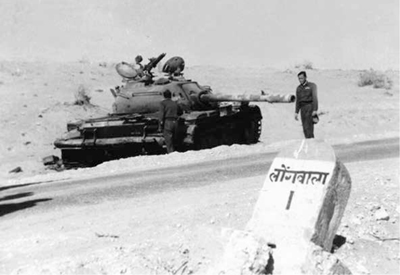 A destroyed Patton tank near Longewala. 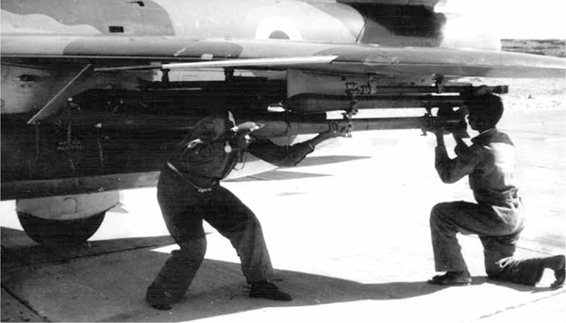 Loading the deadly T-10 rockets on a Hunter aircraft. 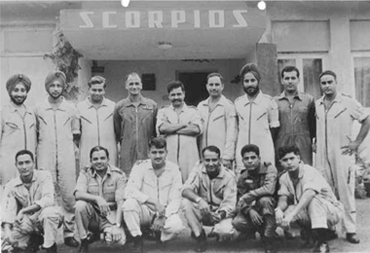 29 Squadron (Scorpios) of MiG-21s saw much action in the desert sector. 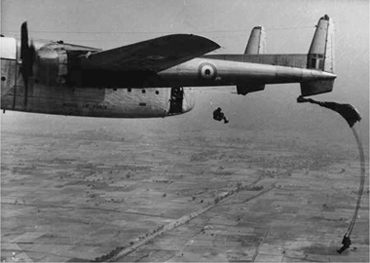 IAF Packets over Tangail. Over fifty aircraft of various types were used in this airborne operation. 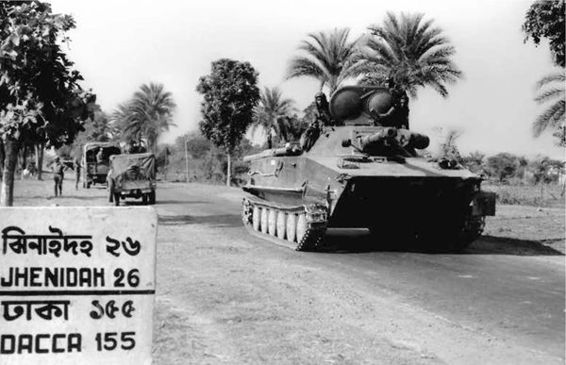 Indian tanks on the road to Dacca, December 1971. 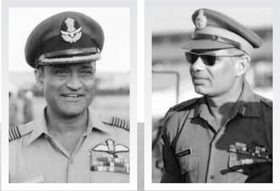 Group Captain Chandan Singh (left) and Lieutenant General Sagat Singh (right), the two architects of the joint operation in Bangladesh. 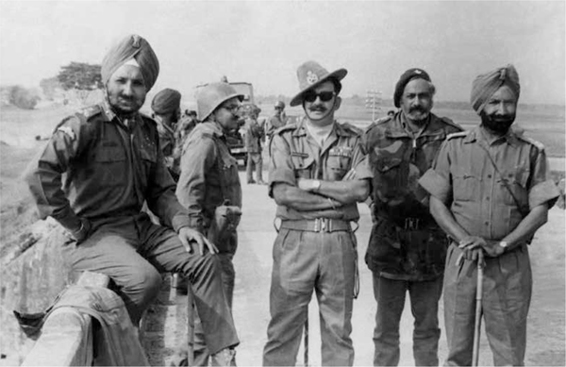 (From left to right) Brigadier Kler, Major General Nagra, Lieutenant Colonel Pannu and Brigadier Sant Singh in Dacca. 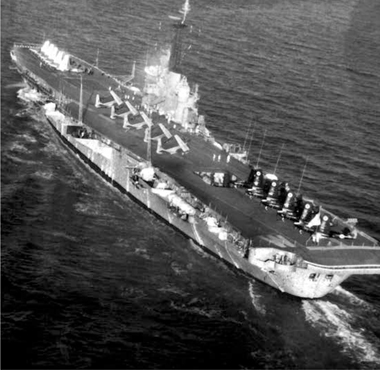 INS Vikrant in the Bay of Bengal with her full complement of aircraft. 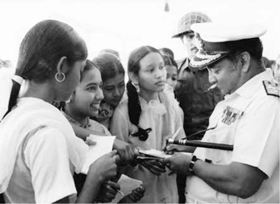 Vice Admiral Krishnan with children in Chittagong. 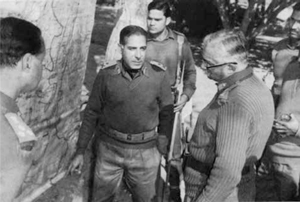 Lieutenant General Candeth being briefed by Major General Bakshi, 26 Infantry Division sector, December 1971. 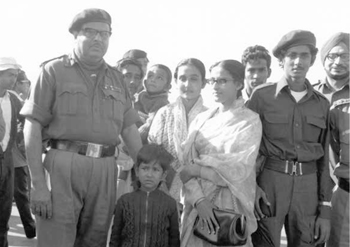 Sheikh Hasina and her family after their release from house arrest on 16 December 1971. 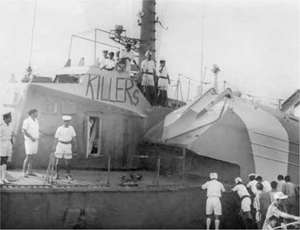 Osa Class missile boats used by the Indian Navy in the attacks on Karachi. 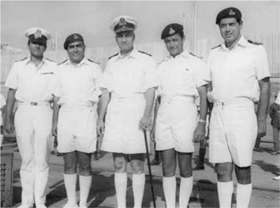 Vice Admiral Kohli (centre) with Commander Babru Yadav, MVC, on his right and Lieutenant Commmander Kavina, VrC, on his left. 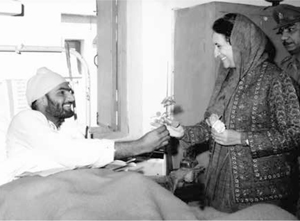 Indira Gandhi visiting a wounded soldier at a military hospital. 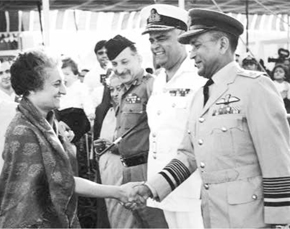 Indira Gandhi greeting Air Chief Marshal Lal while his fellow chiefs look on. 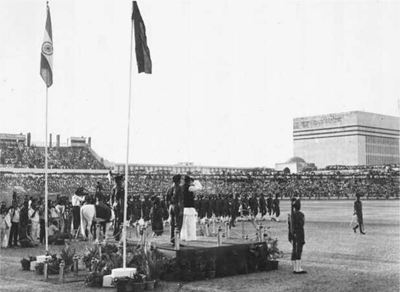 Sheikh Mujib reviews a parade by the Indian Army in March 1972. [About the Book](part0002.html#INBook) AN INSPIRING ACCOUNT OF INDIA’S MILITARY LEGACY The armed forces play a key role in protecting India and occupy a special place in people’s hearts. Yet, standard accounts of contemporary Indian history rarely have a military dimension. In India’s Wars, serving Air Vice Marshal Arjun Subramaniam, who has a PhD in Defence and Strategic Studies, seeks to give India’s military exploits their rightful place in history. Beginning with a snapshot of the growth of the armed forces, he provides detailed accounts of the conflicts from Independence to 1971: the first India–Pakistan war of 1947–48, the liberation of Hyderabad and Junagadh, the campaign to evict the Portuguese from Goa in 1961, and the full-blown wars against China and Pakistan. At the same time, India’s Wars is much more than a record of events. It is a tribute to the valour of the men and women in olive green, white and blue in the hope that it reaches out to a large audience, specially the youth. It highlights ways to improve the synergy between the three services, and emphasizes the need for wider discussions on matters related to national security. Laced with veterans’ exhilarating experiences in combat operations, India’s Wars fuses the strategic, operational, tactical and human dimensions of war with great finesse. Deeply researched and passionately written, it unfolds with ease and offers a fresh perspective on independent India’s history. [About the Author](part0002.html#INAut) Arjun Subramaniam is a serving Air Vice Marshal in the Indian Air Force. An alumnus of Rashtriya Indian Military College, National Defence Academy and National Defence College, he is an accomplished fighter pilot who has primarily flown MiG-21s and Mirage-2000s during his active flying career. He has commanded a MiG-21 squadron and a large flying base. An instructor at academies and institutions of military learning in India and abroad, he is a soldier-scholar with a PhD in defence and strategic studies. A prolific writer and speaker on military history, air power and national security, he is currently posted as a faculty member at the National Defence College, New Delhi. [Advance Praise for India’s Wars](part0002.html#INPraise) ‘Arjun Subramaniam is a remarkable soldier-scholar who combines an avid interest in history with keen strategic insights. He writes with great clarity and balance on India’s modern conflicts. His sound history fills a major lacuna in the field of contemporary Indian history and could contribute to a more informed formulation of policy and strategy in the future.’ – Sugata Bose, Member of Parliament and Gardiner Professor of Oceanic History and Affairs at Harvard University ‘Military history is a seriously under-researched field in India. This outstanding book on India’s military conflicts since Independence is, therefore, very welcome. As a scholar-practitioner, Air Vice Marshal Arjun Subramaniam is uniquely qualified, and both aspects of his background are revealed to good effect in his book. The close attention to the technical and organizational aspects of the armed forces, combined with a rich and nuanced analysis of the conflicts themselves, makes for compelling as well as instructive reading.’ – Ramachandra Guha, historian and author ‘Deftly telescoping six decades of India’s conflicts in a single volume, Arjun Subramaniam presents an objective and compelling tri-service narrative which I found hard to put down. He joins a select band of service officers who have, in the tradition of Thucydides, shown the intellectual acumen as well as courage and perseverance to put pen to paper while still in uniform.’ – Admiral Arun Prakash (retd), former Chief of Naval Staff and Chairman, Chiefs of Staff Committee ‘Air Vice Marshal Arjun Subramaniam’s deep insights into the first twenty-five years of independent India’s military history fill a big gap in our understanding of modern India’s political evolution. As Delhi rises to be one of the world’s leading economic and military powers, Subramaniam’s narrative contributes to the construction of a more productive discourse on India’s strategic future.’ – C. Raja Mohan, foreign affairs columnist and director, Carnegie India ‘Considering the scope and nature of conflicts that the Indian armed forces have engaged in since Independence, presenting a narrative within a tri-service perspective is a daunting task by any measure. Air Vice Marshal Arjun Subramaniam has rendered yeoman service to the profession of arms and to the idea of ‘jointmanship’ that will need to be the bedrock of military operations in the future. Very well researched and authenticated with exhaustive interviews, striking photographs and detailed maps, the narrative meets the rigour of academic discourse. It certainly has the potential to form part of the curriculum for study of contemporary Indian military history at war colleges and universities. It is what many of us would call a “labour of love”, by a person who has enjoyed being in the profession of arms, and has therefore tried to place its achievements, and, I dare say, inadequacies, in the public domain for the greater benefit of society in general, and the Indian armed forces in particular.’ – Lieutenant General Satish Nambiar (retd) ‘A well-researched, well-written, very readable account of the development of the Indian armed forces over the last 300-plus years and, particularly, their performance during the wars fought in independent India up to 1971. The book is a saga of the spirit and commitment of the Indian armed forces in spite of being consistently surprised by our adversaries and forever low on resources. The author has often trodden virgin ground and produced what can only be termed as a “special work”, peppered with his personal views, that will intrigue and interest the lay reader and the professional. Any such work has to rely on books and interviews, and history is a many-sided study. Some disagreements on details are likely, but that does not detract from the quality of the essential narrative. The author deserves kudos and accolades.’ – Air Marshal Vinod Patney (retd) ‘For too long, the military contribution to India’s post-Independence development has been underplayed in standard histories. Arjun Subramaniam provides a detailed, thoughtful and compelling view of this missing factor in understanding the turbulent years after 1947. A valuable and innovative work of history.’ – Rana Mitter, professor and director of the China Centre at Oxford University [PHOTO CREDITS](part0002.html#INPhoto) I am grateful to the following organizations, units, regimental centres, fleets, squadrons and individuals for sharing photographs and helping with sketches so willingly. Their contributions added significant value to the narrative. Ministry of Defence Photo Division and Armed Forces Film and Photo Division, special thanks to Major V.K. Singh (retd) and Mr Sreekumar Air Force Museum and Institute of Flight Safety, Palam Mr Gurbinder Dhillon Squadron Leader Rana Chhina Netaji Research Bureau Kumaon Regimental Centre, Ranikhet A.V.M. Vikram Singh Parachute Regimental Centre MEG Regimental Centre BEG Centre Armoured Corps Centre Artillery Centre Ladakh Scouts Centre Eastern Naval Command No. 1 Squadron, IAF No. 4 Squadron, IAF No. 12 Squadron, IAF No. 14 Squadron, IAF 4 Mech Regiment (formerly 1 Sikh) Photo archives of The Hindu (special thanks to N. Ravi and Pothen Jacob) [www.bharat-rakshak.com](http://www.bharat-rakshak.com) Lieutenant General W.A.G. Pinto (retd) P.V.S. Jagan Mohan Group Captain Deb Gohain (retd) Air Commodore Nagesh Kapoor Eastern & Western Naval Command Archives  TALK TO US Join the conversation on Twitter
In the final analysis, Kautilya may not have been a genius. It is highly probable that Arthashastra was left incomplete by him and completed over centuries by a series of scholars from the same school of thought. What is undisputable is the fact that no one after him has been able to convert knowledge into deliverables of statecraft and strategy as he has. His legacy has been one of giving confidence to Indian kings and statesmen that intellect, knowledge and common sense, when combined together, make for sustainable and long-lasting power. His treatise is the closest we have come to articulating comprehensive national power in which the military is a key element.