Part I: Opening Perspectives
Sighter Burst
The Mission
In the old days when fighter pilots had the luxury of making multiple passes over the target areas during ground attack missions, they let loose what was called a sighter burst in their first pass to check whether their guns were firing properly or not. This burst also allowed them to size up the enemy, assess ranges and impose themselves psychologically on the enemy. As the first chapter in Part I ('Opening Perspectives') of the book, 'Sighter Burst' aims at none of the above. Instead, it attempts to give you, the reader, an overview of what to expect in the pages ahead. Old habits die hard, they say, and I could not but help looking at this project as a mission with four primary objectives.
The first is to showcase the legacy of modern India's military pioneers along with the exploits and sacrifices of its armed forces in protecting India's sovereignty and democracy to both an international readership and a bulging youthful segment of the country's population. My second objective is to chronicle the largely fragmented contemporary military history of India in the form of an easily readable joint narrative devoid of too many statistics, tables, graphs, or emphasis on casualties, claims and counter-claims. My third objective is to convince policymakers at all levels of the need to adopt a progressive approach towards declassifying material about national security and learning from the mistakes of previous wars, campaigns and conflicts, both external and internal. This would then, I sincerely hope, create a missing link between the study of military history and its impact on contemporary Indian strategic culture. My last objective is to urge not only India's men and women in uniform but also the growing number of informed and literate youth to read more about war and conflict in the subcontinent after Independence as part of India's overall historical discourse and draw inspiration from some of the brilliant military commanders of independent India.
Along the way, I hope to bring out some of the central themes of the book. Among these are the strong historical legacies, ethos and professionalism of the Indian armed forces; their slowness in shaking off colonial attitudes and legacies; their sustained contribution and sacrifice to maintain India's chaotic democracy; how they have coped with the changing contours of modern conflict; and why India's armed forces have emerged as a critical element of nation building – one which the nation at large can ill afford to ignore.
The Road Ahead
'A Personal Quest' is an honest attempt to share my personal experiences of soldiering over thirty-three years, and why I feel that not enough has been done to chronicle India's conflicts after Independence from a joint war-fighting perspective. The chapter is a tribute to my fellow warriors in olive green, white and blue. Their sacrifices on the battlefield so that their fellow countrymen may live in peace have no parallel in human endeavour. 'Whither Military History' briefly examines the multiple reasons for the absence of modern Indian military history from the larger historical discourse in the country.
Part II of the book looks at the 'DNA of India's Armed Forces'. It sets the pace for an introductory and evolutionary overview of the growth of the armed forces, and attempts to provide the reader with a snapshot of the Indian Army, Indian Air Force and Indian Navy from the early years of the modern era till India gained Independence from the British in 1947. Rather than attribute the entire DNA to a colonial legacy, an attempt has also been made to highlight the influence of late-medieval Indian military thought on military ethos.
Part III of the book comprises 'Teething Years'. It covers three principal conflicts during the early years after Independence – the first India–Pakistan war of 1947–48; the liberation of Hyderabad and Junagadh; and the short campaign to evict the Portuguese from Goa in December 1961. India's baptism as a nation state was by waging war against state-sponsored tribals and regular Pakistani forces, which attempted to exploit the rather precarious political situation in the state of Jammu and Kashmir and sever it from the Indian Union. Thousands of tribals from the North-West Frontier Province (NWFP), complemented by regulars of the newly formed Pakistan Army, united under the flag of Islam and raided Kashmir in October 1947. In a three-pronged attack aimed at capturing the whole of Kashmir and forcing the Maharaja of Kashmir to cede to Pakistan, the raiders surprised both the maharaja and the Indian government with the timing and audacity of their attack. In response to an SOS from the Maharaja of Kashmir to the Government of India, the conflict, which began as a rearguard action by the Indian Army and the Royal Indian Air Force to save the state capital, Srinagar, expanded into a full-blown conflict between India and Pakistan across three distinct geographical sectors that lasted over a year. The conflict only ended when a UN-brokered agreement was signed by India and Pakistan in late 1948 to peacefully resolve the Kashmir issue.
While the war was raging in Kashmir, the government had to launch a small but coercive military action against the princely state of Junagadh to force it to abandon its secessionist aspirations and join the Union of India. In September 1948 a larger military action involving an army division backed by air power was launched against the Nizam of Hyderabad to compel him to abandon his grandiose plans of ruling over an independent state that was surrounded by the Union of India. While the Hyderabad military campaign was later termed a 'police action', from a strategic perspective it merits attention as India's first successful attempt at coercion orchestrated by an assertive home minister, Sardar Vallabhbhai Patel.
After almost thirteen years of relative peace and failed attempts by India to reach a negotiated settlement with the Portuguese over the colonies of Goa, Daman and Diu, a multi-pronged, tri-service operation code-named Operation Vijay was launched in December 1961 to evict the Portuguese from India and bring an end to centuries of colonial rule in India. Though the operation was a success and resulted in some chest-thumping by the Indian military, it deflected some amount of national attention from a more pressing security problem that was brewing on India's northern and eastern frontiers with China.
Part IV of the book is titled 'Across Borders' and deals with India's experiences with full-blown conventional conflict in diverse terrain along borders with hostile neighbours. It begins with the India–China war of 1962, which was fought over vast expanses of mountainous and jungle terrain. The narrative then shifts focus to the two large-scale wars with Pakistan in 1965 and 1971, which were fought over mountainous terrain in Jammu and Kashmir; across the plains of Punjab; in the riverine areas of East Pakistan; and, finally, southwards across the deserts of Rajasthan and swamps of Kutch.
India's inability to gauge China's grand strategy in the 1950s and understand its key determinants of securing historically unsettled frontiers, resolving border disputes from a position of strength, and building capabilities for pan-Asian hegemony resulted in the ill-fated conflict of 1962. An objective analysis of the entire conflict from a politico-intelligence and military viewpoint with key input from diverse stakeholders could put the conflict in the right perspective and offer some lessons for the future.
Still smarting from the inability to force the secession of Kashmir in 1947–48, Pakistan's aggressive politico-military leadership led by their young and aggressive foreign minister, Zulfiqar Ali Bhutto, and a fading military dictator, Ayub Khan, took the opportunity to surprise India in the western swamps of Kutch and the state of Jammu and Kashmir during April and August 1965. The September 1965 conflict with Pakistan across three battlefronts was actually 'a baptism by fire' for India's almost non-existent joint war-fighting capability. Though many tactical and operational assessments over the years pointed at a stalemate, the inability of Pakistan to achieve any of its strategic objectives may well be considered a 'victory' for India and helped it regain much of its confidence in terms of the battleworthiness of its armed forces.
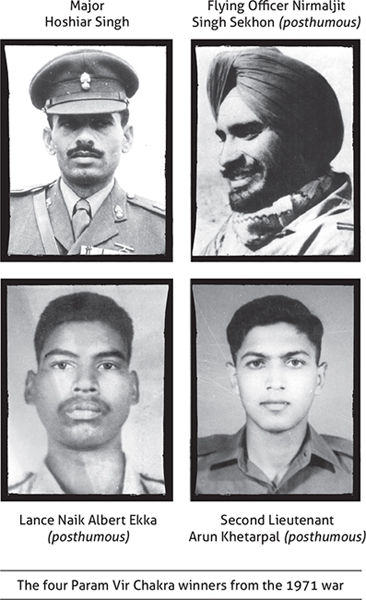
The 1970s began with a decisive strategic and military success for India in the two-front 1971 war against Pakistan. The Indian armed forces not only resoundingly defeated the Pakistani armed forces in the eastern sector with a clinical display of joint war-fighting prowess and paved the way for the formation of Bangladesh, they also notched up limited successes in the western sector with armoured thrusts, effective employment of air power and telling maritime attacks against critical infrastructure in West Pakistan. The 1971 conflict is also India's best documented conflict, which only re-emphasizes a stark reality that India's strategic and military establishment is largely comfortable with recording military victories and strategic game plans that have worked.
The narrative then attempts to look at how Kautilya, ancient India's foremost strategist, would have assessed India's modern conflicts till 1971. Revered in India much as Sun Tzu is in China, or Machiavelli and Clausewitz are in Europe, bringing Kautilya into the discourse is a tribute to his foresight and strategic acumen.
On Sources and Method
This book is not a definitive compilation of individual service, regimental, fleet or squadron histories and accomplishments; nor is it an attempt to highlight the achievements of a select set of regiments or individuals. I have the greatest respect for the regimental, fleet and squadron ethos of the Indian Army, the Indian Navy and the Indian Air Force. If any regiment or squadron has been highlighted more than the others, it is without any motive or malice. I take full responsibility for all omissions as the challenge was to put together a concise volume. While there are a reasonable number of primary sources, the book is drawn mostly from secondary sources, and I have used them to create a new synthesis of India's military history during the early years after Independence. I have offered enough references and suggested further reading for those who wish to dig deeper for I have just scratched the surface of what has actually been a fascinating period of evolving military history. I claim no new revelations based on archival or documentary research, or access to any classified information; and rather than sources, I believe that the core of the book revolves around the innovative nature of my argument and a conviction that as a scholar, I have the freedom to dissect and analyse issues of diplomacy and higher strategy and challenge status quo when it comes to sticking to academic rigidity that often limits a practitioner-scholar's horizons. Weaving in myriad issues of statecraft into military history is essential if one is to get a holistic perspective of wars and conflict. Writing in his latest book on broad-spectrum strategy titled Strategy: A History, Sir Lawrence Freedman argues:
Research for this book has taken me into unfamiliar territory. Part of the enjoyment of writing this book has come from my exposure to some wonderful scholarship in social science and fields supposedly distant from my own. Despite the best efforts of colleagues I have undoubtedly over-reached in a number of areas. Nonetheless, the exercise has reinforced my conviction that academics worry too much about making a good impression within their own disciplinary boundaries while not paying enough attention to what is going on beyond them.1Lawrence Freedman, Strategy: A History (New York: Oxford University Press, 2013), p. xvi.
I can take heart from Sir Freedman's thoughts on crossing 'domain boundaries'.
The thrust, throughout the book, has been to discuss in a layered manner, much like peeling an orange, numerous facets of higher strategy, operational art and tactical joint operations through the lens of the major participants. The flavour of the book revolves around people and not just events. As these stories unfold, they will, I hope, reinvigorate the spirit of soldiering and 'Jointmanship'. For a first-time reader of modern Indian military history, 'Jointmanship' is a term exclusively used within the Indian armed forces to highlight synergy and interoperability between the three services.2Air Vice Marshal A.K. Tiwary, 'Jointmanship in the Military', Indian Defence Review Vol. 26, No. 2 (April–June 2011), available at indiandefencereview.com (accessed 8 February 2015). It is said to have been clearly articulated some time in 2001 at the Defence Services Staff College, Wellington, in the salubrious Nilgiris district of Tamil Nadu – the first truly joint Staff College in the world – as 'Integrated planning and application of military power at the strategic, operational and tactical levels, with proper sequencing of combat power of the three services in time and space.'
The Spirit
Finally, I wish I could loiter over the target area for longer, but that would be inviting danger. I guess it is time for the 'first pass' after leaving you to ponder in an age of multi-skilling and multitasking over one of Vivekananda's3Swami Vivekananda was a nineteenth-century monk and philosopher who first introduced Vedanta philosophy and yoga to the Western world. quotes that inspired me throughout the period I was researching and writing this volume:
'Take up one idea. Make that idea your life – think of it, dream of it, live on that idea. Let the brain, muscles, nerves, every part of the body be full of that idea, and leave every other idea alone. This is the way to success.'