A Personal Quest
Growing Up with Warriors
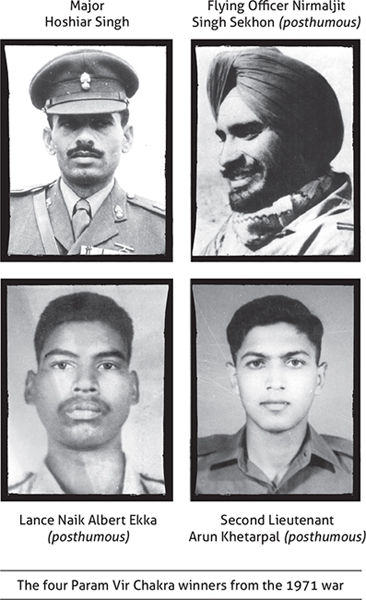
I grew up on a staple diet of the great Indian epic Mahabharata, the Iliad, and Readers Digest Illustrated Story of World War II. Arjuna, the principal protagonist warrior of the Mahabharata, Achilles, Alexander, Shivaji – the defiant Maratha king of the seventeenth century – Napoleon, Rommel, Patton, Montgomery, Subhas Chandra Bose, Wingate and Douglas Bader were my heroes. The small and highly popular Commando comic series allowed me to wade through the Battles of Britain, Monte Casino (where an Indian division performed admirably), Alamein, Normandy, Coral Sea, Guadalcanal, Imphal and Kohima. I was a ten-year-old when India fought the 1971 war with Pakistan and Major Hoshiar Singh, Second Lieutenant Arun Khetarpal, Flying Officer Nirmaljit Singh Sekhon and Captain Mahendra Nath Mulla, India's heroes in that war, caught the attention of a grateful nation after their exploits in battle.
As a teenager at the Rashtriya Indian Military College (RIMC), a highly pedigreed military school with illustrious alumni that not only included four army chiefs and one air chief from independent India, but also two air chiefs from the Pakistan Air Force (PAF), history and geography were my favourite subjects. Even today when I read a military history campaign, I like having a map around; it gives you a sense of proportionality. Toynbee, Churchill and Nehru were my favourite historians, though I found them a little hard to digest. I found Romila Thapar, the noted Indian historian, easier to digest. I was dismayed, however, that she hardly referred to the exploits of independent India's military in her chapters on contemporary Indian history. However, I read all of them mainly because my father insisted I do so in his many long letters to me. He argued that if I really wanted to study the military dimension of history, I must arm myself well. Our history teacher introduced me to John Keegan when I complained to him that I could not lay my hands on any worthwhile book on Indian military history. Though he hardly wrote on Indian military history, I tracked the growth of John Keegan as a military historian of international repute and marvelled at his passion for the profession of arms despite not being in uniform. I would rediscover Keegan a few years before he passed away in 2012.
In a preface to one of his last books, he emotionally shared the various reasons that motivated him to devote a lifetime of endeavour to the study of modern British military history. As he narrates in the 'Introduction' to his superb book, A History of Warfare: 'I was not fated to be a warrior. A childhood illness had left me lame for life in 1948 and I have limped now for forty-five years.' He goes on to add: 'Fate nevertheless cast my life among warriors … It aroused an interest in military affairs that took root, so that when I went up to Oxford in 1953 I chose military history as my special subject.'
Though these views, expressed by him during an era of large conventional conflicts, are at variance with the Clausewitzian school of warfare, they nevertheless merit serious attention. The only difference I could detect now was that modern warfare demands that warriors acquire multiple skill sets including the ability to engage in diplomacy and provide governance when called on to do so, particularly in stability operations. The bottom line with John Keegan, of course, was a fascination and a deep respect for the profession of arms.
Despite the many wars and constant skirmishes and face-offs along its troubled northern and western borders, it was quite clear to me that the overwhelmingly dominant narrative of contemporary India's history since 1947 is of a country that operated internationally and domestically through deft diplomacy and peaceful democratic politics. Military history has mainly been a sideshow to the main political and diplomatic narrative. This, to me, was a half-baked narrative even in school, and for years I have felt that the issue demanded closer scrutiny by India's historical community.[1]This thread emerged from a stimulating and rewarding exchange of ideas over email in March 2015 between the author and Prof. Rana Mitter, an eminent Oxford historian.
Into the Cockpit
My personal tryst with India's recent military history began as a pilot officer in a MiG-21 training squadron in Tezpur in 1982; not as a participant, but as a distant observer. The 4 Corps headquarters was located in Tezpur and I not only had the opportunity to interact with officers who were involved in the ongoing counter-insurgency operations in the north-east, but also with a few civilians who had fled from Tawang and Bomdila and settled down in Tezpur following the 1962 conflict with China. The archives at Tezpur University had a small collection of memoirs and recollections of prominent citizens, which were collected after the 1962 war. I did manage to visit the university when I commanded a squadron at the same base in the late 1990s and browsed through some of the translations.
I was next posted at Adampur airbase near Jalandhar in the heart of Punjab during Operation Blue Star in 1984, the operation against Sant Bhindranwale, the separatist Sikh preacher, and his fierce militia. Many of my army course mates from the corps at Jalandhar were involved in operations which culminated in the storming of the Golden Temple in Amritsar, the holy shrine of the Sikhs where Bhindranwale had sought sanctuary, unmindful of the collateral danger he was subjecting thousands of innocent devotees to. The year 1985 saw me moving to another MiG-21 squadron, which participated in Operation Brass Tacks, the massive joint exercise on the western front with Pakistan and the brainchild of the mercurial chief of the army staff (COAS), General Sundarji. My squadron was at the time the only electronic warfare squadron in the IAF. We escorted Jaguar strike aircraft on simulated strikes along the international border (IB) with Pakistan and I will never forget the rush of adrenalin whenever our radar warning receivers (RWR) picked up F-16 radar signals, or when an excited fighter controller would give us a call 'Rapier formation to turn around, bogey at 12'o clock and closing in fast'. I still remember the sheer audacity of the whole exercise, orchestrated as a show of force by General Sundarji, arguably one of the most visionary and brilliant soldiers of our time, though many whom I spoke to over the course of writing this book would not agree as they felt that he failed to understand or anticipate the changing nature of warfare.
Wars Up Close
Four of my fighter pilot contemporaries were selected in the mid-1980s to switch to the newly inducted Mi-25 attack helicopters. Little did they realize that they would hone their skills in the cauldron of Sri Lanka with the Indian Peacekeeping Force (IPKF). Fighting the LTTE (Liberation Tigers of Tamil Eelam) in the jungles of Jaffna, Vavuniya and Trincomalee changed their perspectives on modern warfare. Their experiences formed part of my PhD thesis on fourth-generation warfare. The 1990s were grim years for the Indian Army, particularly in Jammu and Kashmir (J&K). As part of a Mirage-2000 squadron we used to conduct patrols in the extreme northern portions of J&K whenever the proxy war with Pakistan escalated, attempting to draw out Pakistan F-16s from Chaklala, the closest Pakistani airbase in the area. As the political establishment sporadically debated 'hot pursuit' as a strategy to deter the proxy war strategy of Pakistan, we happily honed our operational procedures. One clear day, I remember being able to see Skardu from almost 30,000 feet as we approached the northernmost limit of our patrols, and wondered how we let go of it in 1948. I can also clearly recall in the early 1990s that while most Indian military commanders supported the idea of 'hot pursuit' as a strategy to counter Pakistan's proxy war in J&K and debated the issue extensively, very little was done on ground to operationally support such a strategy in terms of realigning joint force employment strategies with respect to rapid response; particularly in terms of exploiting the various Indian Air Force capabilities. This, arguably, made the political and strategic leadership uncomfortable about articulating 'hot pursuit' as a state policy of coercing Pakistan and making the price of supporting a proxy war in India too high to sustain.
When I moved on as the flight commander of a MiG-21 squadron in the mid 1990s, we often moved to the Kashmir Valley on summer detachments for valley-flying practice to the Avantipur airbase situated in the beautiful but troubled Pulwama district of the Kashmir Valley (it was earlier in the Anantnag district), which at the time was the epicentre of Pak-sponsored terrorism in the southern areas of the Valley. The airbase was located close to the headquarters of an Indian Army formation, which was engaged in counter-insurgency and counter-terrorism operations. I spent many free evenings at the army officers' mess, listening to friends talk about their numerous fierce encounters with foreign terrorists of Afghan and Pashtun stock in the Kashmir Valley, and along the Pir Panjal and Kishtwar ranges. Many of these foreign terrorist had operational experience in Afghanistan against the Russians in the 1980s; the officers grudgingly said that the foreign terrorists fought like tigers. I even sat as an observer during an interrogation session with one of them, chilled to the bone hearing his rationale for waging jihad against India. It was also during one of these detachments that I lost a course mate from the National Defence Academy (NDA) and a dear friend, Major Ajit Bhandarkar, in one of the fierce encounters that often raged in the Valley between army patrols and terrorists.
I will also never forget one crisp September morning when one of our young pilots sauntered across to me and literally demanded that I allow him to fly a sortie that I was slated to fly. Impressed with the lad's enthusiasm, I said, 'Go ahead, take my aircraft and have a ball!' The lad ejected in terrorist-infested terrain after his aircraft experienced severe technical glitches while recovering after a routine valley-flying mission. The speed with which the Indian Army launched the recovery operation with their best team set me deeply thinking about terrorism and the proxy war. I closely followed India's war on terror thereafter. I would do my dissertation entitled 'Protecting India against Terrorism' at the National Defence College twenty years later and publish a version of it in an international journal soon after.
At Sea and in the Mountains
My experiences with the Indian Navy were pretty exhilarating too. For many years in the 1990s, Western Naval Command used to play host to Mirage-2000s from Gwalior during annual fleet exercises off the Mumbai coast. I was posted to 1 Squadron flying Mirages and we used to operate from Goa, escorting Jaguars from Pune as they attempted to penetrate the solid air defence and electronic cordon around the aircraft carrier INS Viraat. While the Jaguars from 6 Squadron were comfortable flying at 100 feet above the sea, it took us a while to get used to the idea of having the salt spray spot your windshield from time to time. Skimming the waves was exhilarating, but the moment our radar warning receivers (RWRs) would start flashing and beeping, the good times over the sea would end and the business end of the mission would commence. While the cat-and-mouse game between us and the ring of screen ships protecting the carrier was always a challenge, the experience for me was more about getting to know the navy, its ethos and work ethics. The icing on the cake of course was a sortie I got to fly from the carrier on a Sea Harrier. Even though it was in the trainer and I hardly got to touch controls on the approach for landing on a bobbing and swaying deck in swirly conditions, I realized that flight deck operations from a carrier is probably the most exciting and hazardous experience in military aviation.
Like most active-duty fighter pilots who did not see action during the Kargil conflict with Pakistan, I was deeply disappointed. I envied my fellow 'Mirage boys', Nambi, Tiwi and the others who dropped laser-guided bombs (LGBs) on Tiger Hill and decimated a large logistics hub, Muntho Dalo, with unguided or 'iron bombs'; marvelled at the bravery of some of the Mi-17 aircrew who flew in hostile air space without much self-protection; and admired the doggedness of 17 Squadron, a MiG-21 reconnaissance squadron that took great risks in photographing the occupied heights around Kargil, Dras and Mushkoh, and then went on to fly risky bombing missions. I followed the Kargil air–land campaign closely – as an aviator during the conflict, and later as a military historian.[2]Arjun Subramaniam, 'Kargil Revisited: Air Operations in a High Altitude Conflict,' CLAWS Journal, Summer 2008, p. 183–95, available at claws.in. CLAWS is Centre for Land Warfare Studies, New Delhi. A moderately critical piece on air–land operations was refreshingly published by a well-respected army journal without any cuts, indicating changing mindsets within India's army-dominated military culture about air power's ability to influence warfare across the spectrum of conflict.
I must mention here that my renewed interest in chronicling India's modern wars was also influenced by the seriousness and solidity with which a Western air power historian, Dr Benjamin Lambeth, went about researching the Kargil war from an air power perspective. His monograph on the Kargil air war is by far the most authoritative and objective writing so far on the use of air power and joint operations in Kargil.[3]Benjamin Lambeth, 'Airpower at 18,000: The Indian Air Force in the Kargil War,' a monograph published by the Carnegie Endowment for Peace, available at carnegieendowment.org.
Questions That Demand Answers
After the barrage of criticism that followed the Kargil war regarding suboptimal inter-service cooperation, I discerned only superficial improvements in synergy. There were very few proactive and innovative approaches to joint war fighting in varied terrain. However, a limited offensive aerial action in mid-2002 by IAF Mirage fighter-bombers during Operation Parakram, the year-long face-off between India and Pakistan following the terrorist attack on the Indian parliament in December 2001, demonstrated some synergistic coercive capabilities, albeit against an intrusion into Indian territory. The fact that there is still not enough debate in India's institutions of professional education on whether the Kargil war could have been fought differently is worrisome, to say the least. By now questions should have been asked: Was it right to commit such a large force upfront without softening the targets adequately with artillery and aerial bombardment? Or, were our troops adequately prepared for a frontal assault? Or, why did the IAF need to evolve high-altitude bombing tactics only when confronted with a Kargil-like situation when they had operational high-altitude ranges available in Ladakh from 1986 onwards? I was a squadron commander in the north-east from 1999 to 2001 and I remember being tasked after the Kargil conflict to explore the operational feasibility of opening a high-altitude air-to-ground weapons range in Arunachal Pradesh. My flight commander and I flew sorties over that area in MiG-21s and found it fit for firing during the winter months when the range was snowbound. There was only one problem – the proximity to Tibet made it an uncomfortable geopolitical proposition even though it was a perfectly legitimate training requirement for the IAF.
As we entered the twenty-first century, classical definitions of war as it was experienced in the previous century started blurring across the world; so was it in India. I was commanding a large station in 2008 when the IAF got involved in the fight against left-wing extremism in a purely supporting and non-kinetic role despite some of its helicopters being shot at and damaged. This only reiterated India's restraint and willingness to look at minimal and calibrated force application against its own citizens. The debate on the use of air power in full-spectrum operations has reached new levels, as has the discourse on the declining role of force in statecraft.
The Scholar Emerges
By conventional yardsticks, the years 2012 to 2014 were intellectually productive for me and I benefitted from a period of glasnost which gave me the freedom to expand my intellectual and academic horizons. Apart from my responsibilities at Air Headquarters (HQ), New Delhi, as the assistant chief of air staff looking after space, concepts, doctrine, media and public relations amongst other things, I also started writing extensively in the open media on larger issues of military history, statecraft, diplomacy and the need to build intellectual capital within India's armed forces. In mid-2012 I moved to Pune as air officer commanding, Advance Headquarters, an Indian Air Force interface with the Southern Army Command as I had all the QRs that were required for this assignment, and I was told that there was a fresh impetus being given to strengthening joint service structures. It was in Pune that I started reading, researching and writing furiously on India's modern wars. When my elder daughter left for boarding school in mid-2013, followed soon after by my wife and younger daughter, who returned to Delhi for the latter's schooling, I had enough time at my disposal. After finishing off routine office work, I would read, write and interview veterans with combat experience. So in a way, I have to thank the IAF for unwittingly enabling me to have an intense period of intellectual awakening. Though I was a fairly conspicuous social recluse, my time in Pune opened new academic and publishing horizons, which till then had seemed a distant dream.
This book attempts to showcase the exploits of the Indian armed forces from a 'joint perspective' as objectively and analytically as is possible by someone who has served in the same organization for over thirty-three years. The book is not meant to be a critique or a detailed analysis of India's modern conflicts; it does not claim to be an 'official history'; nor is it a PR effort to glorify the exploits of India's armed forces. It has to be merely seen as an honest and 'hybrid' piece of work, which seeks to amalgamate a simple and easy-flowing 'people-centric' historical narrative with operational and strategic overtones, and a fair element of academic rigour.