Part III: Teething Years
Seizing Goa
Portugal and her NATO allies should no longer be in any doubt about India’s firm policy towards Goa. India has tried all possible means, short of war, to settle the problem of Goa. But Portugal seems determined to perpetuate colonialism in this area which is an integral part of India.
GOA’S PORTUGUESE LEGACY
Goa nestles on the south-west coast of India and is among the many beautiful coastal states of the country with its pristine beaches washed by the multicultural waters of the Arabian Sea – waters that have actually shaped the destiny of modern India. Vasco da Gama was the first seafaring European explorer to set foot on Indian soil in 1498, coming ashore at Calicut, a trading hub of the Zamorin rulers in what is now the state of Kerala. Realizing the trading potential with the region, rich as it was with spices and the finest cotton muslin, the Portuguese went about ruthlessly establishing both trading and military outposts along the Kerala and Konkan coast. They were followed by the Dutch, French and the British – all realizing that India of the sixteenth century resembled a fat, rich and lazy cow waiting to be milked by all and sundry. The struggle for dominating the west coast of India peaked in the seventeenth century with the British managing to extract significant trading rights from the Mughal emperor Jahangir at Surat in modern Gujarat and other parts of India.
The Portuguese seized Goa from the Sultan of Bijapur and fought off attempts by Prince Sambhaji, the son of the legendary Maratha warrior Shivaji, and the subsequent Peshwa rulers till the mid-eighteenth century2Bipin Chandra, History of Modern India (Hyderabad: Orient Blackswan, 2009), p. 37. Also see P.D. Gaitonde, The Liberation of Goa: A Participant’s View of History (London: Oxford University Press, 1987), p. 3. to liberate it from their clutches. Fortunately for them, the Marathas were too preoccupied with fighting the Nizam of Hyderabad, and subsequently the British, to devote too much attention to Goa. At the same time, as the British asserted their naval supremacy, the Portuguese had to hand over most of their conquests on the west coast of India, including Bombay, to the British East India Company by the end of the seventeenth century.3Ibid., p. 57. The exceptions were Goa, Daman and Diu; these were to remain with them even after the British left India in 1947. Daman and Diu were separated by some distance from Goa; Daman lying 250 km to the north of Bombay to be precise and Diu, a small island with fortifications, located off the Gujarat coast close to the princely state of Kathiawar.
The Portuguese ruled Goa with an iron hand for over 400 years with the Catholic Church embarking on a ruthless conversion programme, even going to the extent of condoning large-scale extermination of local males and granting incentives for Portuguese nationals to set up home in Goa. So intense was the commitment of the church in nineteenth century Goa that it resembled an inquisition.4P.D. Gaitonde, The Liberation of Goa: A Participant’s View of History (London: Oxford University Press, 1987), p. 2–3. The mere fact that almost 28 per cent of the population was Catholic at the time of India’s Independence reflected the domination of the church over the years. Defeated by the Dutch and the British in most of their colonial battles in Asia, Goa in India and the two African colonies of Angola and Mozambique remained the only colonial possessions of a fading European power in the twentieth century.
Procrastination In Free India
Serious students of modern Indian history have always wondered at the turn of events that resulted in the inability of one of the most inspired and effective independence movements to evict an insignificant and militarily weak colonial power for almost fifteen years after having forced the world’s mightiest colonial power to leave India’s shores. While the initial impetus to the freedom struggle in Goa came in 1946 from Dr Ram Manohar Lohia, a Congressman turned socialist; the movement fizzled out once he left the Congress party in 1948.5Satya Mitra Dubey, ‘Dr Ram Manohar Lohia: A Rebel Socialist and Visionary,’ Mainstream, Vol. XLIX, No. 13 (19 March 2011), available at
Three reasons for the lethargic response of the Government of India to local aspirations for Goan freedom from Portuguese rule seem plausible. First was that the government expected that with the British leaving and seeing its willingness to use force to defend its sovereignty and coerce the recalcitrant maharajas, it would only be a matter of time before the Portuguese6P.D. Gaitonde, The Liberation of Goa: A Participant’s View of History (London: Oxford University Press, 1987), p. 58. Also see Arthur G. Rubinoff, India’s Use of Force in Goa (Bombay: Popular Prakashan, 1971), p. 2. left Goa. Second, the military action in Kashmir and Hyderabad was contradictory to the Congress party’s professed abhorrence for violence as a means to settle political and territorial differences. Once the guns fell silent in Kashmir and Hyderabad, Nehru went on a diplomatic offensive for the next decade, championing peaceful resolution of conflicts and was highly critical of the unfolding ‘cold war’, even playing ‘peacemaker’ in Korea by having Major General Thimayya lead the UN forces there. In the bargain, he effectively put paid to any immediate chances of using force to evict the Portuguese from Goa. A third reason for the ‘go slow’ on Goa could be attributed to the political reality of the opposition parties like the Communist Party of India (CPI) and other parties like the Praja Socialist Party (PSP) attempting to take up cudgels on behalf of the nationalist movement in Goa and pressurizing the government to initiate military action to liberate Goa.7P.D. Gaitonde, The Liberation of Goa: A Participant’s View of History (London: Oxford University Press, 1987), p. 102–04. In the bargain, politics scored over nationalistic aspirations and resulted in more than a decade of procrastination on Goa by the Government of India. John Keay in his expansive book India: A History from the Earliest Civilizations to the Boom of the Twenty-First Century says this about India’s apathy towards Goa:
The conservation of Portuguese rule over Goa’s church-ridden congregation could have been of antiquarian interest and no more menacing to the Indian republic than was the Vatican to the Italian republic.8John Keay, India: A History from the Earliest Civilizations to the Boom of the Twenty-first Century (London: Harper Press, 2010), p. 534.
Had the ruling Congress party been at the forefront of the Goan nationalist movement, military intervention may have come about earlier. From a Portuguese perspective, the reluctance to leave Goa was due to a misplaced sense of territorial propriety on the part of the Portuguese government under the fascist dictator Salazar, and a delusion that NATO (the North Atlantic Treaty Organization) and the US would come to its rescue should India use military force to evict them from Goa.9Arthur G. Rubinoff, India’s Use of Force in Goa (Bombay: Popular Prakashan, 1971), p. 63–64.
Building Pressure
As the 1950s passed by relatively peacefully for India, it became clear that the escalating cold war and emerging colonial conflicts in Africa meant that hoping for any kind of international pressure on Portugal to leave India was remote as Portugal was a member of NATO and the Western alliance in the global fight against communism.10Ibid. The USSR had little to benefit from any overt support to India over Goa, preferring instead to support the anti-colonial struggle against the Portuguese in Angola and Mozambique. Thus, it was clear that any pressure to liberate Goa had to come from within India. Nehru made a number of peaceful overtures to the Portuguese government, urging them to pay heed to the nationalistic aspirations of the Goan people, but to no avail. On 15 August 1955, a large group of over 3,000 Goan freedom fighters or satyagrahis led by the communists attempted to march on the capital Panjim in a show of solidarity with the Goan freedom movement. The march was brutally opposed by the Portuguese security forces, which killed and injured many peaceful marchers; the number of casualties suffered by the peaceful protesters was put at twenty-two killed and 225 wounded as stated by Gaitonde,11P.D. Gaitonde, The Liberation of Goa: A Participant’s View of History (London: Oxford University Press, 1987), p. 108. and reported by the renowned political scientist Arthur Rubinoff in his authoritatively researched monograph.12Arthur G. Rubinoff, India’s Use of Force in Goa (Bombay: Popular Prakashan, 1971), p. 56.
Surprised by the extensive international criticism of the satyagraha (peaceful protest) even from countries like Switzerland, Nehru’s Congress government did not endorse or support the opposition-led movement stating that the violence it had perpetrated was against the principles of conflict resolution eschewed by India. It was clear that narrow and opportunistic politics and a premature need for global importance was scoring over nationalism – a characteristic that was to emerge frequently in the years ahead when it came to the application of force in statecraft. At this juncture, had the ruling government ignored international opinion and mobilized its armed forces as it had done when Kashmir was threatened, or when the Razakars in Hyderabad had stepped up genocide against the majority Hindu population, Portugal may have been sufficiently coerced to leave Goa without a fight. Unfortunately, this did not happen and Goa kept simmering with discontent for another six years.
As the political opposition to the Congress became stronger, so did the pitch for the liberation of Goa. The late 1950s saw significant international criticism of India’s policy of non-alignment and lack of support for militant liberation movements in Africa,13P.D. Gaitonde, The Liberation of Goa: A Participant’s View of History (London: Oxford University Press, 1987), p. 154. Also see Arthur G. Rubinoff, India’s Use of Force in Goa (Bombay: Popular Prakashan, 1971), p. 78–80. particularly from within the developing world. Making matters worse for India’s international stature was the failure of the Panchsheel Agreement with China and the increasing prospects of conflict with its powerful northern neighbour. Facing domestic flak over numerous developmental and security concerns, and faced for the first time with serious electoral challenges, Nehru had no choice but to silence his critics and take decisive action over Goa in the winter of 1961. In the bargain, Nehru renewed his commitment and passion to the developing world on eradicating colonialism in Asia and Africa.14John Keay, India: A History from the Earliest Civilizations to the Boom of the Twenty-first Century (London: Harper Press, 2010), p. 534. This was despite numerous shrill voices emanating from the West, cautioning Nehru against abandoning his policy of resolving conflict through diplomacy and dialogue, rather than force.15Arthur G. Rubinoff, India’s Use of Force in Goa (Bombay: Popular Prakashan, 1971), p. 57. The US, led by its stridently anti-India Secretary of State John Foster Dulles,16Ibid., p. 67–69. obliquely cautioned India not to resort to force in Goa, but stopped short of any official pronouncements supporting continued Portuguese occupation.
What of Portugal’s untenable desire to hold on to Goa in times of expanding anti-colonial feelings across the developing world? Portugal rightly assessed that Goa’s relative obscurity in the prevailing Indian political landscape had resulted in a lukewarm support from the Government of India for the indigenous liberation movement. However, when the movement gained momentum in the mid-1950s, it underestimated its strength. As a member of NATO, Portugal thought that it would have the military support of other NATO members, particularly the US and Britain, should India attack it.17Ibid., p. 102 Finally, its own diminishing status as a significant European power forced it to hang on to all its colonies as a demonstration of its fading power.
Decisiveness Or Compulsion
Though the decision to use military force to evict the Portuguese from Goa, Daman and Diu was taken in late November/early December 1961, the armed forces had been alerted of the possibility of military action to liberate Goa in mid-1961. Lieutenant General Chaudhuri, the GOC-in-C, Southern Army Command, had already made an operational assessment in October 1961 and had his operational plans ready by November.18P.N. Khera, Operation Vijay: The Liberation of Goa (New Delhi: Ministry of Defence, 1974), p. 40. Squadron diaries and the operational record book of the Indian Air Force’s Armament Training Wing at Jamnagar reveal that the quantum of operational flying had increased since June 1961 with special emphasis on armament delivery at the Sarmat air-to-ground range near Jamnagar.19Group Captain Kapil Bhargava, Operations at Diu: The One Day War, available at [www.bharat-rakshak.com/IAF/1961Goa/1013-Diu.html](http://www.bharat-rakshak.com/IAF/1961Goa/1013-Diu.html) (accessed 28 October 2013). IAF Canberra bombers from Pune airbase had started carrying out stray reconnaissance sorties over Goa, while the Indian Navy started exercising off the coast of Karwar in the vicinity of the small island of Anjadiv, one of the two islands still in the possession of the Portuguese. Anjadiv was one of the first conquests of the Portuguese when Vasco da Gama captured it in 1505 during his second voyage to India.20P.N. Khera, Operation Vijay: The Liberation of Goa (New Delhi: Ministry of Defence, 1974), p. 9. This was in response to reports that the Portuguese gun positions on the island had started harassing Indian shipping that passed by.
The final catalyst that prodded India to use force was an international conference on Portuguese colonialism hosted by India in New Delhi towards the end of October 1961. Castigated at that conference by African countries like Angola and Mozambique for not leading the colonial struggle against the Portuguese, V.K. Krishna Menon, India’s defence minister, asserted that ‘at no time has India abjured the use of violence in international affairs’.21Ibid., p. 38. Frustrated at his inability to convince Portugal to give up Goa peacefully, Nehru finally gave the go-ahead in early December for Operation Vijay to be launched to liberate Goa. There was, however, an element of political opportunism too in the build-up to the military action. Faced with a tough electoral battle in the North Bombay constituency in early 1962 against one of modern India’s socialist giants, J.B. Kripalani, Krishna Menon needed a face-saver: the annexation of Goa just turned out to be that.22Ramachandra Guha, ‘Kripalani versus Menon,’ The Hindu, 1 August 2004, available at
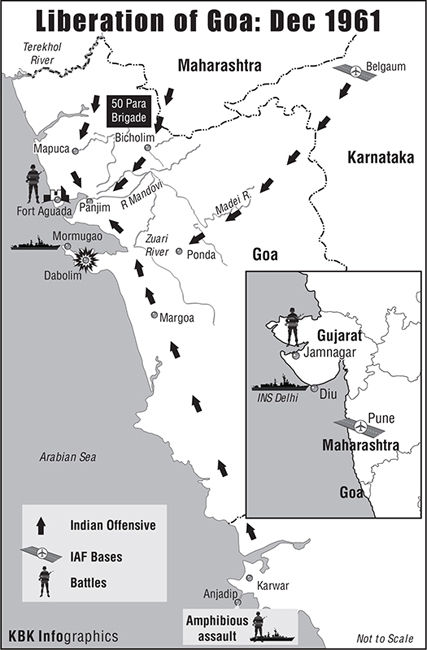
The broad military plan was to launch a division-sized force with limited armour and artillery supported by fighters and bombers operating from the airfields of Pune and Belgaum23P.N. Khera, Operation Vijay: The Liberation of Goa (New Delhi: Ministry of Defence, 1974), p. 57. against Goa, and a smaller force of approximately two battalions supported by fighters operating from Jamnagar airfield against the fortified island of Diu. The territory of Daman was lightly defended and it was expected to surrender as soon as hostilities commenced. Hence, only a battalion with light artillery support and some air effort from Bombay was allocated for the attack on Daman.24For a detailed break-up of forces and threat assessment, see P.N. Khera, Operation Vijay: The Liberation of Goa (New Delhi: Ministry of Defence, 1974), p. 46 and Appendix 1 at p. 145, which highlights the essentials of an appreciation by Lieutenant General J.N. Chaudhuri submitted to the Government of India on 10 November 1961. The advance into Goa was planned on two main axes from the north and the east with a small diversionary attack from Karwar in the south. These axes were planned keeping in mind the availability of roads and the ease with which the numerous river crossings could be executed by the infantry and the mechanized formations as they advanced towards Panjim.
In Diu, the operations were to be commenced with a boat assault across the creek to capture the fort, followed by the capture of the airfield and the rest of the island. INS Delhi, the Indian Navy’s flagship and cruiser, would provide fire support along with fighter support provided by Vampire aircraft based at Jamnagar. Additionally, the Indian Navy was tasked to carry out a blockade of Goa by preventing any ship from entering the three harbours on the Goa coast except ships with essential supplies. The operation was scheduled to commence on the night of 15/16 December 1961 and was expected to last a maximum of three days. Rattled by the large-scale movement of troops from all parts of India to the two launch pads of Pune and Belgaum and the increased naval and air activity, the Portuguese government frantically attempted to garner Western and NATO support to stall the operation. Particularly disconcerting for them was the positioning of the crack 50 Parachute Brigade at Pune and the availability of a large naval fleet at India’s disposal on the west coast. Responding to increased Western efforts to resolve the crisis, the Government of India postponed the operation by two days without diluting any of its demands, which mainly revolved around an unconditional vacation of Goa, Daman and Diu by the Portuguese government and cessation of colonial rule.
The Commanders
While Lieutenant General J. N. Chaudhuri, the flamboyant, imposing and battle-hardened veteran of WW II and the Hyderabad military action, was the overall force commander as the GOC-in-C of Southern Command, the main field commander who executed the operation was Major General K.P. Candeth, another outstanding soldier with loads of combat experience. Like Somnath Sharma, the hero of the Badgam battle, who laid down his life fighting to save Srinagar airfield from the raiders in 1947, Candeth was an alumnus of the Prince of Wales Royal Indian Military College (later called Rashtriya Indian Military College or RIMC for short). Commissioned into the Corps of Artillery in 1936, he saw action during WW II in West Asia and then gained vital battle experience in the mountains quelling rebellious tribesmen in the North- West Frontier Province.25http://en.wikipedia.org/wiki/Kunhiraman\_Palat\_Candeth. Also see an obituary: ‘K.P. Candeth Dead,’ The Hindu, 20 May 2003, available at
Opposing the formidable Indian forces in Goa were a combination of regular Portuguese army personnel numbering about 5,000, a naval sloop, the Albuquerque, three patrol boats and a sprinkling of police and volunteer paramilitary forces. Daman and Diu were defended by approximately two companies of regulars at each place. The overall command of the Portuguese forces rested with Manuel Antonio Vassalo E Silva, the Governor General of Goa since 1958.27http://en.wikipedia.org/wiki/1961\_Indian\_annexation\_of\_Goa (accessed 10 December 2013). Faced with an imminent attack by India, he was ordered by Salazar to fight to the last man, a ridiculous expectation given the asymmetry of forces and the ragtag army at his disposal for the defence of Goa.
The Short Battle
As large waves of IAF Canberra bombers from Poona airbase bombarded Dabolim airfield at the crack of dawn on 18 December 1961, and Hunters from the Sambra airfield destroyed the vital communications hub at Bambolim,28P.N. Khera, Operation Vijay: The Liberation of Goa (New Delhi: Ministry of Defence, 1974), p. 129. Also see
By noon on 19 December, Panjim and Mapuca, the two primary objectives, were captured as Chaudhuri made his way to Panjim along with Air Marshal Pinto and an intelligence officer, B.N. Mullick, later to come into prominence during the intelligence bungling prior to the 1962 India–China conflict.
The Goa sector saw fairly intensive naval operations too with the Indian Navy mounting an independent amphibious operation to take over the island of Anjadiv despite having no real capability beyond a few training drills carried out in the past.30Interview with Admiral Nadkarni. After softening defences with naval gunfire support from the cruiser INS Mysore, an assault force from the frigate went ashore on 18 December morning on normal boats, but was met with stiff resistance from machine gun positions and took some casualties. The force had to be reinforced and finally captured the island on the afternoon of 19 December.31P.N. Khera, Operation Vijay: The Liberation of Goa (New Delhi: Ministry of Defence, 1974), p. 117. After a short naval battle off Mormugoa harbour with two Indian Navy frigates, the INS Beas and INS Betwa, the lone Portuguese warship Afonso de Albuquerque was badly damaged and captured. Thus ended a badly lopsided battle for Goa!
The battle for Daman was short and swift and commenced at the same time as the battles for Goa and Diu. With concurrent battles being fought at all three places there was immense confusion within the Portuguese ranks considering that the IAF had rendered the main communications hub at Bambolin totally useless. This left the dispersed Portuguese forces without any higher directions for battle and totally reliant on local resources and commanders, who in any case were hardly battleworthy. The Indians had underestimated the enemy strength as they later realized that pitted against a Maratha Light Infantry Battalion was a force of approximately 500 soldiers including twenty-three officers. However, the superior training and operational plan of the Indian Army, coupled with the psychological impact and degradation of defences caused by effective IAF Mystere fighter strikes which even injured the governor of Daman, ensured that the defences were easily overrun with minimum casualties by the morning of 19 December.32Ibid., p. 100–02. The IAF carried out a total of fourteen missions during the two days and clearly demonstrated the growing inter-service cooperation in Operation Vijay.
From an operational point of view the toughest and most interesting battle during Operation Vijay was the battle to capture the island of Diu. Dominated by a citadel, which had numerous vantage points from where accurate fire could be directed against forces attempting to cross the creek that separated it from the Kathiawar coastline; the Indian Army grossly underestimated the strength of the defenders and the firepower they had in terms of Light and Medium Machine guns (LMGs and MMGs). Ignoring the earlier advice of the IAF and the Indian Navy to delay the crossing of the creek till the defences had been sufficiently softened up by IAF fighter strikes from Jamnagar airfield and naval gunfire from INS Delhi, 20 Rajput Regiment courageously attempted to carry out an assault crossing of the creek from two directions in the early hours of 18 December. Simultaneously, a company of 4 Madras Regiment attempted to capture a village opposite the citadel called Goga to provide a firm base from which subsequent attacks could be launched across the creek. All three attacks were initially repulsed by withering LMG and MMG fire with a number of boats capsizing and a fair number of casualties. This was when the IAF and the Indian Navy stepped in with some telling air strikes and accurate naval gunfire support through the morning and afternoon of 18 December. Wing Commander Mickey Blake, the chief instructor of ATW, who was in charge of operations from Jamnagar, had at his disposal a wide range of attacking options, which included Toofani fighter jets of No. 4 Squadron and Vampire trainer jets of ATW.33Group Captain Kapil Bhargava, ‘Operations at Diu: The One Day War,’ available at [www.bharat-rakshak.com/IAF/History/1961Goa/1013-Diu.html](http://www.bharat-rakshak.com/IAF/History/1961Goa/1013-Diu.html) (accessed 14 December 2013). As early as 7 December, he had taken up the CO of the Rajput Regiment in a Vampire trainer to pinpoint targets and advised him to attempt the creek crossing only after the first wave of fighter strikes had been completed.34Ibid. This advice was not heeded as the army felt that it would be preferable to launch an attack under the cover of darkness – a fair assessment at that except that whether day or night, the attack was expected and the LMGs and MMGs did not distinguish between night and day. After the Toofani jets and Vampires had plastered the Diu defences and crippled the runway, the Portuguese resistance withered and by late night, the Rajputs had taken Diu. A total of thirty-five sorties had been flown in support of the Diu assault. It was an excellent example of what air power could do in shaping the environment and battle space before a ground assault.
Admiral Nadkarni was the navigation officer of INS Delhi and, in an interview, he recounted the effective naval gunfire that was directed on the hapless defenders from a distance of less than 2 miles. The massive 6-inch guns of the INS Delhi proved to be the last straw for the defenders and the Delhi crew were the first ones to see the white flags being waved from the fort and conveyed the same to the ground troops.35Interview with Admiral Nadkarni.
The Indian armed forces lost twenty-two men in the entire Goa, Daman and Diu operation including two officers with another fifty-four being wounded, the majority of them in the Diu and Anjadiv operations. The Portuguese lost thirty men, had another fifty-seven wounded and, more humiliatingly, had over 3,000 taken prisoners.36P.N. Khera, ‘Casualties during Operation Vijay’, Operation Vijay: The Liberation of Goa (New Delhi: Ministry of Defence, 1974), p. 238. In a nutshell, a division- plus-sized ground assault force supported by a large naval and air element had defeated a poorly led, inadequately equipped and overconfident Portuguese force, which really had no idea what they were up against.
Some Strategic And War-Fighting Lessons
At the strategic level, India lost an opportunity to use calibrated, state-sponsored coercion to evict the Portuguese from India in the 1950s. Instead, it had to resort to force application as a strategy despite professing abhorrence for such tools of statecraft. During the relatively quiet period of the 1950s had Nehru authorized the movement of army formations to locations around Goa, had he authorized periodic harassment of Portuguese shipping and a naval blockade of sorts, and had he authorized leaflet dropping and frequent buzzing of the airfield at Dabolim by IAF fighters and bombers – it is more than likely that the Portuguese would have folded up without a fight. But for that, Nehru would have had to shed his altruistic and liberal coat that he had so assiduously built over the years. Had Sardar Vallabhbhai Patel, India’s first home minister and architect of the firm amalgamation of princely states, been alive, there would have certainly been a coercive strategy to evict the Portuguese in the early 1950s itself. The Goa crisis was the first serious challenge to Indian statecraft after the Kashmir and Hyderabad conflicts. Albeit a trifle diffident, the action was better late than never.
Intelligence gathering about Portuguese force levels was terribly inaccurate. Eleven years down the line after the Hyderabad operations, there seemed to have been very little improvement in synergies between military intelligence and civilian intelligence agencies that were responsible for piecing together all the HUMINT (human intelligence) and converting it into operational intelligence. There were ridiculous inputs about the presence of Portuguese fighter jets in Goa and the possibility of Pakistan supporting Portugal militarily in the conflict.
At the operational level, while there was reasonable synergy between the three services, two operations that had the largest number of casualties yielded some lessons for the future. First was the attempt by the Indian Navy to capture Anjadiv on its own. A small amphibious force comprising trained army units of even a platoon or company strength may have done the job in a more professional manner. In a scathing critique of the operation, Major General D.K. Palit, then a brigadier and director of military operations, recounts how he had identified a platoon of Gorkhas from the 4th Battalion of the 9th Gorkha Rifles and had them positioned at Bombay. To his surprise the GOC-in-C, Lieutenant General Chaudhuri had no intentions of sharing any glory with the Indian Navy and decided that if the army had to assault Anjadiv, it would do so on its own despite having no such assault expertise.37Major General D.K. Palit (retd), War in the High Himalayas: The Indian Army in Crisis, 1962 (New Delhi: Lancer, 1991), p. 143–44. Readers may wonder how Goa figured in a book about the 1962 war with China. The book has a chapter on Operation Vijay, the military operation to liberate Goa in December 1961, the same time as things were hotting up along the India–China border. Bravely, the navy attempted it, but succeeded against amateurish opposition only after suffering heavy casualties of seven dead including two officers, and seventeen wounded. Second was the manner in which Diu was assaulted by 20 Rajput Regiment and 4 Madras Regiment. Had the defences at Diu been softened up by the Indian Navy and the Indian Air Force, the ground operation would have been a cakewalk. Underestimating the potential of the other two services would be a characteristic that would continue to plague the Indian Army in the years ahead. In a scathing critique of the manner in which the GOC-in-C of Southern Command, Chaudhuri, and other senior commanders overplayed the preparation for the operation, thereby diverting attention from the more serious China border situation, Palit recounts:
Yet, in its consequences, Operation Vijay eventually took on greater significance: the easy conquest was taken too seriously in many quarters. The euphoria of success inflated a passing interlude of secondary military consequence into a famous victory.38Ibid., p. 111.
Brian Cloughley, an Australian colonel who spent two years as the deputy head as the UN Military Observer Group (UNMOG) in India and Pakistan, made these observations on India’s reaction to its Goa victory:
Unfortunately for the army and Indian prestige, the invasion of the tiny Portuguese enclave of Goa had been greeted with euphoric approval by an Indian public which considered it to be a great feat in arms, which it patently was not.39Brian Cloughley, A History of the Pakistan Army (New Delhi: Lancer, 1999), p. 59.
In the final analysis, Operation Vijay was a reasonably well-planned and well-executed military operation against a significantly weaker adversary after almost thirteen years of peaceful existence. Though the Indian armed forces gained valuable battle experience, little did they realize that barely a year later they would be pitted against an enemy who would prove to be of a different mettle in a completely different environment.