Part III: Teething Years
Liberating Hyderabad
How can I stop you from committing suicide if you want to?
The Recalcitrant Maharajas
One of the primary methods used by the British to retain their hold over their Indian empire for almost two centuries was by deft and devious parcelling of major portions of the huge Indian subcontinent into areas that could be directly governed by them, and those over which they ensured proxy control. This proxy control was exercised by what the world commonly knew as the princely states of India ruled by exotic maharajas. Owing allegiance to the British Raj in return for handsome privy purses and opulent living, most of these maharajas were oblivious to nationalistic aspirations and milked the land and their oppressed people to increase their personal wealth and that of the British Empire. At the time of Independence, India and Pakistan had to amalgamate nearly 556 princely states into their respective countries. While most princely states accepted the ‘fate of geography’ and acceded to India or Pakistan without a whimper, six states created problems for India: Jammu and Kashmir, Junagadh, Travancore, Bhopal, Jodhpur and Hyderabad. While Kashmir has been dealt with in the previous chapter and will come up repeatedly in the book, it was the large and prosperous state of Hyderabad which would give a political migraine to India’s inexperienced leadership as it vacillated for almost a year before finally ordering military action to take control of the large state.
While Bhopal and Jodhpur acceded without much coercion, a quick look at how the Travancore and Junagadh problems of accession were resolved reveals the complexities of state-sponsored coercion by an Indian government that desperately wanted to steer a path of inclusive and amicable accession. It soon realized the necessity of coercion as a tool of statecraft thanks to its no-nonsense home minister, Sardar Vallabhbhai Patel, and his hatchet man in the Ministry of Home Affairs, V.P. Menon, who was put in charge of the accession of princely states into the Indian Union.
OBLIVIOUS TO REALITY: TRAVANCORE AND JUNAGADH
At the time of Independence, the state of Travancore encompassed much of what is the modern state of Kerala and parts of Tamil Nadu. It was a relatively prosperous and literate province ruled by an enlightened maharaja and assisted by a powerful and brilliant dewan (chief minister), Sir C.P. Ramaswamy Iyengar.2Ramachandra Guha, India after Gandhi (London: Pan Macmillan, 2007), p. 45. Displaying complete strategic naivety, the dewan thought that he could create an independent state on India’s southern flank and bank on sea lines of communication in the Arabian Sea to counter any kind of Indian blockade and sustain the economy. Fortunately for India, but unfortunately for the dewan, a deadly attack on him by socialists in the state3Ibid., p. 46. made him realize the futility of confrontation with India and he advised the maharaja to join India.
Junagadh, which was a princely state occupying a part of what is the Saurashtra region of the modern state of Gujarat, was a harder nut to crack. Ruled by a Muslim ruler with a predominantly Hindu population, it was surrounded on three sides by Indian states with a coastline hugging the Arabian Sea.4Ibid., p. 49. More importantly, it was also close to the birthplace of India’s home minister, Sardar Vallabhbhai Patel, the man entrusted with reining in the recalcitrant maharajas.5Rajmohan Gandhi, Patel: A Life (New Delhi: Navajivan, 1991), p. 292. Encouraged by Jinnah from Pakistan, the petulant dog-loving Nawab of Junagadh declared the accession of his state to Pakistan on 14 August 1947 and invited the extreme displeasure of Sardar Patel as other states around Junagadh had signed the instruments of accession with India. Responding to reports of violence and incursion by troops of Junagadh against its neighbouring states of Mangrol and Babariawad, the Government of India promptly ordered a hastily put together military force to invade Junagadh in October 1947 and teach the nawab a lesson.
To execute Exercise Peace, as the operation to liberate Junagadh was called, the military force put together by India was a large one comprising a brigade at Rajkot, and an amphibious task force with a battalion of the Kumaon Regiment being landed at Jafrabad in the region of Kathiawar as a show of force under the overall command of Brigadier Gurdial Singh.6Rear Admiral Satyindra Singh, Under Two Ensigns: The Indian Navy 1945–50 (New Delhi, Oxford & IBH Publishing, 1986), p. 98 Amphibious exercises were also carried out on beaches at Mangrol and Porbandar. There was also a squadron of Tempest fighter aircraft (No. 8 Squadron) of the RIAF under the command of Squadron Leader Padam Singh Gill on readiness at an airfield at Jamnagar in the princely state of Nawanagar.7Ibid. As a coercive exercise, the squadron even carried out practice rocket firing at an island (Panera) off the Nawanagar coast,8Operational Record Book of No. 8 Squadron RIAF, Ministry of Defence, Historical Division, New Delhi. which was the largest princely state bordering Junagadh that was available to the Indian armed forces as a launch pad for military action in case the need arose. The joint force was completed by a Royal Indian Navy task force comprising three frigates, three minesweepers and three landing craft under the command of Commander R.D. Katari.9Ibid. This operation was actually the first joint operation launched by independent India’s armed forces and the first time a RIN task force had sailed for a mission that was not in furtherance of the British Empire’s operational or strategic objectives. Seeing the large force ranged against him, the Nawab of Junagadh, Sir Mahabatkhan Rasulkhanji, fled to Pakistan with his entourage of dogs and wives, leaving his dewan, Sir Shah Nawaz Bhutto, to throw in the towel in late October 1947 as Indian ground forces entered Junagadh and IAF Tempests carried out a number of high-speed runs over the state capital. This paved the way for a referendum on 20 February 1948 in which 91 per cent of the population voted for accession to India.10Ramachandra Guha, India after Gandhi (London: Pan Macmillan, 2007), p. 51. Bhutto was, however, commended by Jinnah for his attempt to force the secession of Junagadh to Pakistan.11Farzana Sheikh, ‘Zulfikar Ali Bhutto: In Pursuit of an Asian Pakistan,’ in Ramachandra Guha, ed., Makers of Modern Asia (Cambridge: The Belknapp Press, 2014), p. 269. At the end of it all John Keay writes about the Nawab of Junagadh and his flight to Pakistan:
A show of strength duly sent him winging his way to Karachi with just four wagging companions and a like number of wives. To this day maps printed in Pakistan record the fact with a little patch of green in the middle of Indian Gujarat. Less remembered is the role played in this affair by Shah Nawaz Bhutto, the chief minister of Gujarat in 1947. Having encouraged the prince to accede to Pakistan, it was this Bhutto who, after his employer’s flight, cleared the way for Indian intervention. Twenty four years later Shah Nawaz’s son, Zulfiqar Ali Bhutto, would play a similar ambivalent role in respect of East Bengal/Bangladesh.12John Keay, India: A History from the Earliest Civilizations to the Boom of the Twenty-first Century (London: Harper Press, 2010), p. 512.
Indecisiveness Over Hyderabad
As the ‘idea and shape of India’ emerged slowly out of the cocoon of the various British-ruled provinces and princely states in 1948, apart from J&K, Hyderabad remained a thorn in India’s hinterland. The state of Hyderabad was one of the oldest princely states in the Deccan and had been ruled by the Asaf Jahi dynasty since 1724, after it broke away from the declining Mughal Empire. Centred at Hyderabad, the Nizam ruled over a large state with a majority Hindu population in the west and north-western areas bordering the Maratha Empire and in the south and south-east areas bordering the Madras Presidency. The Muslim population grew around the capital of Hyderabad and provided the much needed physical security for the Nizam from the oppressed and restive majority population. From time to time the Maratha and the Mysore Empires nibbled into the Nizam’s kingdom, but every time the Nizam skilfully manoeuvred his way through the crisis, aligning at different times with the French and the British to regain control over his large territory by paying huge levies and tributes. Finally, as the British gained control over the entire Deccan Plateau after defeating the Marathas in the mid-eighteenth century, the Nizam of Hyderabad became their most loyal vassal in the region and a virtual cash cow for the British Raj.
The close relationship with the British allowed the Asaf Jahi dynasty to establish trade and cultural links with Europe and it is little surprise that the last Nizam of Hyderabad, Sir Mir Osman Ali Khan Siddiqui Asaf Jah VII, emerged as amongst the richest men in the world at the time of Independence. Indians, particularly those who lived in Hyderabad, have always wondered where the Nizam accumulated such wealth. The answer lay in his ability to retain control over the rural population, extract huge taxes, exploit the fertile cotton and sugar cane belts of the region and send the produce to Great Britain and Europe in return for exotic riches and unimaginable wealth. Such control would not have been possible had it not been for the existence of Arab and Pathan militia13S.N. Prasad, Operation Polo: The Police Action against Hyderabad 1948 (New Delhi: Historical Section, Ministry of Defence, 1972), p. 4. in the Nawab’s army – recruited in the early nineteenth century – not only to beef up the Nizam’s security forces, but also to support the ulema (holy men) in forcible conversions and spreading the Islamic faith amongst a predominantly Hindu populace. This aggression was in stark contrast to the rather benign approach of the Nawab of Junagadh, who did not force Islam on his subjects beyond a point.
As this militia integrated with the local population, they were organized into a twentieth-century militia called Razakars under a hard-line Islamist cleric named Qasim Rizvi,14Operation Polo, at en.wikipedia.org/wiki/Operation Polo. the leader of a political party called Ittehad-ul-Muslimeen devoted to the cause of Islamic supremacy in the region.15S.N. Prasad, Operation Polo: The Police Action against Hyderabad 1948 (New Delhi: Historical Section, Ministry of Defence, 1972), p. 9. It was this militia that perpetrated communal violence in the state and created a combustible security situation warranting immediate intervention by India. Unfortunately, it was allowed to fester as a wound for some months as a result of multiple pressure points on the Indian government.
First was the escalating religious violence between Muslim fundamentalists (Razakars) and a restless Hindu-majority population led by communists and a sprinkling of Andhra Hindu Mahasabha activists. This created a ‘fog of communal violence’ in large areas of the state away from the capital of Hyderabad, which needed to be first penetrated and analysed by the Indian state before deciding on any action. Second was a purely materialistic phenomenon of Britain wanting to ‘milk its richest cow’ for a while longer – allowing much of the wealth of the Nizam to be spirited away overseas while advising the Indian government to exercise caution in dealing with the Nizam. Third was that since India had chosen to internationalize the J&K conflict, it was not long before international pressure piled on India to resolve the Hyderabad crisis peacefully. Fourth was an intelligence failure that overhyped the military capability of the Razakar-led Nizam’s army. News filtering out of Hyderabad talked about large purchases of arms and aeroplanes from abroad and it is quite surprising that in all the military briefings made to the political executive, while it was understandable that the British military leadership advised excessive caution to suit their own objectives, none of the senior Indian officers offered contrarian opinions and suggested immediate military action. Fifth and last was the growing realization by the majority (87 per cent) Hindu population that it was time to reclaim much of the land from an oppressive minority ruler (13 per cent of population held over 90 per cent of the land and occupied over 97 per cent of state government posts).
With so many pressure points the Government of India was initially at a loss how to peacefully resolve the issue and offered a Standstill Agreement to the Nizam in September 1947. The agreement offered significant autonomy to the Nizam, emboldening the radical elements within the Nizam’s government to reject the agreement and push for complete independence. Thus, the political indecisiveness in Delhi reinforced the hands of the Nizam and his band of Razakars, ripening an already fragile and adversarial situation between the Muslims and the Hindus in the state. The situation worsened much through the first half of 1948 with stray but fairly authentic reports of killings on either side coming from British army personnel posted in Hyderabad.
Finally, the intransigence of the Nizam and increasing brutality of the Razakars, coupled with growing public opinion and pressure from the communists and the Andhra Hindu Mahasabha, forced the Indian government to seriously contemplate military action in the summer of 1948. Western reporters too wrote on the absurdity of the Nizam seeking to establish independence, the organized fanaticism of Qasim Rizvi’s storm troopers, and regular gun-running from Pakistan. Robert Trumbull of The New York Times feared a communal backlash after military action,16‘First Year of Freedom: India through Western Eyes,’ Bombay Chronicle, 24 August 1948, p. 6. a prediction that was to come true much to the discomfort of the secular Indian government.
Planning Military Action
One of the most interesting facets of the use of military force to coerce the Nizam of Hyderabad to accede to the India Union is the term Hyderabad Police Action. How and why this term was coined by the Government of India is interesting to reflect on as it has been a matter of much debate whenever the strategic community has discussed the action. While some believe that the term police action reveals much about the apologetic and rather diffident nature of Indian strategic thought on force application at the time of Independence, others believe that it provided early signs of the restraint and maturity that India’s political leadership would display whenever its hands were forced to employ the military against its own people. Even though Jawaharlal Nehru clearly called it a military action and not war in one of his pronouncements at Madras17‘The New Hyderabad,’ Bombay Chronicle, 14 September 1948, p. 6. prior to the actual commencement of operations, he assumed that by downplaying a full-fledged military operation and calling it a mere police action, India would be seen as a mature and restrained power. Little did he realize that it would also reveal strategic contradictions about India’s reluctance to accept that force application and demonstration of coercive power and intent were critical ingredients of statecraft, which could coexist with expressions of faith in collective international security mechanisms and altruism as effective tenets of international relations in a troubled neighbourhood.
During the reign of the British Raj, Secunderabad, a satellite town of Hyderabad, emerged as a major cantonment of the Indian Army in the Deccan. At the time of India’s Independence, the senior-most British commander in Hyderabad was Major General C.E. Pert, the general officer commanding of a division located there. His advice to the C-in-C, General Bucher, was alarming and indicated that he feared that the Razakars were belligerent enough to target various stores and depots and even attack some formations.18S.N. Prasad, Operation Polo: The Police Action against Hyderabad 1948 (New Delhi: Historical Section, Ministry of Defence, 1972), p. 22. He was advised to secure all Indian assets and stand by for further instructions. In all fairness, the division was a depleted one and devoid of any major infantry fighting capability and may not have been able to overcome the Nizam’s army and the Razakars. However, for an officer of General Pert’s stature, his appreciation of the enemy’s capability was poor and alarmist.
To be fair to the British, the British GOC-in-C of Southern Command, Lieutenant General Goddard, was blunt in his assessment and, while retaining objectivity and impartiality in his prognosis, obliquely suggested immediate military action as early as February 1948. He wrote in his impressive style:
An ageing, headstrong, ill-advised and anachronous ruler is at the head, or nominally at the head of an autocratic and worn-out administration, on which the various political agitations and trends are exercising an ever-increasing weakening influence. Behind this crumbling administrative façade stands the Itehad-ul-Muslimeen, fanatical, unrealistic and devoid of men skilled in public affairs. Engaged in a tussle with the Ittehadists are the Communists, who are in semi-open revolt in the eastern districts of the state, and the Satyagraha movement.19Ibid., p. 26.
While planning for a likely military solution started in February, actual military action commenced only in early September 1948 after a series of skirmishes between the Razakars and Indian Army units had taken place along the western and southern borders from July onwards. Indian units were repeatedly ambushed during routine patrols with some casualties and finally, after a skirmish, when an Indian armoured squadron of the Poona Horse was fired upon by armoured cars of 1 Hyderabad Lancers,20Operation Polo, at en.wikipedia.org/wiki/Operation Polo. it was clear that the Nizam was losing control in Hyderabad. Running out of options, the Government of India realized the time was ripe for full-fledged military action – not a mere police action as the Historical Section of the Government of India has repeatedly stated. On 17 August 1948, the Bombay Chronicle, a widely respected newspaper, reported widespread attacks and looting by Razakars in Berar on the border between Hyderabad and what is present-day Maharashtra in the Nanded district.21‘Razakars Attack Village on Berar and Razakars loot Nanded Border,’ Bombay Chronicle, 17 August 1948, p. 8. On the same day the Razakar chief, Qasim Rizvi raised his battle cry at a public meeting at a town named Biloli by playing the communal card:
The Sovereignty enjoyed by the Nizam cannot be taken away by any power on earth. We Muslims of Hyderabad are today faced with difficult problems which will decide our fate. We should neither be discouraged nor disheartened on account of the measures adopted by the Indian Union to demoralise us. We should face our enemies with courage and determination.22Ibid.
As the ante was upped on all fronts, the communists, representing the voice of oppressed peasants, hit key railway stations in the area around the southern Vijaywada and engaged in fairly fierce skirmishes with the Hyderabad state forces.23‘Reds Attack Nizam’s State Railway Stations,’ Bombay Chronicle, 18 August 1948, p. 8. Pathans and Arabs of Kasim Rizvi’s Razakar force were reported to have kidnapped women and stripped them and then made them walk naked in the streets in Bidar and Raichur.24‘Razakar Orgies at Gulbarga, Bidar, Raichur,’ Bombay Chronicle, 24 August 1948, p. 7. As the clouds of war loomed on the horizon, gunrunning from Pakistan was stepped up as clandestine flights landed at Warangal and Bidar aerodromes, bringing in arms and ammunition for the Razakars. 25Josy Joseph, ‘Hyd Nizam Said: Gandhi an old Fool,’ The Times of India, 2 August 2013, p. 12.
Soon after, the Nizam sought UN intervention on 19 August 1948 alleging threat of invasion and blockade by India, expecting that Syria, one of the Security Council members, would sponsor the resolution.26‘Nizam to Seek UN Intervention,’ Bombay Chronicle, 20 August 1948, p. 1. The process fizzled out and the stage was set for an armed confrontation between the Nizam and the Indian Union. On 10 September, all westerners including forty American missionaries were evacuated from Hyderabad by RAF and BOAC aircraft. The next day, US president Harry Truman turned down a desperate appeal from the Nizam to intervene in the matter and most British officers from the Nizam’s army resigned.27Bombay Chronicle, 11 and 13 September 1948. The writing was on the wall and yet the Nizam did not see reason, blinded by his own geopolitical naivety and intimidated by Kasim Rizvi, who had actually become the de facto ruler of Hyderabad.
Multi-Pronged Offensive
One of the largest princely states of the British Raj, Hyderabad had a border of 644 km with India prior to accession. This made it a formidable task for a stretched Indian Army to plug the entire border with Hyderabad, grappling as it was to pump in more troops to support Thimayya’s summer offensive in J&K and push back raiders, particularly from the Leh and Poonch sectors. Largely planned under the supervision of Brigadier J. N. Chaudhuri when he was chief of general staff at Army HQ, New Delhi, Operation Polo, as the action was code-named, was finally executed by an all-Indian team of Southern Army Command under Lieutenant General Maharaj Shri Rajendra Sinhji, a freshly promoted major general J.N. Chaudhuri (later to be COAS), the GOC of 1 Armoured Division, and Major General Ajit Anil ‘Jock’ Rudra, who was GOC of the Madras Area.
Lieutenant General Rajendra Sinhji was commissioned into 2 Royal Lancers and was a squadron commander in the same regiment in 1941 in North Africa where he was awarded a DSO for his exploits in leading his squadron in a fighting withdrawal in the face of superior German armour.28Bombay Chronicle, 14 September 1948, p. 4. Some of the finest and most objective details of the initial days of the campaign can be found in this newspaper, which established a fine legacy of military reporting in all of India’s initial conflicts. Major General Chaudhuri was one of the youngest generals in the Indian Army having been commissioned only in 1928. After seeing major action as a staff officer with the 5th Indian Division in Sudan, Eritrea and the western desert during the early years of WW II, his major exploits were reserved for the Burma campaign. Commanding 16 Cavalry, an armoured regiment, he moved the unit in a gruelling 3,000- mile induction into the Burma theatre in 1944, forming the advance guard in the march to Rangoon.29Ibid. He was the third Indian brigadier after Cariappa and Thimayya in the pre-Independence British Indian Army. Major General Rudra was one of the earliest Kings Commissioned officers, and the oldest Indian general in the Indian Army. Blooded in battle as an enlisted soldier in WW I, he saw action in France and Belgium in the Battle of Somme and Flanders. ‘Jock’ as he was popularly known rose to be a sergeant before being selected for commissioning into 4/15 Punjab Regiment as an officer in 1919 in reward for his splendid performance in the Great War. During WW II, he excelled as the 2 I/C of his battalion with Slim’s 14th Army in the Burma campaign.
The air element comprised a ‘Polo Air Task Force’ under the command of Air Commodore Subroto Mukerjee as AOC Caterpillar Air Task Force. He was later to be the first Indian chief of the air staff in 1954. Subroto Mukerjee was the first Indian commanding officer of 1 Squadron RIAF and cut his teeth as a fighter pilot and leader in the NWFP against rebellious Afridi and Mahsud tribesmen. His mandate for the use of air power in the operation was to provide photo reconnaissance and close air support to advancing Indian army columns, particularly the armoured division, with two fighter squadrons of Tempest fighter-bombers (3 and 4 Squadrons) at Pune.
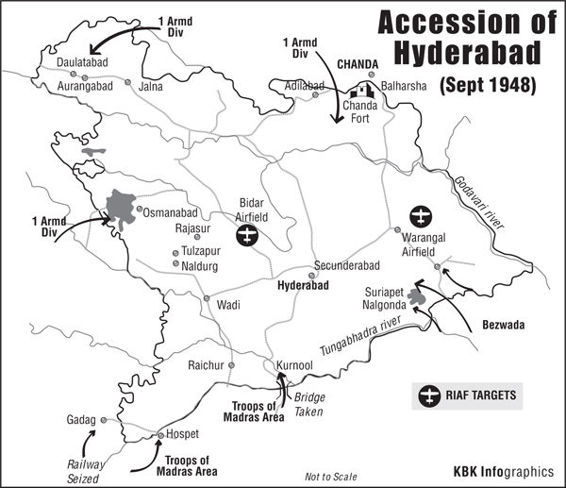
At 1:45 p.m. on 12 September 1948,30S.N. Prasad, Operation Polo: The Police Action against Hyderabad 1948 (New Delhi: Historical Section, Ministry of Defence, 1972), p. 51. the Indian Army commenced a five pronged thrust along the frontier with four provinces of the Union of India: Central Province, Bombay, Mysore and Madras. Symbolically, on the same day in 1727, the Marathas under Peshwa Balaji Rao defeated the Nizam of Hyderabad in the first battle he fought after declaring his independence from them.31Ibid. The major thrust was from the west where the Sholapur–Hyderabad highway presented the best opportunity for Major General Chaudhuri’s 1 Armoured Division to steamroll past stubborn state forces and Razakars at Bidar and capture Hyderabad. A subsidiary thrust by additional troops assigned to 1 Armoured Division was to commence from the north-west with the aim of capturing Aurangabad and Jalna, two important towns in the north-western areas. A north-eastern thrust was planned from Adilabad, a southern thrust from Kurnool and a major south-eastern thrust from Bezwada. Both the southern thrusts were entrusted to infantry and armoured formations from Rudra’s Madras Area.32For a detailed overview of all the forces involved, see S.N. Prasad, Operation Polo: The Police Action against Hyderabad 1948 (New Delhi: Historical Section, Ministry of Defence, 1972), Appendix III to Appendix X, p. 126–78.
Race To Hyderabad
What of the opposition to the well-trained and battle-inoculated Indian force of almost two-and-a-half divisions including an armoured division? The state forces of the Nizam were poorly trained and had no battle experience. Their equipment was old and rusty and did not support the numbers of a 30,000-strong standing army, an armed police force of approximately 35,000, besides 8,000 irregulars and a large force of Razakars.33White Paper on Hyderabad from Bombay Chronicle some time in September 1948. The strength of Razakars widely varied since it was a militia and ranged from a modest 30,000 as reported by Western commentators to a figure of 70,000 active and armed men and women, as indicated in the white paper. Contrary to initial reports, the Nizam had no air force34‘Where is the Nizam’s Air Force,’ Bombay Chronicle, 17 September 1948, p. 1. and most of his armoured cars were off-road. Indicating a sense of urgency in response to the wildly exaggerated strength of the Nizam’s forces, and anticipating concurrent and prolonged operations in Hyderabad and J&K, the Union of India adopted proactive measures by summoning reserve officers from Travancore, Madras, Cochin and Coorg.35‘Reserve Officers in South Summoned,’ Bombay Chronicle, 17 September 1948, p. 1.
In the final analysis the main threat to the advancing forces was to come from the Razakars in the Bidar and Bezwada region. Loosely organized into platoon- and battalion-sized formations and adept at hit-and-run tactics like the raiders in Kashmir, the Razakars proved to be sticky and fierce opponents, though it was only a matter of time before they capitulated in the face of superior firepower.
The operational rationale for a multi-pronged offensive was quite clear: force the Nizam to disperse his forces and dilute his fighting potential to such an extent that 1 Armoured Division could exploit the Sholapur–Hyderabad highway and race to Hyderabad. The RIAF was to attack all the Nizam’s airfields from where gunrunning from Pakistan was taking place, particularly those at Warangal and Bidar. Additionally, Tempest aircraft operating from Pune were to provide close air support to 1 Armoured Division and cause psychological degradation to the morale of the state forces, strafing them and even dropping leaflets – all of which were carried out professionally.
The southern forces of almost a division strength on two thrust lines were to ensure that the important road and railway bridges at Hospet and Kurnool were captured intact and prevent any escape of the Nizam’s forces southwards. The south-eastern thrust in the prosperous and fertile Telangana region was important as this region saw numerous skirmishes between the Razakars and the Kisan Dal (communist militia) prior to commencement of hostilities. This region was nearly 100 per cent Hindu and it was feared that a major genocide against them could be perpetrated in the absence of a military force in the region. After three days of sporadic fighting mainly in the form of skirmishes and tough encounters with the Razakars, Chaudhuri’s 1 Armoured Division supported by RIAF Tempests operating from Pune smashed past defences at Rajasur, Zahirabad, Bidar and Homnabad from the west and Aurangabad in the north-west, while General Rudra’s formations forged ahead in the Suriapet salient of the Bezwada sector. By the early morning of 17 September, 1 Armoured Division was poised to take Hyderabad and by 5 p.m. on the same day, the Nizam surrendered.36‘Nizam Surrenders to Indian Union,’ Bombay Chronicle, 18 September 1948, p. 1.
Aftermath
The altruism of Jawaharlal Nehru, his abhorrence of violence and empathy towards the people of Hyderabad was clearly evident in his statement on Hyderabad to parliament on 7 September. He urged the Nizam
… for the last time to disband the Razakars and to facilitate return of Indian troops to Secunderabad.37‘Hyderabad on the Brink,’ Bombay Chronicle, 8 September 2013, p. 8. Also see, Proceedings of the Legislative Assembly, September 1948, at NMML.
However, in its earnest attempts at inclusiveness, the Government of India was widely criticized for being too patient and generous with the Nizam after he had violated all the tenets of the Standstill Agreement, which was mainly signed to give him some manoeuvring space to fall in line with other princely states. With sinister communal forces at work, the Razakars engaged in widespread pogroms and atrocities on the Hindus and sowed the seeds for retaliation in the coming months. No amount of exhorting the people to steer clear of communal retaliation would prevent a Hindu backlash; something that was widely anticipated and did happen. Considering what had happened during the Partition riots and the massacre of Hindus by the raiders in Kashmir in retaliation for the perceived atrocities on Muslims by the Maharaja of Kashmir’s Dogra forces, it was naive to imagine that the Hindus of Hyderabad state would amalgamate the Muslims with open arms. After the fall of Hyderabad, communal tension ran high with widespread violence rocking the state,38Srinath Raghavan, War and Peace in Modern India (Ranikhet: Permanent Black, 2010), p. 98–100. Also see A.G. Noorani, ‘Of a Massacre Untold,’ Frontline, Vol. 18, No. 5 (3–16 March 2001), available at [www.frontlineonnet.com/fl1805/18051130.htm](http://www.frontlineonnet.com/fl1805/18051130.htm) (accessed 10 September 2013). ‘substantiating Nehru’s concerns over the fragility of communal relations in India’.39Ibid., p. 100. The Indian government’s failure to prevent this backlash was mainly because it was administratively ill-prepared, and expecting the Indian Army to maintain communal peace across the state was a tall order considering the size of the state.
While historians like Srinath Raghavan argue that the Hyderabad police action demonstrated the limited effectiveness of force application to preserve internal stability,40Ibid. what emerged finally was the inevitability of force application to overcome radical extremism of the kind displayed by the Razakars. Had this force been applied at a time when the Razakars were not fully organized, the Government of India might have been able to limit the extent of communal violence that preceded and succeeded the military action.