Part IV: Across Borders
Sparring and Probing
There is little point in attempting a profound facetiousness and writing off China as a riddle wrapped in an enigma. Failure of intelligence, no less than failure of nerve can manifest itself in seeing Han expansionism.1From correspondence between General Thimayya and Romesh Thapar soon after the India–China war of 1962, NMML Archives, accessed January 2013.
The Dragon Awakens, The Elephant Argues
A lot has already been written in this book on India’s attempts to resolve its internal and external disputes under an initial and overarching template of extensive internal debate, negotiations, diplomacy and an overwhelming desire to be seen as a responsible and restrained nation state. The decisions to use force in Kashmir, Hyderabad or Goa were couched in a moralistic fait accompli of ‘we tried our best, but ultimately had to use force against recalcitrant adversaries who underestimated our resolve to preserve the fabric of our fledgling democracy’. Somehow, the use of force to resolve disputes was seen as morally incorrect by the ‘Gandhian and Nehruvian school of diplomacy’; strengthened as it was by a vindication of the success of India’s non-violent ousting of the British Empire from the subcontinent.
Communist China on the other hand emerged from years of bloody military violence against the Japanese and the Kuomintang. Mao was quick to understand the inevitability of emerging post–WW II concepts of statecraft like deterrence, coercion and compliance, while Nehru bravely stuck to his liberal and altruistic belief that modern nation states were designed to negotiate and coexist. It is in the backdrop of those halcyon days of international relations in the Cold War era that India and China engaged in almost a decade of protracted negotiations over Aksai Chin and Tibet.
The years 1950–54 saw India and China approaching their frontier strategies in a starkly contrasting manner. China militarily occupied Tibet in October 1950 by systematically crushing all opposition. Soon after, it commenced building a strategic highway running through Aksai Chin linking Tibet with the south-western province of Sinkiang (now called Xinjiang). While India attempted to play down the likelihood of any confrontation with China over border differences and highlighted the Panchsheel agreement as a template for India–China relations,2The Panchsheel Agreement between India and China was signed with much fanfare at the Bandung Conference in 1954 and laid down five tenets of peaceful coexistence between India and China. These were mutual respect for each other’s territorial integrity, mutual non-aggression, mutual non-interference in each other’s internal affairs, equality and mutual benefit and peaceful coexistence. Sardar Vallabhbhai Patel, India’s nationalistic home minister, did warn Prime Minister Nehru of his apprehensions regarding India’s China policy. He advocated a capability-building strategy, rather than a conciliatory one as a hedge against Chinese adventurism. In a prophetic letter written to Nehru in 1950, a few months before his death, Patel wrote:
I have been anxiously thinking over the problem of Tibet and I thought I should share with you what is passing through my mind. I have carefully gone through the correspondence between the External Affairs Ministry and our Ambassador in Peking and through him the Chinese Government. I have tried to peruse this correspondence as favourably to our ambassador and the Chinese Government as possible, but I regret to say that neither of them comes out well as a result of this study.3Claude Arpi, 1962 and the McMahon Line Saga (Atlanta: Lancer, 2013), p. 430.
He goes on in the same letter to specifically highlight the strategic ramifications of China’s occupation of Tibet:
In the background of this, we have to consider what new situation faces us as a result of the disappearance of Tibet, as we know it and the expansion of China almost up to our gates. Throughout history, we have seldom been worried about our northern frontier. The Himalayas have been regarded as an impenetrable barrier against any threat from the North. We had a friendly Tibet which gave us no trouble … China is no longer divided. It is united and strong.4Ibid., p. 434.
Though Patel was a political disciple of Mahatma Gandhi, he was a tough and practical statesman who fitted into the mould of a realist and nationalist when it came to relations between nation states. His understanding of an emerging Chinese mistrust with regards to India’s position in the international order was highly accurate and perceptive. No amount of posturing by Nehru and India in the years ahead with respect to championing non-alignment would change this opinion. He wrote on this issue:
It is impossible to imagine any sensible person believing in the so-called threat to China from Anglo-American machinations in Tibet. Therefore if the Chinese put faith in this, they must have distrusted us so completely as to have taken us as tools or stooges of Anglo-American diplomacy or strategy. This feeling, if genuinely entertained by the Chinese in spite of your direct approaches to them, indicates that, even though we regard ourselves as friends of China, the Chinese do not regard us as their friends. With the Chinese mentality of ‘whoever is not with them being against them’, this is a significant pointer of which we have to take due note.5Ibid.
Despite these early warnings, Nehru did not pay heed and continued to bank on his international stature and perceived leadership of the developing world as being enough to stave off any hostility from China. China’s strategy was clear. Mao with his increasing disdain for Nehru as the 1950s went by assumed control of China’s strategy to ‘teach India a lesson’, while the consummate Zhou Enlai, China’s prime minister, was entrusted with keeping India guessing about China’s actual intentions with deft but argumentative diplomacy. To be fair to Zhou Enlai, he genuinely attempted at times to impress upon Nehru that it would be in India’s interest to meet China halfway and understand its strategic fears about Aksai Chin in return for China’s acceptance of the McMahon Line in the east. India and Nehru stuck to their guns that Aksai Chin was an intrinsic part of Ladakh and that the McMahon Line was inviolable in the east. India did not realize till 1957 that Nehru had met his match in Zhou Enlai; right or wrong was not the issue, there was no going back for China on its claim on Aksai Chin.6Dr P.B. Sinha and Colonel A.A. Athale, S.N. Prasad (chief editor), History of the Conflict with China, 1962 (New Delhi: Ministry of Defence, 1992), p. 52–59. Zhou Enlai was skilful and consummate in his letters to Nehru, hoping that India would realize in time that they would not be able to cope with Chinese aggression.
Reconnaissance, Indian Statecraft And Chinese Intransigence
It is widely believed that since India’s Intelligence Bureau (IB) was rather strangely and naively entrusted with border management in Ladakh by the Nehru government, military intelligence was completely absent in the area. It was not so. Following on Zorawar Bakshi’s forays into Tibet in 1949, Captain Rajendra Nath of the recently formed 11 Gorkha Rifles was a young officer in the Intelligence Directorate at Army HQ in 1952 and volunteered to lead the first clandestine mission into Aksai Chin after China’s occupation of Tibet. The eighteen-member team was well organized with rations, mules and yaks, interpreters, and traversed two 18,000-foot passes before descending into the Changanchemo Valley. After hitting the 18,300-foot-high Lanak La they returned without encountering any Chinese troops and only heard of their infrequent patrols from local herders and grazers. Sadly, his report did not attract much attention and was not followed up at regular intervals with similar forays.7Mandeep Singh Bajwa, ‘General Nath’s Recce in Aksai Chin,’ Hindustan Times, Chandigarh, 22 January 2013, available at
The year 1957 was a defining one in India–China relations. The unveiling of the Tibet–Sinkiang Highway through Aksai Chin completely spooked India and took away the possibility of any equitable and negotiated settlement. Not only was it a blatant display of aggressive strategic posturing and admirable high-altitude infrastructure engineering, but also a very accurate analysis of India’s possible reaction based on its scanty deployment of armed forces in Ladakh and near absence of any operational infrastructure worth the name. Apart from a display of an indignant ‘you stabbed me in the back’ and ‘how could you do this to us – your partners in the fight against colonialism’ kind of statements, India could do very little in terms of physically contesting the road construction through the territory it claimed. The second successful clandestine mission in 1958 to investigate reports of the highway building was orchestrated by General Thimayya, the chief of army staff at the time. Two separate patrols, one under an IB officer, and the second under an enterprising sapper (engineers) officer, found clear evidence of Chinese intrusions into Aksai Chin. While the IB officer, Karam Singh, returned safely, the young sapper officer, Lieutenant Iyengar, was apprehended by the Chinese and interrogated for almost two months before being released.8C.B. Khanduri, Thimayya: An Amazing Life (New Delhi, KW Publishers, 2006), p. 222. Consequently, the absence of an adventurous spirit that was displayed by the British and Indian explorers like Pandit Nain Singh and Sarat Chandra Das while exploring the frontiers resulted in India failing to establish innovative border management mechanisms.
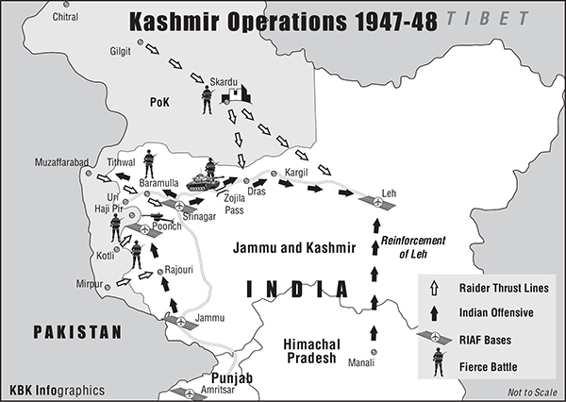
It was quite obvious that the sheer physical distance, terrain impediments and weather acted as critical barriers for the Intelligence Bureau. It, however, continued to oversee border management with meagre resources, and it is only in 1957 and beyond after the discovery of the Tibet–Sinkiang Highway that the army first suggested that it take over the entire defence of Ladakh9Ibid., p. 213–215. and set up posts in the area. Other than absolute strategic naivety and disdain with regards to the role and capabilities of India’s armed forces, there can be no other reason for keeping the Indian Army and Indian Air Force out of the area for so long. If aircraft like the Tempest fighters could actively participate in the battles of Zojila and Skardu in the 1947–48 conflict with Pakistan, it is mystifying why ten years later aircraft like the Canberra bomber, or Toofani and Mystere fighter jets were not deployed for regular photo and visual reconnaissance in the Ladakh and Aksai Chin region. Of course, though Srinagar by then was an established airbase, fighter operations were not permitted from there under the 1948 UN-sponsored ceasefire resolution over J&K between India and Pakistan. Had the Government of India been decisive enough, it could have overruled that clause citing national security imperatives with respect to China, and it is highly likely that China’s road construction would have been discovered much earlier. More than anything, it would have displayed some intent on the part of India. Instead, it was only in 1960 that the long-range Canberra bomber-cum-reconnaissance aircraft of 106 Squadron flew a few missions to try and investigate the extent of China’s build-up in Aksai Chin.
Mao’s role in the 1962 conflict with India was underplayed for years and the Chinese perspective was kept under wraps for long. It was only in the 1990s that a series of good writing from China emerged, revealing Mao’s impatience and irritation with Nehru’s growing influence in the developing world and India’s unwillingness to let go of Aksai Chin. Along the way, he also made some fundamental errors by wrongly assessing that after granting asylum to the Dalai Lama, India wanted to seize Tibet from China.10John Garver, ‘China’s Decision for War with India in 1962,’ in Robert S. Ross and Alastair Iain Johnston, ed., New Approaches to the Study of Chinese Foreign Policy (Stanford University Press, 2005). From a PDF extract of the chapter (p.4) taken from
The Gloves Come Off
After the Dalai Lama fled to India via Tawang in March 1959 and was given shelter by India, China was convinced of India’s role in stirring ferment in Tibet. Covert US operations from Sikkim in support of Tibetan Khampa rebels added fuel to the fire with China convinced that such operations could not have been launched without tacit support from the Indian state.12Ibid., p. 10–11. It then commenced aggressive patrolling, citing Indian forays into Aksai Chin and along the McMahon Line in NEFA as having forced its hand. The first armed incident of significant importance was reported at Longju on the NEFA border where India had set up a post right on the McMahon line and just south of the Tibetan village of Migyitun. Longju was conveniently placed on the Tsari river and allowed good visibility into Tibet. However, according to the Chinese, India had transgressed 2 miles north of the McMahon Line and the Chinese asked India to vacate the post. This face-off in August 1959 resulted in a small but fierce firefight between the PLA and the Indian Army. This can well be considered as the first serious encounter with ‘gloves off’ as a prelude to the 1962 war and Garver clearly places the blame on China for triggering this encounter.13Ibid., p. 32.
The Longju incident was soon followed in October of the same year by another fierce encounter in the Chang Chenmo Valley of the central Ladakh sector where an Indian paramilitary and Intelligence Bureau patrol led by Inspector Karam Singh, who had made earlier forays into the region, was en route to Lanak La to set up a post there. This pass was claimed by India as being the eastern extremity of the border in Aksai Chin. Without any real intelligence of the Chinese disposition in the area, the force was ambushed by a larger force near Kongka La, some 20 km short of Lanak La. In the ensuing firefight, nine Indian soldiers were killed and eleven personnel including Karam Singh were taken prisoner, with many suffering serious injuries.14R.D. Pradhan, Debacle to Revival: Y.B. Chavan as Defence Minister, 1962–65 (New Delhi: Orient Longman, 1999), p. 2. The Chinese are believed to have lost fewer soldiers as they attacked from a tactically advantageous position.15Neville Maxwell, India’s China War (London: Cape, 1970), p. 110. The prisoners were returned in November after a fierce protest from India, but not before being tortured extensively.
The diplomatic fallout of these two clashes in 1959 was an offer from China for both countries to fall back by 20 km in Ladakh and to attempt not to violate the McMahon line in the east. Except for the reinforcement of the Tawang garrison by a small force comprising a battalion of the Gorkhas under Lieutenant Colonel Eric Vas, the first regular Indian Army battalion to be deployed in the region replacing the Assam Rifles, which was a paramilitary force, there was a temporary lull in hostilities till mid-1961. While China grappled with the Khampa rebellion in eastern Tibet, India was preoccupied in its efforts to dislodge the Portuguese from Goa. Concurrently, Nehru met with Zhou Enlai on numerous occasions, trying to resolve the various boundary issues without any success. Why these diplomatic parleys were unsuccessful is well documented16For a detailed analysis of India–China diplomacy during those turbulent times, also see Ramachandra Guha, India after Gandhi (London: Pan Macmillan, 2007), p. 301–21. For a biased China-centric view see Neville Maxwell, India’s China War (London: Cape, 1970). For Nehru’s perspective on his attempts to diplomatically resolve the boundary impasse, see S. Gopal, ed., Selected Works of Jawaharlal Nehru, Vol. 14 (New Delhi: Orient Longman). and does not merit much attention here barring a few ‘realist’ deductions as understood by the author over five decades later. Some of these are highlighted below:
* The two encounters at Longju and Kongka La in 1959, the inability of India to gather international support to condemn the building of the highway through Aksai Chin, and the ruthless suppression of the Khampa rebellion despite covert CIA support, convinced Mao that he was in a position to dictate terms to India from a position of strength. This, without doubt, was a correct and realistic assessment from China’s point of view.
* India, on the other hand, was clearly unable to back its large territorial claims in Aksai Chin and the defence of the McMahon line with actionable intelligence and adequate military capability. Instead, a delusionary and distinctly leftist influence on the political leadership led it to believe that China was neither interested nor capable of contesting any forward posturing by the Indian Army in Ladakh and NEFA. That the military leadership failed to effectively contest this strategic misconception was a reflection of its indecisiveness and tentativeness with regards to higher defence strategy.
The Forward Policy
Pushed into a corner by China and faced with an election in a couple of years, Nehru had no other option but to harden his stance vis-à-vis China without the wherewithal to convert it into any tangible strategic game plan. The inexperienced and strategically naive political opposition within India too played its part in allowing the situation to deteriorate by badgering Nehru and accusing him of cowing down to Chinese bullying. They demanded, without realizing the skewed military balance between the two countries, that ‘not an inch of Indian territory must be bartered with the Chinese’. Not one mainstream political party other than the communists suggested a negotiated settlement with China, albeit from a position of slight weakness. With the pressure building and in the absence of any let-up in Chinese incursions and military build-up, Nehru had to come up with some security policy to combat China. The Forward Policy was a result of this relentless pressure on the Indian government, both from the Chinese as well as the domestic constituents comprising the opposition parties, media and the public at large.
After the farcical resignation episode of India’s chief of army staff, General Thimayya, in March 1960 following a bitter feud with the defence minister, and his subsequent retirement,17For a detailed general review of Thimayya’s resignation drama, see C.B. Khanduri, Thimayya: An Amazing Life (New Delhi, KW Publishers, 2006), p. 282–95. The episode reveals the deep and debilitating schisms that existed within the politico-military interface of the time because of the dominating and condescending approach of Defence Minister V.K. Krishna Menon towards senior military leadership. the appointment of Lieutenant General B.M. Kaul as the chief of general staff saw the Forward Policy gaining momentum through the summer of 1961 and spring of 1962.18Ibid. This translated into over sixty posts being established in Ladakh and NEFA – many of them being within territory claimed by China and ‘behind enemy lines’ in Ladakh. In NEFA, however, some of these posts were extremely close to the McMahon Line despite the agreement after the 1959 clashes that both countries would withdraw 20 km from their last positions. Particularly irksome for the Chinese was Indian posturing in the Namka Chu Valley of NEFA, and the forays by Indian patrols into the Chip Chap Valley and Galwan Valley of Ladakh. While the former would be a flashpoint in October 1962, the latter would result in serious conflagrations in Ladakh.
From a military and operational perspective, the Forward Policy was a poorly conceived and politically driven military posture with almost no coercive potential against a much stronger adversary. How the Indian Army went along with Nehru and Krishna Menon, the mercurial and acerbic defence minister, is a story by itself.19For a detailed analysis of the Forward Policy, see Major General D.K. Palit (retd), War in the High Himalayas: The Indian Army in Crisis (New Delhi: Lancer, 1991), p. 90–100. Also see Major General Jagjit Singh, While the Memory Is Fresh (New Delhi: Lancer, 2006), p. 101–10. Crystallized into a policy directive in October 1961 and incrementally implemented right through the winter of 1961, it envisaged creation of small static enclaves of troop positions of a maximum of a platoon strength in no-man’s-land very close to where the Chinese were occupying similar positions, but in much larger strength. The strategy was tactically unsound and though field commanders like Lieutenant General Daulat Singh, the commander of the Western Army Command, and Lieutenant General Umrao Singh, the top field commander in the east, expressed serious apprehensions about sustaining such a policy, they fell in line once the chief insisted on implementing the directive.20The Indian Army’s operational dissent to the Forward Policy is well chronicled by Neville Maxwell, India’s China War (London: Cape, 1970), p. 199–205. Instead of coercing or deterring the Chinese, it provoked them into responding with brute force and strength. While the ‘nuts and bolts’ of the policy will be discussed in the next chapter, the Forward Policy was the final catalyst which catapulted the situation from one of posturing to application of force – a clear disaster for Indian statecraft.
In the absence of roads and railway lines in areas where troops had to be deployed, the Indian Air Force played a pivotal role in translating the Forward Policy into an operational deployment in both NEFA and Ladakh. Tezpur, Gauhati and Jorhat in the east were the main hubs from where loads were flown by IAF Dakotas and Packets to build up and sustain the garrisons at Khinzemane, Tawang, Sela and Bomdila. The loads were either dropped at dropping zones close to the garrisons, or off-loaded at Tezpur and transported by road and mules thereafter. By mid-1961, Chandigarh, Srinagar and Pathankot airfields became hubs21Dr P.B. Sinha and Colonel A.A. Athale, S.N. Prasad (chief editor), History of the Conflict with China, 1962 (New Delhi: Ministry of Defence, 1992), p. 343–46. from where the Forward Policy in Ladakh was supported. Even with airfields at Leh and airstrips at Kargil, Fukche, Daulat Beg Oldi and Chushul, numerous forward posts like the ones at Galwan Valley, Shyok Valley, Sirjap-Spangur (around Lake Pangang Tso), Khurnak Fort and Demchok22Air Chief Marshal P.C. Lal, My Years with the IAF (New Delhi: Lancer, 1986), p. 100–106. had to be sustained by airdropping of stores and ammunition at dropping zones. It is extremely surprising that there is no record of the IAF leadership at any time cautioning the government that such an arrangement of supporting the Forward Policy exclusively by air was fraught with danger and unsustainable in the long run.23The IAF and the Indian Army had calculated that to sustain the Forward Policy in the east a monthly airlift of 2,200, tons was the bare minimum required. Despite its best efforts the IAF could manage an average of only 1,200 tons a month. If one factors in the 25–30 per cent loss due to the small size of the dropping zones and narrow valleys, the airlift was woefully inadequate. See Dr P.B. Sinha and Colonel A.A. Athale, S.N. Prasad (chief editor), History of the Conflict with China, 1962 (New Delhi: Ministry of Defence, 1992), p. 353. Squadron Leader Baldev Raj Gulati (retd) was a young flying officer navigator flying Super Constellations, a four-engine jet that could carry eighty-five fully equipped troops. He clearly recollects after cross-checking from his logbook that from 3 October onwards, he flew in hundreds of raw recruits from the airfields of Halwara and Adampur (airbases close to the Punjab towns of Ludhiana and Jalandhar respectively) to Tezpur. After barely a week of training, these young recruits were sent to the eastern front when it was realized that IV Corps needed to be bolstered significantly if they were to put up any kind of fight and after the western army commander, Lieutenant General Daulat Singh, clearly indicated that he had no troops to spare from his kitty. Gulati reckons that approximately 3,000 (over two battalions worth) such raw recruits were inducted into the eastern war zone between 3 October and 21 November. They would prove to be fodder for the well-equipped PLA (People’s Liberation Army) troops when inducted into battle in Phase 2 of the conflict.24Interview with Squadron Leader Baldev Raj Gulati (retd) on 17 October 2014. A highly experienced navigator, Gulati remains till today a bitter man about India’s defeat in 1962 and retains vivid recollections of the conflict which he shares very willingly.
Convening a Central Military Commission meeting in late 1961, Mao compared India’s Forward Policy to a strategic move across the centre line in a game of chess. He remarked:
Their (India’s) continually pushing forward is like crossing the Chu Han boundary. What should we do? We can also set out a few pawns on our side of the river. If they don’t then cross over, that’s great. If they do cross, we’ll eat them up.25John Garver, ‘China’s Decision for War with India in 1962,’ in Robert S. Ross and Alastair Iain Johnston, ed., New Approaches to the Study of Chinese Foreign Policy (Stanford University Press, 2005), p. 35.
This was the signal for the PLA to abandon the agreement of 1959 and recommence their aggressive patrolling. In a chapter from a monograph brought out by the US Army War College on the PLA in 2003, Larry Wortzel argues that Mao likened India’s Forward Policy to can shi zheng ce, or a ‘nibbling policy’, and asked his border troops to secure China’s claim over Aksai Chin by weaving an interlocking pattern around Indian troops without seeking a fight unless provoked and fired upon.26Larry M. Wortzel, ‘Concentrating Forces and Audacious Action: PLA Lessons from the Sino-Indian War,’ in Laurie Burkitt, Andrew Scobell and Larry Wortzel, ed., The Lessons of History: The Chinese People’s Liberation Army at 75 (US Army War College Monograph, 2003), p. 336.As the crisis hurtled towards conflict, if one were to dissect Chinese pre-war strategy, it could be summarized as below:
Act first with definite and time-bound strategic goals; reach a position of physical strength; then negotiate and play diplomatic hard ball leaving enough bait for a weaker adversary to bite and finally act again, this time decisively.