Part IV: Across Borders
Ominous Signs
The PRC has a long history of using military force to maintain domestic stability, to guard its territorial integrity and to obstruct interference from great powers into its immediate neighbourhood. China’s changing attitude to the use of force has affected stability in Asia in important ways.1Jonathan Holstag, ‘China’s Rise and the Use of Force: A Historical and Geopolitical Perspective,’ Chapter 1, Adelphi Series, Vol. 50, No. 416, p. 19–28, available at
Military Balance On The Frontier
Except for war on the Korean Peninsula and continued anti-colonial conflict in Asia and Africa, the world at large was at peace in the 1950s, recovering from the catastrophe of WW II. As the Cold War emerged as the new global security challenge, countries like India and China were searching for a place in the comity of nations in divergent fashion. While India spoke the language of peace and friendship among developing nations and concentrated rather myopically on the security threat only from Pakistan, Chinese authoritarianism, expansionism and revisionist ambitions saw it build military power as a hedge against perceived and continued Anglo-American hegemony in Asia. It is this divergent approach which ultimately resulted in the inability of India to effectively respond militarily to China’s 1962 assault along the two fronts of Ladakh and what is today called Arunachal Pradesh, but in those days was called the North-East Frontier Agency or NEFA. Some commentators and historians have called the 1962 war a set of skirmishes and even downplayed the impact of the military defeat, but when you look at the fine print of forces ranged against each other towards the second phase of the conflict in November 1962, there were two undermanned Indian divisions in the east including complements of the paramilitary forces in the form of Assam Rifles, pitted against approximately five divisions of the PLA with some armour and significant artillery support – battle-tested, equipped and acclimatized for high-altitude operations after having been in Tibet and Aksai Chin for almost twelve years.2Larry M. Wortzel, ‘Concentrating Forces and Audacious Action: PLA Lessons from the Sino-Indian War,’ in Laurie Burkitt, Andrew Scobell and Larry Wortzel, ed., The Lessons of History: The Chinese People’s Liberation Army at 75 (US Army War College Monograph, 2003), p. 341.
As referred to in the earlier chapter, the Indian government continued to assign the Intelligence Bureau with the defence of the Ladakh–Tibet frontier including areas of Aksai Chin till 1959.3For a detailed rationale of why the IB was put in charge of the defence of eastern Ladakh, see B.N. Mullick, My Years with Nehru (Bombay: Allied Publishers, 1973). The essence of Mullick’s argument that it was sufficient to have stray patrols by IB teams in eastern Ladakh, rather than have the army deployed there in numbers, pointed at a Pakistan-centric threat analysis in Ladakh. Therefore, the army was asked to concentrate on western Ladakh (Kargil and Dras) and leave eastern Ladakh to the IB. Mullick completely overestimated the military potential of the IB! The NEFA border too was defended during the same period by stray posts of the Assam Rifles, a paramilitary force raised for the defence of NEFA; the regular Indian Army came in only in 1959. So convinced was Nehru of the potential of his 1954 Panchsheel Agreement to maintain peace and tranquillity along the Indo-Tibetan border and forge a close relationship with China that he chose to ignore Sardar Patel’s letter warning him of China’s hegemonic ambitions in the region. The only Indian Army brigade in the region after it was entrusted with the defence of Ladakh was 121 Brigade, which was located at Kargil, primarily to stave off any Pakistani incursions from the Gilgit and Skardu sectors after the experience of the 1947–48 conflict. This brigade was assigned the additional task of defensive operations in the entire Ladakh sector.4Major General S.V. Thapliyal (retd), ‘Battle for Eastern Ladakh: 1962 Sino-Indian Conflict,’ [http:// www.usiofindia.org/Article/?pubno=5608&ano=482#](http://www.usiofindia.org/Article/?pubno=5608&ano=482) (accessed on 10 August 2013). Nehru even ignored the cautionary advice of his army chief, General K.S. Thimayya,5C.B. Khanduri, Thimayya: An Amazing Life (New Delhi, KW Publishers, 2006), p. 233–38. to beef up military capability in Ladakh along the Indo-Tibetan border despite knowing that ‘Timmy’ had first-hand knowledge of Chinese military capability after his stint as commander of the UN peacekeeping force in Korea. During his stint there he had acquired a fair understanding of emerging Chinese strategic thought while interacting with many US commanders who had fought the Chinese during the Korean War. It is unfortunate that ‘Timmy’ fell out with his defence minister and resigned from his post as COAS in 1959, only to withdraw his resignation a few days later and retire honourably in March 1960.6Ibid., p. 296–97.
B.G. Verghese, a highly respected journalist and strategic commentator recollects that Timmy had recommended the name of Lieutenant General S.P.P. Thorat to the government as his successor, but the Nehru–Krishna Menon combine were said to be uncomfortable with the prospect of an aggressive Maratha taking charge of the Indian Army and influencing their China strategy.7B.G. Verghese, ‘50 Years After 1962: A Personal Memoir,’ from a presentation delivered at the India International Centre, Subbu Forum, SPS Round Table on ‘50 Years after 1962: Recall and Review’ on 6 September 2012, available at southasiamonitor.org/detail.php?type=yearsafter&nid=3844 (accessed 28 November 2014). They instead appointed a milder and more acceptable General P. N. Thapar, who was not considered much of a strategist, as the army chief.8Also see Dr P.B. Sinha and Colonel A.A. Athale, S.N. Prasad (chief editor), History of the Conflict with China, 1962 (New Delhi: Ministry of Defence, 1992), p. xxii. Menon and his aggressive and politically well-connected chief of general staff, Lieutenant General B.M. Kaul, then enforced the Forward Policy on an ill-prepared Indian Army. To be fair to the Indian Army, a number of field commanders like Lieutenant General Umrao Singh, the GOC of 33 Corps in charge of the NEFA region,9Major General D.K. Palit (retd), War in the High Himalayas: The Indian Army in Crisis (New Delhi: Lancer, 1991), p. 179. Also see p. 247–55. and Lieutenant General Daulat Singh, the GOC-in-C of Western Army Command, did express their dismay at the operationally unviable policy, but they were overruled by Delhi. In the absence of an army chief who could take a strong stand based on a military appreciation of the difficulties of executing a flawed strategy, a plan that was drawn up in the comfortable environs of Delhi was forced down the throat of protesting field commanders.
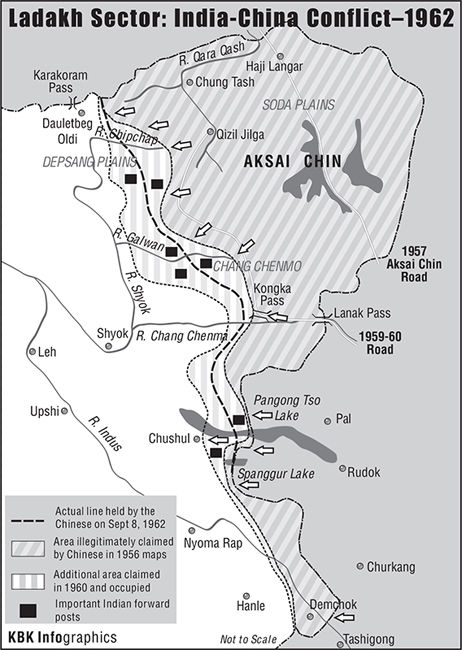
What does it take to put together a viable defensive line in high- altitude terrain? Dominating ground, adequate integral firepower, mutual cross-cover with adjoining defensive positions, location in areas that are covered by artillery support from the rear, and, most importantly, a robust logistic network and secure communication lines that facilitate recycling of troops. Replenishment of ammunition and other material are essentials that cannot be ignored. In case the terrain and force ratios do not support a defensive line right on the frontiers, a defensive deployment in depth that relies on channelizing the enemy into killing grounds is the next best option. All these tenets of defensive deployment in the mountains were ignored when the Indian Army was deployed in section- and platoon-sized pockets (10 to 40 troops) as they were in the Daulat Beg Oldi complex, Chip Chap Valley, Galwan Valley, and Sirjap complex on the north bank of the Pangang Tso in the Chushul sector of Ladakh.10For a complete deployment in the Ladakh sector, see Major General S.V. Thapliyal, ‘Battle of Eastern Ladakh: 1962 Sino-Indian Conflict’ at
After the military situation started deteriorating in 1959, the entire Ladakh sector including the 85,000 sq. km of Aksai Chin and the 1,600- km-long LAC was reinforced in March–April 1960 by an undermanned 114 brigade, commanded by Brigadier T.N. Raina,12Major General S.V. Thapliyal, ‘Battle of Eastern Ladakh: 1962 Sino-Indian Conflict’ at
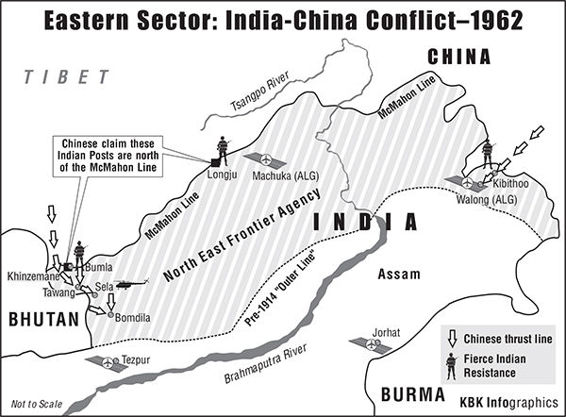
The troop disposition in the east was no better in terms of both tactical deployment and numerical strength. Serious reservations were expressed by both the corps commander of 33 Corps, the corps entrusted with the defence of NEFA, Lieutenant General Umrao Singh, and the brigade commander of 7 Infantry Brigade, Brigadier J.P. Dalvi, about the vulnerability of a forward deployment right on the McMahon Line in the Tawang sector. Yet, Army HQ insisted that 7 Brigade with its four battalions deploy along and around the Namka Chu. Part of the Indian Army’s battle-tested 4th Division, the broad task of the brigade was to eject a Chinese division off the Thagla Ridge, amongst other places, and secure the McMahon Line. How on earth a brigade was to throw a division out was not clearly spelt out. Of course, there was no intelligence about enemy dispositions!
Further east, the entire Lohit Forward Division sector of NEFA with a frontage of approximately 150 km was defended by a mere battalion of the Indian Army, complemented by a platoon of paramilitary forces (Assam Rifles). These forces were concentrated at the trijunction of India-Burma and Tibet and strung out in pockets over a distance of 10–20 km with virtually no mutual cover and sustained support from the air by the Indian Air Force.16Brigadier J.P. Dalvi, Himalayan Blunder (Dehradun: Natraj Publishers, 1969). Ranged against them in mid-October 1962 were almost two Chinese regiments17A PLA regiment was equivalent to an Indian Army brigade in terms of combat potential. with artillery and logistics support. The dragon clearly held the upper hand as the autumn of 1962 turned ominous for India’s rather naive politico-military leadership.
The Air Situation
In the skies, the Indian Air Force (IAF) was qualitatively superior to the People’s Liberation Army Air Force (PLAAF) in terms of all aircraft (fighters, transport and helicopters) that could be employed effectively both in Ladakh and NEFA. Its pilots were considerably more skilled than their PLAAF adversaries as a result of stringent training patterns that still had the RAF stamp on it.18Interview with Air Marshal Vinod Patney on 2 June 2013. The air marshal was a young flying officer and posted at Tezpur during the conflict. A number of senior pilots in middle-level leadership appointments like flight commanders and commanding officers had seen action in the 1947–48 war against Pakistan. However, to be fair to the PLAAF, its fighter pilots too had seen action over the Korean Peninsula in the mid-1950s with some success. Even in terms of transport and helicopter support to army operations, the balance was in favour of India – this would go on to play a significant role in supporting the Forward Policy and providing casualty evacuation in hostile battle conditions as the conflict progressed. Unsung and Unheard: The IAF in the 1962 Conflict with China is a well-researched book by an IAF stalwart, Air Marshal Bharat Kumar (retd), which highlights the exploits of the IAF during the conflict.19Air Marshal Bharat Kumar, Unknown and Unsung: Indian Air Force in Sino-Indian War of 1962 (New Delhi: KW Publishers, 2013). The title of the book pretty much sums up how the IAF was seen to have contributed to the conflict. Why offensive air power was not used despite the clear superiority of the IAF and the availability of bases and aircraft that had the radius of action to operate in the areas of operation is a question that has perplexed many till now. Tezpur, Chabua and Jorhat in the east, and Adampur and Ambala in the west were airfields which were ready for operations. Had the situation demanded, Srinagar airbase could have been activated for fighter operations after overruling the UN restrictions that had been placed after the 1948 UN-brokered ceasefire following the first India–Pakistan war over Kashmir. The reasons for not exploiting the IAF have stirred a widespread debate20See R. Sukumaran, ‘The 1962 India-China War and Kargil 1999: Restrictions on the Use of Air Power,’ Strategic Analysis, Vol. 27, No. 3 (July–September 2003): p. 332–55. Also see Arjun Subramaniam, ‘Clearing the Air,’ The Indian Express, New Delhi, 21 October 2012, p. 2. and have been widely criticized as a strategic blunder.
For now let us merely take a look at the availability of aircraft for operational exploitation on both sides and the early attempts by the IAF to provide some inputs regarding the Chinese build-up, particularly in Aksai Chin. The first comprehensive aerial reconnaissance mission in the region was undertaken by Canberra fighter-bomber-reconnaissance aircraft of No. 106 Squadron as late as on 14 December 1959,21Air Marshal Bharat Kumar, Unknown and Unsung: Indian Air Force in Sino-Indian War of 1962 (New Delhi: KW Publishers, 2013), p. 39. nearly two years after it came to be known to the Indian government that China had built a road through Aksai Chin. Routing via Daulat Beg Oldi and braving bad weather, the single aircraft mission brought back clear pictures of the Tibet–Xinjiang highway, which were seen with great interest by the PM himself. Surprisingly, no mention of any significant military build-up towards the west was made and it could be conjectured that either bad weather prevented it or the aircrew were not briefed to look for any other target systems in the absence of any hard intelligence. In a telephonic conversation with ninety-two-year-old Air Marshal Randhir Singh, who was commanding 106 Squadron during the tumultuous period of 1959–62, he revealed to the author that he and his flight commander, Squadron Leader Nath, carried out a number of intrusive missions into Aksai Chin and across the McMahon Line in NEFA, bringing back valuable information about troop deployments and the build-up of forces. Sadly, not much of the information was taken seriously by the powers that be.22Telephonic conversation with Air Marshal Randhir Singh in October 2014. He revealed during that interview that he was asked to assume command of 106 Squadron after it had one aircraft shot down over Pakistan in 1959 during a clandestine intrusive mission. Air Marshal Raghavendran, who retired as the vice chief of the IAF in 1988, was at the time on the operational staff of Operational Command, which later became Western Air Command. He recollects in his book that Squadron Leader Jaggi Nath, a close friend of his and ‘the bravest of the brave Canberra pilots’,23Air Marshal S. Raghavendran, Panther Red One (New Delhi: KW Publishers, 2013), p. 141. brought back highly incriminatory photographs of thousands of Chinese troops, fortifications and vehicles in the open. While the Chinese protested at these intrusive missions, India continued to vehemently deny these instead of placing the photographic evidence before the Chinese, or even releasing it to the international media to highlight China’s expansionist designs.24Ibid., p. 187.
After the clashes at Kongka La and Longju in 1959 and the subsequent ceasefire, there was a strange disconnect between the ground and air situation. While the Indian Army was asked to continue to establish posts in disputed territory as a means of outflanking Chinese positions, the IAF was restricted from flying fighter and recce missions within 15 miles of the disputed border till December 1961. Even when there were clear signs of a Chinese military build-up, there were no attempts to coerce the Chinese with fighter reconnaissance sorties. It had become too late to reverse the policy paralysis which had crept into the Indian government with regards to its ability to call China’s bluff with the ill-fated Forward Policy.
With over twenty-two combat squadrons and around 500 aircraft available, the IAF in mid-1962 comprised the relatively modern Hunter Mk-56 fighter-bomber aircraft and Gnat interceptor aircraft, older but still potent French-built ground attack aircraft like the Mystere and Toofani, Canberra bomber-reconnaissance jets, and the venerable Vampire trainer-cum-ground-attack jet.25Ibid., p. 83–84. Also see R. Sukumaran, ‘The 1962 India-China War and Kargil 1999: Restrictions on the Use of Air Power,’ Strategic Analysis, Vol. 27, No. 3 (July–September 2003): p. 333. Also see S.N. Prasad, ed., History of the Conflict with China, 1962 (New Delhi: Ministry of Defence, 1992), p. 356–57. Of these, a total of approximately two squadrons each of Toofani and Vampire jets and a detachment of Canberra aircraft were spread amongst the airfields of Tezpur, Chabua and Bagdogra and would have been available for operations in the NEFA sector.26A detachment of Canberra reconnaissance and bomber aircraft from Agra was moved to Tezpur and worked in close liaison with HQ 4 Corps. Also see Air Marshal Bharat Kumar, Unknown and Unsung: Indian Air Force in Sino-Indian War of 1962 (New Delhi: KW Publishers, 2013), IAF deployment map, p. 95. Approximately fifteen combat squadrons including the Hunter Mk-56 were available in northern India at the airfields of Agra, Palam, Adampur, Ambala and Halwara.27Ibid. The remainder of the squadrons were deployed at Pune and Kalaikunda. The IAF deployment clearly indicated a Pakistan-centric deployment, and no major changes barring a few detachments were made even after the conflict started. Air Marshal Vinod Patney, the Indian Air Force’s most highly decorated airman, and among its cerebral and operationally proficient commanders, was posted to a Toofani squadron (29 Squadron) at Tezpur during the 1962 conflict. He recollects being quite familiar with the valleys of NEFA where they would regularly train for close air support (CAS) and interdiction missions. He recollects that joint structures for CAS with 33 Corps were in place in the form of a tactical air centre (TAC) with forward air controllers. While he agrees that effective CAS may have been a difficult proposition once the forces were engaged in a close-contact battle, particularly in the narrow valleys of Namka Chu and Tawang, he maintains that the IAF could have created havoc among the massed Chinese troop concentrations and logistics lines on the Tibetan side north of the Thagla Ridge. This, he added was because the terrain on that side was devoid of the dense vegetation that marked the Indian side of the McMahon Line.28Interview with Air Marshal Patney on 2 June 2013. He reiterated that the terrain in Ladakh was ideal for both CAS and interdiction and that the relatively modern IAF Hunters could have provided effective CAS with the Canberra bombers chipping in with interdiction missions. He also added that the older Toofanis and Mysteres with external tanks fitted could also have provided offensive air support from airfields like Adampur, Ambala and Halwara.29Ibid.
Ranged against a professionally well-trained IAF fighter force, the offensive element of the PLAAF was a numerically superior force of obsolete platforms like the MiG-15/17, MiG-19 and medium-range IL-28 bombers, most of which were deployed against Taiwan. In the absence of any sound operational assessment of the PLAAF by the IAF,30An operational assessment from Air HQ sounded extreme caution with regard to close air support (CAS) in NEFA. However, it is surprising that the same report does not mention that CAS in Ladakh could be a worthwhile proposition. Also see R. Sukumaran, ‘The 1962 India-China War and Kargil 1999: Restrictions on the Use of Air Power,’ Strategic Analysis, Vol. 27, No. 3 (July–September 2003): p. 337. the Government of India relied on inputs from the IB to calibrate its decision whether or not to use offensive air power against China. Contrary to IB reports, which indicated that the PLAAF had acquired the MiG-21, considered at that time to be amongst the most sophisticated fighters in the world, Wing Commander Asher Lee, a British air power analyst, reported in 1963 that this was grossly incorrect.31Asher Lee, The Russian and Chinese Air Forces, Brasseys Annual – The Armed Forces Yearbook (London: William Clowes and Sons, 1963), p. 97–99. Also see R. Sukumaran, ‘The 1962 India-China War and Kargil 1999: Restrictions on the Use of Air Power,’ Strategic Analysis, Vol. 27, No. 3 (July–September 2003): p. 335–336. The IB also went on to caution the Government of India that the use of offensive air power may result in the PLAAF attacking Indian cities like Calcutta and the danger of India not being able to occupy the ‘moral high ground’ in case of a protracted conflict. No cognizance was taken of the fact that PLAAF aircraft could reach targets in India only if they operated from airfields in Tibet with the high altitudes imposing severe restrictions on their weapon-carrying capacity.32Most of the twenty-odd airfields in Tibet were at altitudes of above 3,500 m, with some as high as 4,500 m. On the other hand, IAF fighters would have had the advantage of operating with full weapon loads from airfields in the plains of Assam and Punjab. The IAF leadership was completely left out of the decision-making loop and, except for being asked for one rather tepid operational assessment, Nehru and Krishna Menon decided to go with the defensive assessment of Blackett (see Chapter 7).33Also see Air Vice Marshal A.K. Tiwary, ‘No Use of Air Power in 1962,’ Indian Defence Review, Vol. 21, No. 3 (July–September 2006), available at
As it turned out to be, the helicopter and transport aircrew of the IAF turned out to be the heroes of the 1962 war. Even with modern aircraft and state-of-the-art avionics and navigation aids, the weather and terrain in the Ladakh and Arunachal sectors still pose tremendous operational challenges to the IAF. Imagine the challenges in 1962! The IAF’s transport fleet had accredited itself superbly in the 1947–48 conflict with Pakistan, particularly in the sustenance of the Poonch garrison and the relief of Leh. In the years that followed, this capability was sustained as the Leh and Kargil garrisons had to be supported in the winter months by air. However, air activity in NEFA was restricted as there was not much requirement for air maintenance till the Forward Policy came into being. When the crisis snowballed in September 1962, the IAF had ten squadrons of operational transport aircraft divided almost equally between the Western and Eastern Sectors with a number of detachments operating in the east to support the Forward Policy in NEFA. Of the 200-plus aircraft, the mainstays were still the evergreen Dakota (2 ton payload) and the recently acquired C-119 G Packet aircraft (6 ton payload), few of which were modified with a jet pack to support high-altitude operations in 1961.34Air Marshal Bharat Kumar, Unknown and Unsung: Indian Air Force in Sino-Indian War of 1962 (New Delhi: KW Publishers, 2013), p. 103–10. Complementing these war-horses was a squadron of the newly acquired An-12 (10 to 12 ton payload), two squadrons of DH-3C Otter light transport aircraft, which were used for operations from remote airstrips like Walong in NEFA and in narrow valleys. A few Super Constellation aircraft were available for VIP, communication and troop-carrying duties. All these aircraft would perform well beyond expectations during the conflict. The PLAAF transport aircraft fleet was reasonably large and known to have extensively supported the Chinese invasion of Tibet in 1950–52.35Ibid. However, according to British intelligence and American reports, it numbered only around 200 usable aircraft in 1962, comprising a mix of ageing Soviet platforms like the An-2 and IL-12/14/18. Unlike India, China rightly realized that the only way of sustaining operations in Ladakh, Aksai Chin and Tibet was by creating a network of roads, tracks and railway lines, and not relying on air maintenance. This was to prove decisive in the long run.
While China hardly had any helicopters worth mentioning, the IAF had built up a fairly diverse mix of helicopters to support operations in jungle and high-altitude terrain. The fifty-odd helicopters comprised Russian built Mi-4s, which were inducted between 1961 and 1962, and the older American Bell 47G-3, and S-55s.36Ibid., p. 130–33. While 107 Helicopter Unit (HU) with Mi-4s was the sole unit in Ladakh, 105 and 110 HUs supported the Tawang and Walong Sectors in the east.37Dr P.B. Sinha and Colonel A.A. Athale, S.N. Prasad (chief editor), History of the Conflict with China, 1962 (New Delhi: Ministry of Defence, 1992), p. 353–55. Aircrew proficiency was high and the rotary wing fleet took on the onerous responsibility of sustaining the number of forward picquets in NEFA and Ladakh in the absence of roads and tracks. They were, as one young company commander mentioned, ‘angels from the sky’. Their exploits would unfold as the defensive battle in both sectors turned into fragmented retreats. The helicopter boys of the IAF would fly tirelessly through the war as they carried out hundreds of casualty evacuation missions and even searched for stragglers as they retreated through the jungles of Bhutan.
Sparring And Probing
As a military historian I have always wondered how the Indian armed forces, with all their battle experience of the preceding decades, allowed themselves to be caught in a state of virtual stupor when the final assault came. Many questions come rushing to my mind. Where was the intelligence regarding the gradual build-up of forces in Tibet and Aksai Chin? Did the Indian Army not realize what the preponderance of artillery resources meant in terms of the psychological shock it could create amongst its widely dispersed platoon- and company-sized localities, many of which were surrounded by Chinese positions? Why was the IAF leadership diffident about its own offensive capability, and why did it not confidently push to interdict the enemy as it built up forces in Tibet? Many distinguished soldiers and airmen have attempted to answer these questions and many more will try and do the same with the detached and dispassionate countenance of a modern-day military historian.
As diplomatic attempts to resolve the crisis faded in 1962, the Government of India continued with its ill-fated policy of pushing forward towards the McMahon Line in the east and into north-eastern Ladakh. It believed, rather naively, that China’s military build-up was mere coercion and that their bluff could be called. Nothing was further from the truth if China’s operational discourse of the time is to be believed.
In an objective and well-researched chapter written in a book published in 2005 by the Stanford University Press, New Approaches to the Study of Chinese Foreign Policy, written by Robert S. Ross and Alastair Iain Johnston, John Garver has rightly identified three events of 1962 that marked the end of diplomacy and the beginning of serious military action from a Chinese perspective. The first was a meeting at Geneva between the Indian defence minister, V.K. Krishna Menon, and Marshal Chen Yi, China’s foreign minister and one of its most distinguished generals. While Krishna Menon’s disdain for the military had become common knowledge, his condescending brushing off of Chen Yi when the latter asked as to what India was doing about the border problem convinced Marshal Chen that India was scrapping for a fight. Chen thereafter convinced Premier Zhou Enlai, the main interlocutor in the border talks with India, that Chairman Mao must be apprised about the deteriorating situation and India’s stand. Irritated with India’s granting asylum to the Dalai Lama and his huge entourage of almost 1,00,000 refugees,38B.G. Verghese, ‘50 Years After 1962: A Personal Memoir,’ from a presentation delivered at the India International Centre, Subbu Forum, SPS Round Table on ‘50 Years after 1962: Recall and Review’ on 6 September 2012, available at southasiamonitor.org/detail.php?type=yearsafter&nid=3844 (accessed 28 November 2014). and frustrated with not being able to make any diplomatic headway on Aksai Chin, it is widely believed that Mao took the decision to go to war some time in late July 1962. What he also did was to lay down a set of restrictive Rules of Engagement (ROE), which he believed would still give India a long rope and realize the folly of going to war.39John Garver, ‘China’s Decision for War with India in 1962,’ in Robert S. Ross and Alastair Iain Johnston, ed., New Approaches to the Study of Chinese Foreign Policy (Stanford University Press, 2005).
The second incident was an ambitious and successful attempt by a hardy Indian Army platoon from 1/8 Gorkha Regiment to advance down the Galwan Valley of Ladakh in July 1962 and outflank the Chinese position at the head of the valley and isolate it from the important Chinese post of Samzungling.40Major General D.K. Palit (retd), War in the High Himalayas: The Indian Army in Crisis (New Delhi: Lancer, 1991), p. 178. This operation was supported and maintained by IAF helicopters for over two months despite the Gorkha platoon being surrounded by a Chinese battalion (nine platoons). The Gorkhas were audaciously replaced by two platoons of 5 Jat Regiment in another helicopter lift in early October.41Lieutenant Colonel Gautam Sharma, Valour and Sacrifice: Famous Regiments of the Indian Army (New Delhi: Allied Publishers, 1990), p. 170–71. Both the Jat platoons were subsequently wiped out during the initial assault on 20 October.
In September 1962, the third incident that is said to have precipitated the final Chinese assault was a face-off below the Thagla Ridge in the Tawang sector of NEFA at an unviable post, the Dhola Post, on the south bank of the Namka Chu. Manned since June that year by a platoon of poorly equipped Assam Rifles despite objections from China paramilitary was surrounded by over 1,000 Chinese troops in mid-September as a demonstration of their willingness to use force to evict a small Indian force from what they considered as disputed territory.42For a detailed analysis of the Namka Chu battle see Major General P.J.S. Sandhu (retd), ‘1962 – The Battle of Namka Chu and the Fall of Tawang (A View from the Other Side of the Hill)’, USI Journal, New Delhi (April–June 2013): p. 271–89. In response, a poorly stocked and undermanned Indian brigade (7 Brigade under Brigadier J.P. Dalvi) was moved to occupy loosely strung out, underprepared and tactically untenable positions along the Namka Chu. Thagla Ridge was located to the north of the watershed and was publicly declared by the Government of India as the de facto northern limit of the McMahon Line as against the Chinese claim that the boundary lay along the Namka Chu. Seeing that the Chinese had occupied the ridge in strength the Indian Army was asked to launch Operation Leghorn to evict them from the ridge. Despite stiff opposition to the idea that the Namka Chu rivulet be the forward line of defence and launch pad for an offensive on the Thagla ridge from Umrao Singh, the GOC of 33 Corps, New Delhi insisted that he move a brigade forward.43Neville Maxwell, India’s China War (London: Cape, 1970), p. 303–09. Umrao, who wanted his defences to be concentrated around Tawang, reluctantly ordered 7 Brigade to march on foot to the Namka Chu. Led by 9 Punjab Regiment, this move finally convinced the Chinese that war was inevitable.
Speaking to his top commanders on 6 October 1962, Mao is reported to have said confidently and rather contemptuously when he referred to Nehru:
We fought a war with old Chiang. We fought a war with Japan and with America. With none of these did we fear. And in each case, we won. Now the Indians want to fight a war with us. Naturally we don’t have fear. Since Nehru sticks his head out and insists on us fighting him, for us not to fight him would not be friendly enough. Courtesy emphasizes reciprocity.44John Garver, ‘China’s Decision for War with India in 1962,’ in Robert S. Ross and Alastair Iain Johnston, ed., New Approaches to the Study of Chinese Foreign Policy (Stanford University Press, 2005), p. 48.
In a subsequent meeting with his top political and military leadership that reflected a surprisingly participative and inclusive style of decision making, Mao said:
If we fight, what should be our method? What should the war look like? Please everyone contribute your thoughts on these policy issues.45Ibid., p. 49.
Unfortunately, no such operational brainstorming took place on the Indian side with Nehru and Krishna Menon deciding military strategy with Kaul acting as their hatchet man. This broadly summed up the operational scenario in mid-October with the Chinese rapidly building up a division to overrun an undermanned and tired 7 Brigade.
SHOCK AND DESPAIR: THE INITIAL ASSAULT
Collapse in the East
While India insists that the initial Chinese move from the Thagla Ridge towards the Namka Chu forced India to move north of the Namka Chu and occupy defensive positions,46Major General D.K. Palit (retd), War in the High Himalayas: The Indian Army in Crisis (New Delhi: Lancer, 1991), p. 224–25. Chinese claims point at an Indian offensive that precipitated the outbreak of preliminary hostilities on 9 and 10 October.47John Garver, ‘China’s Decision for War with India in 1962,’ in Robert S. Ross and Alastair Iain Johnston, ed., New Approaches to the Study of Chinese Foreign Policy (Stanford University Press, 2005), p. 55. The bottom line was that after a smaller Indian force of approximately 50–60 troops from 9 Punjab were bested in an intense firefight by over 1,000 Chinese troops in early October 1962 as they attempted to outflank Chinese positions by trying to dominate a few heights around Thagla Ridge,48Neville Maxwell, India’s China War (London: Cape, 1970), p. 335–40. the Chinese realized that despite the excellent performance of the Indian troops in this battle, they held both the tactical and numerical advantage. This convinced them that the time was ripe to achieve their initial operational objective – the capture of Tawang and annihilation of India’s forward defences before more defences sprang up.
Despite reports now that the Chinese had built up almost two divisions opposite the Tawang sector and that it would be prudent to pull back the Namka Chu forces to Tawang, there was complete paralysis between 11 and 20 October. The last straw was when Lieutenant General Kaul, the corps commander, was evacuated to Delhi on 17 October after suffering a bout of high-altitude sickness. He was replaced overnight as corps commander by a battle-hardened Lieutenant General Harbaksh Singh, but it was too late to change the ground situation in the face of a rapid Chinese build-up opposite most defensive positions. Seeing that Indian forces were holding firm at over four positions along the Namka Chu, hell broke loose on 20 October as all positions of 7 Brigade were subjected to a relentless artillery barrage by a combination of 82 mm and 120 mm mortars, and 75 mm recoilless guns49Major General P.J.S. Sandhu (retd), ‘1962 – The Battle of Namka Chu and the Fall of Tawang (A View from the Other Side of the Hill)’, USI Journal, New Delhi (April–June 2013): p. 283. before the infantry assault as part of China’s ‘self-defensive counter-attack’.50Zhou Enlai at an expanded Politburo meeting on 18 October. See John Garver, ‘China’s Decision for War with India in 1962,’ in Robert S. Ross and Alastair Iain Johnston, ed., New Approaches to the Study of Chinese Foreign Policy (Stanford University Press, 2005), p. 59. This was possible because all Indian posts had been accurately registered51Registering is a military term that denotes the process of attempting to exactly ascertain the coordinates of a tactical location by firing a few artillery rounds, and then validating the accuracy with visual confirmation, either from a vantage location on ground, or from an aerial reconnaissance platform like a helicopter. by the Chinese during the preceding days. In response, 7 Brigade had just one troop (four guns) of 4.2" mortars and three 75 mm field guns, which had been hastily airdropped with barely 200 rounds of ammunition to equip a recently inducted 17 Para Field Regiment.52See Major J.S. Rathore (retd), ‘Memoirs of a Prisoner of War: Sino Indian War of 1962,’ USI Journal (January–March 2014): p. 128–29. The officer was part of 17 Para Field Regiment who was captured during the battle of Namku Chu and remained a prisoner for over nineteen months. Two of the four battalions of 7 Brigade (2 Rajput and 1/9 Gorkha) were decimated within hours of the attack. Contrary to widespread reports, 7 Brigade did not just fold up – both the Rajputs and Gorkhas fought heroically before being overwhelmed by vastly superior forces.53Lieutenant Colonel Gautam Sharma, Valour and Sacrifice: Famous Regiments of the Indian Army (New Delhi: Allied Publishers, 1990), p. 142–43.
When a battalion loses four officers, seven JCOs and 266 men in fighting within a few hours, when eighty-one are wounded and 171 are taken prisoner in close-quarter fighting,54Ibid. you cannot say ‘why didn’t the battalion fight to the last man and last round’ – that is sheer ignorance of battle. I have gone through the unit histories of some of the battalions that formed part of 7 Brigade – they fought well and followed orders. It is just that the situation overwhelmed them! The other two battalions of the brigade (4 Grenadiers and 9 Punjab) too suffered heavy casualties, but managed to initially withdraw southwards to reinforce Tawang following an inexplicable hesitation on the part of the opposing Chinese commander to press home with his attack.55Major General P.J.S. Sandhu (retd), ‘1962 – The Battle of Namka Chu and the Fall of Tawang (A View from the Other Side of the Hill)’, USI Journal, New Delhi (April–June 2013): p. 283. However, when Chinese forces managed to outflank them and sped towards Tawang, these battalions were forced to head westwards into Bhutan, effectively keeping them out of the battle.56Major General D.K. Palit (retd), War in the High Himalayas: The Indian Army in Crisis (New Delhi: Lancer, 1991), p. 242. With winter having set in, these units suffered heavy casualties along the way. Brigadier Dalvi and over 200 personnel of the brigade had to suffer the ignominy of being POWs. Within a span of twelve hours, the Chinese had crashed through India’s forward defences and were poised to capture Zimithang and Tawang.57For a detailed and poignant defence of 7 Brigade’s performance in the battle of Namka Chu, see Brigadier J.P. Dalvi, Himalayan Blunder (Dehradun: Natraj Publishers, 1969). Major portions of the book were written by Brigadier Dalvi during his six months as a POW after his brigade was run over by a massive Chinese assault on 20 October 1962.
By 22 October Chinese forces had advanced along two axes from the Namka Chu area towards Tawang with a division leading and another in reserve. Unlike the speedy capitulation of the Namka Chu defences, the Chinese faced stiff resistance on the third axis that they had opened through Bumla Pass. Subedar Joginder Singh of the battle-hardened 1 Sikh Regiment was commanding a platoon well ahead of Tawang on the approach from Bumla Pass, which was defended by just a section of Assam Rifles. It was only a matter of time before the post was overwhelmed and Subedar Joginder’s platoon soon came under fire from an entire Chinese brigade. Fortuitously, Joginder had some artillery support and held off the attack for over eight hours, inflicting heavy casualties on the enemy – the Chinese lost over 300 troops in this action before overwhelming the Sikh platoon. Subedar Joginder Singh would live to tell his story and go on to be awarded the only Param Vir Chakra on the Eastern Front – such was the ferocity of his rearguard action ahead of Tawang.58Mandeep Singh Bajwa, ‘The Hero of Battle of IB Ridge,’ Hindustan Times, Chandigarh, 23 October 2012, available at
Realizing that the defence of Tawang was untenable, Major General Niranjan Prasad, the GOC of 4 Division, suggested that all forces withdraw to Bomdila for a rearguard stand; he was overruled and asked to prepare defences at Sela to stop the Chinese advance midway between Tawang and Bomdila. Tawang was vacated on 23 October and fell to the Chinese the next day. The Chinese halted their offensive on 25 October and offered a ceasefire and withdrawal to 20 km from the LAC. This was rejected by India purely due to political compulsions.59An aggressive right-wing opposition with scanty knowledge of the operational situation on ground did not leave any political space for Nehru to negotiate with China after the humiliating experiences of the first few days of the war. Instead, he continued to harp on ‘throwing the Chinese out’. It was clear that political wisdom and sagacity was replaced by nationalistic warmongering. The disaster at Tawang resulted in the removal of Krishna Menon60Air Chief Marshal P.C. Lal, My Years with the IAF (New Delhi: Lancer, 1986), p. 95. and widespread leadership changes at the operational level.
While the main battle in Kameng revolved around Tawang, the Chinese launched a subsidiary thrust on 22 October in the Walong sector, which lay close to the trijunction of India, Burma and China. In response to repeated incursions into the Lohit Valley by Chinese patrols, the lone Assam Rifles platoon was reinforced in March 1962 by a battalion from 6 Kumaon Regiment, and in early October 1962, by 4 Sikh Regiment.61‘Battle of Walong: 18 Oct-16 Nov 1962,’ [www.bharat-rakshak.com/LAND-FORCES/Army/History/1962War/Walong,html](http://www.bharat-rakshak.com/LAND-FORCES/Army/History/1962War/Walong%2Chtml) (accessed 2 September, 2013). Also see Lieutenant Colonel Gautam Sharma, Valour and Sacrifice: Famous Regiments of the Indian Army (New Delhi: Allied Publishers, 1990), p. 281–82 and Major General D.K. Palit (retd), War in the High Himalayas: The Indian Army in Crisis (New Delhi: Lancer, 1991), p. 299. After tasting spectacular success in the Tawang sector, the Chinese were in for a nasty riposte in this area during the first phase of the battle till 27 October as the Kumaonis and Sikhs were positioned at tactically well-thought-out positions. Though most positions had to finally withdraw in the face of withering MMG and mortar assaults, the Kumaonis took a heavy toll on the advancing Chinese by creating killing grounds as they withdrew. Rattled by this response, the Chinese rapidly built up their forces to over a division for the second phase of the operation.
The Aviators Pitch In
While the IAF’s transport aircraft fleet tried its best to sustain 4 Division in its defensive build-up by tirelessly flying supply drop missions, the nature of the terrain with narrow valley floors and steep slopes, proximity of the two opposing forces and difficult weather conditions made it impossible to ensure that all the dropped supplies reached the units.62See note 23 in the previous chapter describing the perils of air dropping in the Eastern Sector. Air Marshal Bharat Kumar describes these dropping zones with great clarity:
The dropping zone selected for Operation Leghorn besides Lumpu was Tsangdhar. The latter was just southeast of the tri-junction formed by India-Bhutan-Tibet border, and south of the Thagla ridge. The dropping zone was a small, flat but sloping piece of ground, the only one available on the narrow southern slope of the Namka Chu Valley running from west to east. The dropping zone was perched on a steep slope at a height of 14,500 feet with a 16,000–17,000 ft ridge to the south and an almost vertical drop of about 3,000 to 4,000 ft to the north into the narrow deep gorge of Namka Chu and our defensive positions.63Air Marshal Bharat Kumar, Unknown and Unsung: Indian Air Force in Sino-Indian War of 1962 (New Delhi: KW Publishers, 2013), p. 181.
Another challenge, however, was faced by the newly formed 110 Helicopter Unit (HU) at Tezpur. Partially equipped with the recently acquired Mi-4 from the USSR, it was entrusted in late October with the difficult task of lifting light field artillery pieces and landing them at different locations on hastily prepared helipads in the Namka Chu area to support the impending offensive on the Thagla Ridge.64Ibid., p. 175. After one aborted attempt, the exercise was abandoned as being too risky. In early October, Mi-4s also started carrying out visual and photo reconnaissance missions in the Tawang sector and reported heavy troop build-up across the Thagla Ridge. These inputs seem to have been ignored! Between 20 and 23 October, Mi-4s of 110 HU, and Bell-47s and Sikorsky S-55s of 105 HU carried out numerous casualty evacuation sorties by day and night from Tsangdhar and Lumpu helipads as the Indian forces were overwhelmed by the advancing Chinese. They followed this up with numerous evacuation sorties from Tawang prior to its imminent capitulation.
Squadron Leader Arnold Williams of 105 HU was continuously involved in flying risky casevac missions from early October till 20 October when there were continuous skirmishes below the Thagla Ridge. He even undertook a daring night evacuation of a critically wounded soldier from Tsangdhar helipad despite not having any night-flying capability and using only torchlight to aid him. Tsangdhar helipad and dropping zone was the closest to 7 Brigade’s location and on the morning of 20 October, one Bell-47 helicopter of 105 HU was taken by surprise when it landed there for a scheduled sortie, little knowing that the Chinese had already overrun the area. Its crew comprising Squadron Leader Sehgal and an army major from the Signal Corps were killed and the helicopter was badly damaged. Another helicopter with Williams as captain which had come to search for Sehgal when he lost radio contact was also shot at; the pilots crash-landed and escaped to safety through the jungles to fly another day.65Air Vice Marshal A.K. Tiwary, Indian Air Force in Wars (New Delhi: Lancer, 2012), p. 73–76. Tiwary offers a detailed account of the events of 20 October. Williams went on to carry out numerous search and casevac missions in the subsequent weeks and was awarded a Vir Chakra at the end of the war.
Further east, in the Walong sector too, the IAF flew tirelessly in support of the forward deployment of Assam Rifles, 6 Kumaon and 4 Sikh. Luckily for the Indian Army, Walong had an active ALG (Advanced Landing Ground) of around 3,000 to 4,000 feet from which Dakotas and DH-3C Otters operated. This was how 4 Sikh was airlifted into Walong in early October so that 6 Kumaon could move up to areas like Kibithoo closer to the McMahon Line. A few other ALGs in the area at Machuka, Tuting, Along and Teju were also used to build and sustain forces. However, this was not enough. A detachment of Mi-4s from 110 HU were positioned at Walong and during the height of hostilities lifted almost 16,000 pounds of load daily for the forward locations of Kibithoo and other posts. Better stocked than the battalions at Namka Chu, 6 Kumaon, 4 Sikh and the Assam Rifles were able to acquit themselves better during the first phase of the NEFA battle in the face of a numerically superior enemy.66A passionate account of the exploits of 110 HU has been written by Air Commodore Melville Rego, who was a young engineering officer in the unit during the battle of Walong. See Air Commodore Mellvile C. Rego, ‘In the Line of Fire – 110 Helicopter Unit,’
Ladakh Erupts
From a situation of near parity in 1960, the Chinese had gradually built up forces in eastern Ladakh by September 1962 to reach a 3:1 superiority in both infantry and artillery resources. There were also reports that the Chinese had inducted tanks and cavalry to exploit some of the open spaces on the Ladakh plateau.67Major General S.V. Thapliyal (retd), ‘Battle for Eastern Ladakh: 1962 Sino-Indian Conflict,’ [http:// www.usiofindia.org/Article/?pubno=5608&ano=482#](http://www.usiofindia.org/Article/?pubno=5608&ano=482) (accessed on 10 August 2013). The cat-and-mouse game in Ladakh had gone on for too long and as Chinese troops of the 54th Division rolled down the slopes of the Thagla Ridge in NEFA, the guns opened up in all the sectors of Ladakh on 20 October 1962. The initial areas of interest for China in Ladakh were chosen carefully and comprised the general area around Daulat Beg Oldi airfield, the Chang Chenmo and Galwan valleys, the Spangur gap between the Pangong Tso and Spangur lakes that would lead to Chushul airfield complex, and Demchok further south. Looking at the line of advance, it was clear that the Chinese wanted greater strategic depth for the Aksai Chin highway than what was available. From the operations conducted in the first phase it was clear that the Chinese had two major objectives.
The first was to annihilate all the forward posts that India had established, and once that was achieved, to make inroads towards Daulat Beg Oldi airfield and the Spangur Gap so as to threaten Chushul airfield. Of the two objectives, it was clear from the build-up of forces that Chushul was the primary one. A relatively lightweight J&K militia battalion along with the 5 Jat Regiment was spread across 320 km from Daulat Beg Oldi in the north through the Chip Chap and Galwan valleys, to Chushul in the south.68Lieutenant Colonel Gautam Sharma, Valour and Sacrifice: Famous Regiments of the Indian Army (New Delhi: Allied Publishers, 1990), p. 170. Along with a company of 1/8 Gorkha Rifles, which occupied precarious posts on the north bank of the Pangang Tso lake called the Sirijap complex, they bore the brunt of the initial Chinese assault. While the J&K militia battalion was wiped out along with the Galwan post of 5 Jats by almost a regiment of Chinese troops within hours of the initial assault, a company of 5 Jat at Daulat Beg Oldi fought valiantly in a continuous rearguard action for eighteen days as it withdrew across the frozen Shyok river, ably supported by Bell-47 and Mi-4 helicopters of 107 HU. More than 100 troops were evacuated to a forward base hospital in what can easily be considered as one of the most difficult high-altitude casualty evacuation operations ever conducted,69Air Marshal Bharat Kumar, Unknown and Unsung: Indian Air Force in Sino-Indian War of 1962 (New Delhi: KW Publishers, 2013), p. 257. an operation that would only be rivalled twenty-two years later when the Indian Army made inroads into the Siachen Glacier. Many of these troops would be fit for action in the second phase of the conflict.
Compared to the air effort in the eastern sector, which was fraught with danger in terms of the fickle weather and suboptimal dropping zones, the situation in Ladakh was a little better despite the higher altitudes of operation. With airfields at Leh, Daulat Beg Oldi, Fukche, Thoise and Chushul acting as feeder nodes to induct and sustain troops, the ‘rate of flow’ of men and material was quite good during 1961–62. However, the Government of India frittered away these advantages by increasing the number of forward posts and stretching the air effort to such an extent that the moment resources from the Western Sector were diverted to the east, the build-up in Ladakh suffered. Without taking anything away from the workhorse of the IAF, the C-119G Packet, the venerable Dakota and the IL-14, all of which performed magnificently, the single biggest ‘air factor’ in the west was the newly inducted An-12 with its payload of 9 tons. The An-12 squadron (44 Squadron) was not aware that the Chinese had commenced their attack in the Daulat Beg Oldi sector at 11 p.m. on 19 October and on the morning of 20 October when Squadron Leader Chandan Singh, while attempting to land at Daulat Beg Oldi, was hit by ground fire and had to return to Chandigarh with nineteen hits on his aircraft.70Ibid., p. 245. He was soon back in the thick of action and was decorated with the Vir Chakra for his courage in that and many other missions through the conflict. Other aircraft including Packets, however, continued on their dropping missions in the area as Indian posts were overwhelmed one by one. On 21 October, it was one of the Packet aircraft on a forward dropping mission that reported a long trail of Indian troops (5 Jat Regiment) trudging across the Shyok river and directed the Mi-4s of 107 HU to commence their stupendous casevac operation. With fighting in the southern sector of Demchok not as intense as elsewhere, by the end of the first phase on 27 October, Chinese troops had achieved their objectives and paused for the final push towards Chushul airfield as Mao offered a ceasefire to India. The shrill cacophony of domestic politics and a lack of realization on the part of both the military and the strategic establishment that there was no way that India could claw back into the conflict meant that there was no way that India could accept a ceasefire on China’s terms.