Part IV: Across Borders
Operational Stalemate
The blood of Pakistani and Indian soldiers stained the wheat-lands of Punjab and the stony ridges of Kashmir; vultures hung over corpses on the Grand Trunk Road, the immortal highway of Kipling’s Kim.1John Frazer, ‘Who can win Kashmir?’ Reader’s Digest, January 1996, from Ramachandra Guha, India after Gandhi (London: Pan Macmillan, 2007), p. 399.
INDIA’S LAHORE AND SIALKOT RIPOSTES
Faced with a possible loss of face should Pakistan succeed in capturing Akhnur and severe communication links between Pathankot and Jammu, Harbaksh Singh came up with two ambitious operational plans to leverage India’s numerical superiority and threaten two important cities in Pakistan’s Punjab province, Lahore and Sialkot. His only limitation was the compressed time frame to launch the operation considering that the move of India’s only armoured division (1 Armoured Division) from its peacetime location to its launch pad in the Sialkot sector was still in progress. This has to be seen in the light of the cantonment culture, which had crept into the Indian Army in the 1950s, and was in the process of being reviewed by the Ministry of Defence so that offensive formations could be located closer to the border with Pakistan.
Two corps, namely, XI Corps commanded by Lieutenant General Dhillon and I Corps commanded by Lieutenant General Dunne, were entrusted with the two offensives, and it was decided to open the Lahore front with XI Corps a day or two before the Sialkot offensive for two reasons. The first was that by advancing towards Lahore, XI Corps of the Indian Army hoped to draw major elements of the Pakistani armour and artillery away from Chhamb, and the second was because it would take a few more days before India’s recently raised I Corps along with its integral 1 Armoured Division was ready to be inducted into the Sialkot sector. As it turned out, this arrangement worked fine for India because it stretched the Pakistan Army over a wide frontage of almost 200 km. Harbaksh Singh has been particularly critical of India’s inability to launch both offensives simultaneously, but in all fairness it must be said that considering that 1 Corps was a newly raised corps with two of its four divisions unfamiliar with the Punjab terrain, it did not do too badly as the campaign unfolded.
Threatening Lahore
Pakistan’s defences in the Lahore sector were based along a major canal, the Ichogil Canal, which runs almost parallel to the international boundary for almost 90 km. The northern limit of this sector was at a tri-junction of the Ichogil Canal, the Ravi and another canal system called the MLRC, while the southern limit was around Kasur and the Sutlej river where some of the fiercest armoured battles would be fought inside Indian territory during Pakistani counter-attacks. Defending the Ichogil Canal were two divisions of the Pakistan Army comprising 10 Infantry Division and 11 Infantry Division. While 10 Infantry Division mainly occupied well-prepared defences behind the canal around Lahore with some aggressive deployment ahead of the canal, 11 Division occupied defences to the south of Lahore in the area around Kasur. Importantly, Indian intelligence missed out on the presence of Pak 1 Armoured Division lurking behind 11 Division, waiting for an opportunity to exploit any initial inroads made by it. This deployment at Kasur was light on infantry and heavy with armour and motorized infantry. It offered good potential for a Pakistani offensive into Indian territory around Khem Karan with a view to outflank India’s ongoing offensives to the north, and threaten Amritsar with a right hook from the south. However, as per classical defensive deployment in the plains along a linear obstacle that demanded a three-division deployment, Pakistan was stretched to the limit as it had similar commitments all along the international border.
India’s main objectives of the offensive were for XI Corps to threaten Lahore from two directions (east and south-east) and conduct a diversionary thrust further south to keep 11 Division occupied. India’s attacking forces in all sectors were infantry-heavy with only limited armour and mobility on each thrust line. It hoped to surprise the enemy with multiple thrust lines and an artillery assault that would, it was hoped, lead to the establishment of multiple crossing points on the Ichogil Canal. The entire 15 Infantry Division was to race down the Grand Trunk Road in a symbolic bid to assault the Ichogil Canal and establish multiple bridgeheads through which follow-on forces could be inducted for the proposed advance to Lahore. Similarly, 7 Infantry Division was to make inroads along another axis to the south while 4 Mountain Division was to advance along the Khem Karan–Kasur Road at the southern extremes of the sector. An independent armoured brigade (2 Independent Armoured Brigade) was kept as a reserve to be deployed at a place and time of India’s choosing. Normally, such formations are inducted into battle only when a clear breach is made in enemy defences, and used as a final sucker punch. Little did India realize on 6 September that this formation would come in handy a few days later at a critical juncture of a defensive battle at Khem Karan against elements of the much talked about 1 Armoured Division of Pakistan.
From 6 to 10 September, the two armies fought a series of bruising battles of attrition for control of the Ichogil Canal and areas surrounding it. While the Indian Army tried its best to establish a foothold across the canal and consolidate its gains before attacking Lahore, the Pakistan Army launched a series of counter-attacks led by its superior armour and mobile artillery, not forgetting some telling attacks through the afternoon on the Indian Army’s advancing 15 Division by PAF Sabre jets of 19 Squadron. Leading the six-aircraft Sabre mission was Sajad Haider, the squadron commander of 9 Squadron, PAF, who had detached two of the six Sabres to provide top cover should the IAF decide to interfere with his ground-attack mission.2Email exchange in March 2015 between P.V.S. Jagan Mohan and Sajad Haider. Why the IAF did not mount combat air patrols over what was the main thrust line is completely inexplicable and only points at suboptimal army–air force coordination.3Email exchange with Group Captain Manna Murdeshwar on Indo-Pak war of 1965 –reflections on Pathankot operation, 29 September 2014. This is more so because on the previous day (5 September), the war diary of the defence minister indicates that he had discussed the Lahore offensive with the two chiefs.4Air Vice Marshal A.K. Tiwary, Indian Air Force in Wars (New Delhi: Lancer, 2012), p. 117. While some formations of 15 Division made spectacular initial progress, there was very little coordination and orchestration of follow-on forces to consolidate the gains made. In fact, what it resulted in was the inability of these infantry-heavy formations to withstand any counter-attacks by armour or from the air.
PAK SEIZES INITIATIVE IN THE AIR – IAF RESPONDS WELL
India’s reactive mindset and lack of air–land synergy was clearly evident from the fact that the three-pronged Lahore offensive of 6 September was not backed by a simultaneous air offensive against Pak bases. Nor were there any combat air patrols airborne. Had such missions been launched on the morning of 6 September, it would have declared India’s offensive intent very clearly and also deterred the strikes on IAF bases that were to follow in the evening. In their indictment of India’s air–land strategy, Jagan Mohan and Chopra write:
The only briefing that the air force received in relation to the ground offensive was to hit targets of opportunity. The intelligence provided was poor, occasionally, targets were not found after reaching the designated areas. Whatever the reason behind the inaction, the IAF lost out on a critical opportunity to hit hard at the PAF’s offensive capability, with little risk of attrition and to influence the outcome of the war.5P.V.S. Jagan Mohan and Samir Chopra, The India-Pakistan Air War of 1965 (New Delhi: Manohar, 2009), p. 95.
Instead of launching widespread aerial counter-attacks on PAF airbases on the morning of 6 September in tandem with the early- morning Lahore offensive, the IAF instead launched sporadic raids by Canberra bombers, Mysteres and Hunters against opportunity Pakistan Army targets in the Chander, Chhamb and Kasur sectors, all of which were intercepted and led to needless waste of effort.6Air Vice Marshal A.K. Tiwary, Indian Air Force in Wars (New Delhi: Lancer, 2012), p. 17. The all-too familiar ‘no clearance from Delhi’ as counter attacks from air would unnecessarily escalate the situation left the IAF vulnerable to attack. One wonders that even at this stage was India’s political leadership hopeful of calibrating the conflict? Air Marshal Asghar Khan, former Commander-in-Chief of the PAF ruminates in his book:
If they had intended to attack us first their best time was the early hours in the morning of the 6th. Since they had launched a pre-arranged attack, the omission of the Air Force was deliberate. Our decision to launch the air offensive was taken at about 3 p.m. The attack was to be launched at the Indian airfields simultaneously a few minutes after sunset.7Air Marshal Asghar Khan (retd), The First Round Indo-Pakistan War 1965 (Ghaziabad: Vikas Publishing House, 1975), p. 20.
Pakistan seized the initiative in the air on the evening of 6 September with a coordinated strike from Sargodha, Mauripur and Peshawar against four Indian airfields, Adampur, Halwara, Pathankot and Jamnagar. While near-simultaneous strikes were planned, only the Pathankot strike managed to surprise the Indians as the other strikes were delayed and met with opposition over the target airfields.8Ibid., p. 21–23. While the strikes on Pathankot, Adampur and Halwara were carried out by Sabres, B-57 Canberra bombers from Mauripur hit Jamnagar. Pathankot was hit badly, losing ten aircraft on the ground comprising nine fighters including two new MiG-21 fighters and a transport aircraft. The Pathankot story would have been different had the station commander at Pathankot, Group Captain Roshan Suri, heeded the advice of Wing Commander Raghavendran, the squadron commander of 23 Squadron, the Gnat squadron that had come in from Halwara to mount a combat air patrol over the airfield that evening.9Air Marshal S. Raghavendran (retd), Panther Red One: The Memoirs of a Fighter Pilot (New Delhi: KW Publishers, 2013), p. 219–21.
Manna Murdeshwar’s diary entry for 6 September reads:
6 Sept ’65: Escorted Mysteres which were tasked to destroy the Pak tanks and attack the retreating Pak troops. A number of Pak tanks were destroyed and their advance was halted. While the 4 Mysteres were returning to base, one of them, flown by Flt Lt ‘Dinky’ Jatar, had a problem and therefore had to restrict its max speed to 250 kph. I informed the Mystere leader (Sqn Ldr Trilochan Singh) to proceed to base and said that I would escort the lone Mystere. My No. 2 also stated he was low on fuel and I agreed to his request to return to base.
Both ‘Dinky’ and I returned with our fuel gauges reading zero – and to ensure that we immediately touched down safely, we landed on either end of the R/W [runway]– his was direct from the north and I from the south. Just when I was entering my blast pen, at the end of the R/W, six Sabres pulled up and before the first bullets strafed my Gnat, I managed to jump out!! That day we also lost a few Mysteres and a Packet aircraft parked at the dispersal area.
The story at Jamnagar from a naval aviator’s perspective is worth telling too. Vice Admiral Vinod Pasricha (retd), one of the Indian Navy’s most distinguished aviators, was a young lieutenant in 1965 and posted with the Indian Naval Air Squadron (INAS) 300, also called the White Tigers. Disappointed that INS Vikrant was undergoing a refit, the squadron nevertheless continued to hone their skills by proceeding to Jamnagar on 1 September for an air-to-ground firing practice detachment. Following the Chhamb offensive by Pakistan, the squadron was also tasked to man the Operational Ready Platform (ORP) at Jamnagar as a precautionary air defence measure, albeit without any radar cover. On the evening of 6 September, there were two Sea Hawks on the ORP with pilots strapped in and ready for take-off. A gut feeling told Commander R.V. Singh, the commanding officer of the squadron, that there would be some action that evening. While in those days, the IAF would cease day flying at sunset, the Indian Navy permitted its fighters to operate for half an hour or so after sunset the period commonly called dusk. R.V. Singh himself was one of the two pilots on ORP and asked the tower for permission to take off at dusk, but was denied permission and had to reluctantly get out of the cockpit and wind up for the day. A few minutes later, the PAF Canberras struck Jamnagar and made repeated passes over the airfield. That was not all. The Sea Hawks had planned a six-aircraft strike on the only PAF radar in the area at Badin near Karachi the next day, but due to reasons of command and control, they were summarily asked to leave Jamnagar and head for Goa, their home base. Lack of coordination between the IAF and the Indian Navy resulted in the squandering of vital offensive air power assets in the Kutch Sector.10Interview with Vice Admiral Vinod Pasricha on 4 September 2014 at Pune.
Alerted by the 5 p.m. Pathankot raid and aided by the delays in the other raids, Group Captain G.K. John, the aggressive and proactive station commander at Halwara (the IAF base near the industrial town of Ludhiana in Punjab) got four Hunters (two each from 7 and 27 Squadron) airborne in anticipation of a raid11Interview with Air Marshal A.R. Gandhi in December 2013. Gandhi was one of the Hunter pilots of 7 Squadron involved in the dogfights over Halwara on 6 September 1965. on his base even as three other Hunters from his base were returning to base after a ground-attack mission over Tarn Taran. Engaged over the TBA by three Sabres, which were actually headed for Adampur, one of the Hunters flew into the ground as he attempted to shake a Sabre off his tail. Low on fuel after this unplanned engagement, the Sabres aborted their strike on Adampur. As the first formation of Hunters landed just before 6 p.m., three Sabres arrived over Halwara and got embroiled with the four Hunters and some classic dogfights were seen over the skies of Punjab. Hunters of No 7 and 27 Squadron shot down three Sabres (though the PAF claimed that one of the Sabres got back) and lost two of their own (Pingale and Ghandhi); more importantly they ensured that none of the Sabres managed to inflict much damage on the two airfields.12P.V.S. Jagan Mohan and Samir Chopra, The India-Pakistan Air War of 1965 (New Delhi: Manohar, 2009), p. 108–14. Three of the four pilots involved in the aerial dogfight that evening, Flight Lieutenants Ghandhi and Rathore and Flying Officer Neb, were awarded Vir Chakras. Flight Lieutenant Pingale would go on to get his on 16 September after he shot down a Sabre in a high-altitude aerial engagement near Amritsar. Though the PAF had initially seized the initiative, it had not reckoned with the fact that it was not only the Gnat, but the Hunter fighter-bomber too that was proving to be more than a match for the Sabre in aerial combat. This, more than anything else, resulted in no more day raids over IAF airfields for the rest of the war. As alluded to earlier in the chapter, six B-57 bombers from Mauripur raided Jamnagar after dusk and in poor weather, inflicting limited damage on a few Vampires on the ground. B-57s also attacked Adampur where they completely destroyed a MiG-21 at the ORP and damaged a second. Halwara too was attacked at night. The IAF was clearly rattled by these strikes and as Air Marshal Asghar Khan writes: ‘We had got in the first punch and given the Indian Air Force a bloody nose.’13Air Marshal Asghar Khan (retd), The First Round Indo-Pakistan War 1965 (Ghaziabad: Vikas Publishing House, 1975), p. 26.
While Asghar Khan was certainly a bold and imaginative commander, he conveniently forgets in his book that one of his ‘brain child’ operations was the botched-up Special Forces airborne assault operations by C-130s around designated IAF airfields. In a bold but unsustainable action, three C-130s dropped sixty paratroopers each of the elite Special Services Group (SSG) around the airfields of Pathankot, Adampur and Halwara, hoping to either seize the airfields or cause maximum destruction. To the PAF’s credit, the operation was carried out stealthily and though the C-130s safely dropped their paratroopers, they could not drop them with the kind of precision that is available today. To complete the story, of the 180 paratroopers, twenty were killed, 132 were captured and only twenty made it back to Pakistan.14P.V.S. Jagan Mohan and Samir Chopra, The India-Pakistan Air War of 1965 (New Delhi: Manohar, 2009), p. 116–117..
The IAF riposte to the PAF strikes came early next morning at dawn on 7 September when large formations of Mysteres from 1 and 8 Squadrons attacked the PAF’s main Sargodha airbase and a satellite base nearby called Chhota Sargodha. These were followed minutes later by Hunters from 27 Squadron. While the Mysteres managed to destroy a few aircraft on the ground including a B-57 bomber and an F-104 Starfighter, the highlight of the mission was a valiant dogfight waged by Squadron Leader ‘Tubby’ Devayya against the superior F-104 Starfighter. It was only years later that Devayya would be posthumously awarded a Maha Vir Chakra for shooting down Flight Lieutenant Amjad Hussain of the PAF close to Sargodha. The IAF Hunter strikes from 27 Squadron and 7 Squadron were relatively ineffective as PAF interceptors were alert by then and forced the Hunters to shed their load prematurely and engage in aerial dogfights with Sabres, one of which claimed two Hunters, with another going down because of fuel starvation. It is during these Hunter missions that Squadron Leader Mohammed Alam, a Sabre pilot, claimed five Hunters over Sargodha within a flash of thirty seconds. Sensationalized by John Fricker in his article ‘Thirty Seconds over Sargodha’,15John Fricker, Battle for Pakistan (Surrey: Ian Allen Ltd, 1979), chapter titled ‘Thirty Seconds over Sargodha’, p. 11–20. Air Commander ‘Cinch’ Sinha (retd) was in the Hunter formation and did the Staff College at Camberly with Alam where he sorted out many of the ambiguities (shared with the author in a conversation at Pune). the story would generate immense heat over the years as Indian and Pakistani pilots would exchange notes at staff colleges in the UK and the US, arriving at a plausible claim of two Hunters for Alam. The next Mystere strike by 1 Squadron of the IAF over Sargodha around noon was the most successful one and got the squadron two Vir Chakras for Squadron Leader Handa and Flight Lieutenant Kahai respectively. At the end of the second full day of the air war, though the IAF initially claimed fifteen PAF aircraft on the ground, realistic estimates indicate 8 to 10 aircraft lost on the ground and 6 to 7 fighters shot down in aerial combat. The IAF had lost 6 to 7 aircraft to aerial combat and almost twenty aircraft on ground during airfield attacks. The day ended with more strikes on other PAF airfields as a realization dawned within Pakistan’s strategic establishment that India had the stomach for a fight and would now go the whole hog with air power thrown in.
In an interestingly candid email exchange with the author on 15 January 2014, Air Marshal Philip Rajkumar shared his perspective on both joint and air operations:
Hi Arjun,
As I was in the 1 Sqn crew room at Adampur those days I will attempt to answer your questions. The main question we kept asking ourselves from 01 Sep to 05 Sep was ‘When the hell do we get to see some action?’ We used to wait hungrily for news from our friends in Pathankot who were in the thick of it from day one. We did night flying to become fully ops during those four nights. When I got airborne in the dark at 0530 am on 07 Sep it was my third night take off in a Mystere! And it was at max AUW with full fuel and 2x1000 lbs bombs.
On 06 Sep we were told that the Army had opened the Lahore front. As young Fg Offrs we were utterly perplexed and dismayed that we were wasting time sitting in the crew room when our army was advancing towards Lahore. We had two Hunter Sqns 17 &27 at Halwara, three Mystere Sqns1, 8 &32 at Adampur and two Mystere Sqns 3 & 31 at Pathankot. There was enough air power available to make a decisive difference.1 Sqn carried out a search and strike mission over Gujranwala rly stn at dawn on 06 Sep. After that we sat on the ground. At 1.30pm we heard FM Ayub Khan broadcast to his nation that the Indians had attacked the sacred soil of Pakistan in the Lahore sector. We waited till PAF Sabres raided Pathankot and Halwara. Adampur was lucky because at about the same time as the Pathankot raid I saw a flight of three or four Sabres on the western horizon as I was peeing into one of those funnel urinals at the rear of our crew room. I immediately ran inside and alerted everyone and the air raid siren was sounded. The aircraft could not have been more than 5–6 Km away as I could clearly identify them as Sabres having seen and flown them at Nellis AFB, USA the previous September.
From Jagan’s research we now know that the formation leader was Sqn Ldr Alam who gained notoriety by claiming five Hunters in 30 secs over Sargodha the next morning. Unlike Rafiqui over Halwara, who fought well, Alam developed cold feet and did not attack his designated target. At about 6.30 pm a PAF B-57 raided Adampur and destroyed a MiG 21. The next morning we attacked Sargodha but with modest results. In 33 sorties on 07 September we clearly shot down one F-104 in the air (Devayya’s), claimed a Sabre, and destroyed one Sabre on the ground (Handa’s) and lost two Mysteres and three Hunters. A poor exchange ratio by any yard stick. The only good that came out of these strikes was that the PAF never again attempted a counter air strike against our bases in the western sector. Hopefully our spirited response was the cause.16Email exchange between the author and Air Marshal Philip Rajkumar on 15 January 2014.
Contrary to tall claims thus far, the PAF realized that it could not sustain the kind of attrition it had met with after the encounter of 7 September. Both air forces were at low key; licking their wounds and deciding which way to progress the air war. The bottom line was that the IAF was larger; its Hunters and Gnats were matching the Sabres and the F-104s; and there was no way in which the PAF could win a war of attrition against the IAF. With IAF MiG-21s also carrying out combat air patrols over Lahore and Kasur, the knockout punch never came – the IAF was clawing its way back into the fight.
Valour At Dograi And Dera Baba Nanak
Of all the brigade-level battles fought around the Ichogil Canal, the Battle of Dograi merits attention from an Indian perspective. Of the three battalions of 54 Infantry Brigade which fought in the battle, it was a single battalion (3 Jat under a dynamic battalion commander, Lieutenant Colonel Desmond Hayde) that came out with its head held high during the bruising fighting over almost two-and-a-half weeks. It was the first unit to go into battle on 6 September and among the last to stop firing on 23 September.17For a detailed description of the battle of Dograi, see Lieutenant General Harbaksh Singh, War Despatches: Indo-Pak Conflict of 1965 (New Delhi: Lancer International, 1991), p. 119. For a personal account of the battle and other exploits of 3 Jat during the 1965 war, see Brigadier Desmond Hayde, Battle of Dograi and Batapore (Dehradun: Natraj Publishers, 2005). Dograi is a small hamlet across the Ichogil Canal, 8 km from the international border and 14 km from the outskirts of Lahore. With this as an initial objective, 3 Jat under Hayde was the first to cross the international border in the wee hours of the morning of 6 September. Under the cover of an early morning mist, the battalion outflanked a company of the Pakistan Rangers and raced towards the canal, surprising the scanty forward deployment of the Pakistan Army and sending the defenders scurrying back towards Lahore. By midday 3 Jat had secured the bridge over the canal leading to Dograi despite six Sabres of the PAF having caused havoc amongst the advancing brigade. With all Pakistani troops in the area having withdrawn to the west of the canal, there was a clear Forward Line of Own Troops (FLOT) for the PAF to exploit. The Indian brigade with one armoured regiment was an easy target for PAF Sabres as they ripped into 54 Brigade, which hardly had any ack-ack guns or aerial cover from the IAF.
Despite suffering heavy losses, 3 Jat did not waver and looked back for support from its parent brigade. The support was not forthcoming as the other two battalions of the brigade had been slowed down significantly by the air strikes and artillery fire from across the canal. It was only a matter of time before the defenders would recoup and launch a counter-attack; this time with armour and artillery. The two companies of 3 Jat, which had made the crossing and captured the hamlet of Dograi, now came under withering fire and had to withdraw to the safety of the east bank of the canal. A golden opportunity to secure at least one crossing was lost because of poor communications, no follow-on support, no air cover and poor higher leadership, which failed to take the correct decisions under fire. For the next ten days, 15 Division would fight an attrition battle to stay inside Pakistani territory and wait for an opportunity to capture Dograi again. When that opportunity came on 23 September, 3 Jat was again the lead battalion during the recapture of Dograi after a bloody battle. By the time ceasefire was declared the battalion had lost over fifty personnel, but inflicted much heavier losses on the enemy – they captured an enemy battalion commander along with three officers and 100 men in the final assault. This was the finest hour for the Indian Army in the 15 Division sector thrust towards Lahore. It remained the best bargaining chip that India had during the ceasefire negotiations and one of the numerous decisive victories achieved by it at the tactical level. It was a pure infantryman’s battle with all grit, guts and glory! Lieutenant Colonel Hayde, the CO, was awarded the MVC during the battle itself while one of his company commanders, Major Tyagi, would later be awarded the MVC (posthumous). While the performance of the rest of the division was severely criticized by the commander of the Western Army Command, Lieutenant General Harbaksh Singh,18Ibid. 3 Jat Regiment stood tall with the CO providing inspirational leadership through the battle.
THE AIR–LAND BATTLE AT DERA BABA NANAK
A question which a lot of Indian Army officers ask even today is where the IAF was on 6 September when XI Corps launched its assault across the Ichogil Canal? Why were IAF fighters not over the crossing area at first light when 3 Jat was making inroads across the canal? If the Gnats could shoot down Sabres over Chhamb, why did they not prevent Sabres from having a field day over 3 Jat and 54 Brigade as they attempted to secure a foothold on the western bank of the Ichogil Canal? From all reports, apart from the extensive damage to vehicles and equipment, the psychological impact of the Sabre strikes was instrumental in blunting 5 Jat’s offensive and allowing Pakistani forces to recoup. The simple and highly plausible answer from most air force officers was: ‘We were ready and waiting with fully armed aircraft, but the call for close air support from the army never came. How could you expect us to just get airborne and loiter over the tactical battle area?’
There are no easy answers for this as around the same time 8 Squadron with their Mysteres operating from Adampur airfield outside Jalandhar was playing havoc with Pakistani armour in response to a call for close air support from the brigade commander of 29 Infantry Brigade on the evening of 6 September. The brigade was tasked with offensive operations in the Dera Baba Nanak sector as part of operations in the northern limits of the Lahore sector.19P.V.S. Jagan Mohan and Samir Chopra, The India-Pakistan Air War of 1965 (New Delhi: Manohar, 2009), p. 124–25. Air Marshal Vinod Patney was a young flight lieutenant at the time, raring to go into action as many of his contemporaries were. He remarked in an interview with me: ‘I was flying Toofanis as a flying officer in the Eastern Sector from Tezpur in 1962 and we were ready and capable of hitting the Chinese as they formed up prior to their assault. It was frustrating to sit and twiddle one’s thumbs as the action unfolded. There was no way we were staying away from the action this time around.’20Interview with Air Marshal Patney. When queried why they did not provide close air support to the 3 Jat-led main Lahore thrust along the Grand Trunk Road, he bluntly remarked, ‘No one asked for it. Did we not react immediately at Dera Baba Nanak.’21Ibid. A telling comment indeed!
The Dera Baba Nanak area marked the northern edge of the Lahore sector and the southern boundary of the Sialkot sector. Since 1 Corps was still forming up for India’s offensive in the Sialkot sector, Harbaksh Singh was keen that a suitable offensive action between the two sectors be launched, albeit with limited resources to keep the Pakistanis guessing about where the main assault was going to take place. However, he did not reckon with the spirited riposte offered by Pakistani armour in response to the Indian attempt to secure a foothold across the River Ravi by capturing the bridge at Dera Baba Nanak intact. Harbaksh was a demanding commander and his expectations of an infantry brigade with limited armour to be able to make inroads across the Ravi against a brigade-defended locality were unreasonable. However, when his brigade flattered to deceive after initial success on 6 September, and almost wilted in the face of a fierce counter-attack that evening, he had to step in and negate a request from the brigade commander, Brigadier Pritham Singh, to withdraw.22V. Ganapathy, ‘Military Lessons of the 1965 Indo-Pakistan War,’ Scholar Warrior (Autumn 2014): p. 168. The journal is published by CLAWS.
This was where the IAF came into the picture late in the evening on 6 September as four Mysteres of 8 Squadron under the call sign of Black Formation streaked towards the Dera Baba Nanak bridge across which 10–12 Patton tanks were firing and advancing on Indian positions on the east bank of the Ravi. Picking up the dust kicked up by the tanks from miles, Patney recollects that the four Mysteres played havoc amongst the Pattons, making two passes and emptying their entire load of SNEB rockets.23Interview with Air Marshal Patney and telephonic conversation with Air Marshal Bhatia. For this mission and numerous other close air support missions and interdiction missions during the war, all members of Black Formation, Squadron Leader ‘Dinky’ Jatar and Flight Lieutenants Patney, Chopra and Bhatia, were awarded the Vir Chakra – they were part of the hard-working ‘ground attack’ boys who in jest always felt that the glamorous ‘Air Defence’ fighter jocks in their Gnats and Hunters cornered much of the glory in the air. Thanks to Jagan Mohan and Samir Chopra in their book, this aerial action over Dera Baba Nanak is recorded for posterity.24For a detailed account of the aerial action over Dera Baba Nanak as narrated by Flight Lieutenant Vinod Bhatia, see P.V.S. Jagan Mohan and Samir Chopra, The India-Pakistan Air War of 1965 (New Delhi: Manohar, 2009), p. 125. What a shame that the official history of the war hardly mentions this engagement!25Ibid.
Armoured Battles At Khem Karan And Assal Uttar
As 15 and 7 Divisions were fighting battles of attrition around Lahore, the Kasur sector saw one of the fiercest tank battles after WW II in Khem Karan and Assal Uttar on Indian territory. The battles comprised a rearguard action by 4 Mountain Division and 2 Independent Armoured Brigade to thwart a bold thrust by 11 Division of the Pakistan Army along with elements of the crack Patton-tank-heavy 1 Armoured Division. The Pakistani plan, which aimed to cut off India’s 15 and 7 Divisions and threaten Amritsar in a quid pro quo outflanking operational trade-off, was reminiscent of the armoured battles in North Africa between Montgomery’s 8th Army and Rommel’s Afrika Korps, the only difference being that the terrains were completely different.
It was all along envisaged by India that action along the southern flank of the Lahore sector in the Kasur sector was going to be a holding action and a diversionary thrust by the Indian Army so that the main thrust lines in the centre could make speedy inroads and capture maximum territory. However, a comedy of errors and poor intelligence on both sides led to miscalculations about where the adversary’s main armour was going to concentrate. While India had no clue that Pakistan was concentrating its 1 Armoured Division in the Kasur area and that they had another armoured division (6 Armoured Division) in the Sialkot area, Pakistan was not sure where India’s 1 Armoured Division was going to be used – in the Lahore sector or further north in the Sialkot sector. Therefore, when India’s limited offensive around Kasur was immediately blunted and its forces were pushed back well to the east of Khem Karan, a small village in India, the danger of losing a large chunk of territory galvanized the Indian forces into action.
The battle of Khem Karan and Assal Uttar can be divided into two phases. The first phase lasted from 6 to 8 September, when infantry of the ‘Red Eagles’ 4 Mountain Division surprised Pak defences. As was the case in most initial encounters across the Punjab front, the forces failed to withstand a counter-attack because of a distinct lack of situational awareness, inadequate artillery, air and armoured support, and poor leadership in the ‘fog of war’. Here too three of the six battalions of the Indian division wilted under a ‘combined arms’ assault by the Pakistan Army’s 11 Division, 1 Armoured Division and some Sabres of the PAF.
By last light on 7 September, the situation was desperate and the reason why Pakistan’s 1 Armoured Division paused a while instead of pushing past Khem Karan cannot be attributed to anything but a lack of situational awareness as the Indian corps commander had not yet committed his reserve armoured brigade into the defensive battle in support of the beleaguered 4 Mountain Division. Less known also is the impact of crippling air strikes on 8 September by IAF Hunters of 7, 20 and 27 Squadrons on an ammunition-laden train at Raiwind marshalling yard on the progress of Pakistan Army’s 1 Armoured Division operations. After destroying the train, the same Hunter formations destroyed a large number of vehicles and a few tanks around Kasur that were moving up to reinforce the advancing Pakistani armoured brigades. This was followed on 9 September by equally crippling strikes by Mysteres from 31 Squadron led by the CO, Wing Commander William Goodman, on a tank-transporting train, destroying and damaging more than twenty tanks.26
Left with limited ammunition and depleted by the loss of a large number of tanks to IAF air strikes, the leading elements of Pakistani 1 Armoured Division, which had raced beyond Khem Karan, had to fall back to Khem Karan and wait for further orders. This permitted Major General Gurbaksh Singh, the beleaguered Indian commander, to reorganize his defences around a town called Assal Uttar, some 15–20 km north-east of Khem Karan. It also allowed the corps commander, Lieutenant General Dhillon, to induct his corps reserve in the form of 2 Independent Armoured Brigade equipped with Centurion tanks to push back the advancing Pakistani armoured assault. However, none of the Indian commanders anticipated what was to follow!
Counter-Attack At Assal Uttar
The second phase of the battle from 9 to 11 September revolved around a surprisingly cautious tactical battle plan by Major General Nasir Ahmed, the GOC of Pakistan’s 1 Armoured Division, and a bold defensive response from the Indian side. While Nasir adopted a conservative three-pronged assault on the Indian defences, Gurbaksh, along with his artillery commander, Brigadier Sandhu, and Brigadier Theogaraj, commander of the freshly inducted 2 Independent Armoured Brigade, worked on a plan to lure two of the three Pak armoured brigades into a tactical trap around the village of Assal Uttar (literally translated into English as ‘actual reply’) about 10 km north-east of Khem Karan. Occupying tactically well-chosen positions and after having flooded large areas of land through which Pakistani armour had to advance by breaching a canal, the Indians created a horseshoe-shaped killing ground with well-hidden tanks and anti-tank teams. The area thus created proved to be a virtual graveyard for Nasir’s Patton and Chaffee tanks.27Peter Wilson Prabhakar, Wars, Proxy Wars and Terrorism: Post Independent India (New Delhi: Mittal Publications, 2003), p. 83–84.
Supported by a well-directed artillery fire plan and well-positioned jeep-mounted tank-busting teams with recoilless anti-tank weapons, also called RCLs, and for once covered by artillery, 2 Independent Armoured Brigade quickly neutralized the 2:1 numerical superiority. Tank hunting teams systematically picked out Pakistani tanks as they got bogged down by the soggy ground and converged towards the killing ground. One such team was led by Havildar Abdul Hamid of 4 Grenadiers, who in a matter of minutes destroyed three Patton tanks and added one more to his tally on 10 September before being located and targeted by the rest of the advancing tanks. Killed in action, Abdul Hamid was awarded the Param Vir Chakra for his conspicuous act of gallantry – he could have chosen to withdraw after knocking out three tanks, but chose to fight to the end. He was one of the two PVC awardees in the conflict. Ably supported by 2 Independent Armoured Brigade, Gurbaksh’s quietly methodical leadership under trying circumstances and operational acumen to recoil gave the enemy a bloody nose with the available resources. They were responsible for holding the enemy at Khem Karan and preventing any further loss of territory.28Mandeep Singh Bajwa, ‘A Quiet General Goes to War,’ Hindustan Times, Chandigarh, 18 September 2012, available at [http://www.hindustantimes.com/punjab/chandigarh/a-quiet-general-goes-to-war/ 931818.aspx](http://www.hindustantimes.com/punjab/chandigarh/a-quiet-general-goes-to-war/%20931818.aspx) (accessed 18 October 2014).
Having failed in its attempt to make serious inroads beyond Khem Karan, Pakistan pulled out more than one armoured brigade from this sector and switched it to the Sialkot sector on 11 September when India’s 1 Armoured Division finally made its move. As a result of this and like in the Lahore sector, the ongoing battles in the Khem Karan sector were devoid of any teeth and ended up as mere attrition battles with India trying to recapture Khem Karan without the necessary numerical superiority, while Pakistan dug in to retain their territorial gain in the sector. The PAF was quite active in supporting this rearguard battle by the Pakistan Army that resulted in their retaining Khem Karan. Many an Indian infantry attack was blunted by accurate strafing by Sabres under effective FAC control. The see-saw battle of attrition continued till the ceasefire, with the IAF continuing to try and assist in pushing the Pakistan Army out of Khem Karan by targeting its launch pad of Kasur. A four-Hunter aircraft strike from 20 Squadron against army positions in Kasur led by Flight Lieutenant Nanda Cariappa, the son of the first Indian COAS, met with heavy ack-ack fire in the target area. Badly hit, Nanda ejected in enemy territory. The story goes that when Ayub Khan came to know of the incident, he offered to intervene and accord special treatment to a ‘special friend’s’ son as he and Field Marshal K. M. Cariappa were close friends from pre-Partition days. In the finest tradition of the IAF, Nanda refused any special privileges and was among the last IAF POWs to be repatriated.2920 Squadron IAF, When Lightning Strikes (New Delhi: The Society for Aerospace Studies, 2006), p. 27. The book is a commemorative volume that was released during the golden jubilee of the squadron in 2006. With the shift in focus to the Sialkot sector, it is time to look at some of the big battles there, Phillaur and Chawinda being the biggest of them all. However, before that, it is also important to see in some detail how two emerging modern air forces fought the battle in the air.
Air Battles Of Attrition
Except for the innovative use of Mi-4 helicopters in J&K to assist X Corps in fighting the proxy insurgency launched by Pakistan in August 1965, the IAF was not dovetailed into the ground plan as J.N. Chaudhuri, the COAS, and Harbaksh Singh, the commander of Western Army Command, were themselves engaged in a highly personality-oriented process of ascertaining threat perceptions and likely military responses. Much older to the air chief, Air Marshal Arjan Singh, General Chaudhuri was an imposing personality who dominated the whole military planning process in the period after the Chinese debacle of 1962. It is in this context that one has to see how the IAF responded to a situation in which it was always asked to react to the situation, and not lead the way into battle or even shape the battlefield. Even after the initial air battles over Chhamb, and the close air support and interdiction missions flown from Pathankot against the advancing Pakistani armour, there was little coordination between the Indian Army and the IAF in terms of prioritizing air effort in specific areas.
The IAF’s Canberra fleet of bombers comprising 5, 35 and 16 Squadrons along with the JBCU30P.V.S. Jagan Mohan and Samir Chopra, The India-Pakistan Air War of 1965 (New Delhi: Manohar, 2009), p. 356–57. (Joint Bomber Conversion Unit) matched the fighter boys for their daring and more! Their night raids on Sargodha, Peshawar, Badin (the most elusive PAF radar that had been effective) and Sakesar kept the Pakistanis on tenterhooks. Wing Commander P.P. Singh led a six-aircraft mission 600 km deep into enemy territory to strike the PAFs bomber force at Peshawar on 13 September. While there is no questioning the daring raid and its psychological impact on the PAF, the results did not do justice as the PAF’s whole bomber force was lined up in the open and could have been destroyed completely had the force reallocated targets after the lead Canberra had dropped flares to illuminate the target area and spotted so many aircraft lined up.31Ibid., p. 243–245. Jagan Mohan and Chopra attribute this miss to bad luck as a single 4,000 lb bomb is said to have exploded in soft soil close to the tarmac. Additionally, there was no intelligence available to the aircrew that indicated that the whole force would be lined up in the open. Squadron Leader Pete Wilson was part of a daring Canberra strike on 21 September against the radar installation at Badin and had a direct hit on the radar dome, destroying it completely. Even their night interdiction missions at Kasur caused a fair amount of damage to the Pakistan Army in the Khem Karan sector, and complemented the day strikes by Mysteres and Hunters.32Ibid. Wing Commander P.P. Singh, Wing Commander Nath and Squadron Leader Gautam from the Canberra fleet bagged three of the five Maha Vir Chakras, while Wing Commander Goodman and Squadron Leader Devayya, both Mystere pilots, bagged the other two.33Ibid., p. 351.
Tank Battles In The Sialkot Sector
India had planned two simultaneous counterpunches to Pakistan’s Chhamb offensive in the Lahore and Sialkot sectors. Though it was an ambitious and tactically sound plan, it could not be backed up by speedy deployment of forces and necessary numerical superiority to force a decisive victory in the plains.34Conventional post–WW II armies went by the ballpark planning figure of a 3:1 and 5:1 numerical superiority in the plains and mountains respectively, which were required to force a decisive result in a battle between evenly matched adversaries. While XI Corps under Dhillon was essentially a defensive or ‘holding corps’,35In Indian Army parlance, a holding corps is essentially an infantry-heavy defensive formation with limited armour, which is deployed along the international border. These formations have limited offensive capability and are designed to shape the battlefield for the ‘strike corps’ to exploit. Unfortunately, India had only one fledgling strike corps at the time. I Corps under Lieutenant General P.O. Dunne was India’s strike corps in the making. It revolved around three infantry divisions and one armoured division and was formed barely months before hostilities erupted. Except for the armoured division and one infantry division, all other forces had to move up from peacetime locations in the hinterland once the decision was taken to offer a befitting riposte to the Chhamb offensive. As a result, instead of going in along with XI Corps on 6 September, the Sialkot offensive had to be delayed till the wee hours of 8 September morning. This delay of almost forty-eight hours would play a crucial role in the days ahead as India’s 1 Armoured Division attempted to make serious inroads into Pak territory. India’s offensive force comprised three infantry divisions (26 Infantry Division, 6 Mountain Division and 14 Infantry Division) and the lone armoured division (1 Armoured Division). Except for 26 Division, all other formations were undermanned. For example, an ideal composition of the armoured division should have been two armoured brigades with four tank regiments in each brigade, one infantry brigade with significant mobility in the form of armoured personnel carriers or APCs, an artillery brigade and other supporting elements like an engineer regiment. This was not the case with 1 Armoured Division, which was short on both armour and artillery.36S.N. Prasad (chief editor) and U.P. Thapliyal (general editor), The India-Pakistan War of 1965: A History (Dehradun and Delhi: Natraj Publishers, 2011), p. 188–89. In this case, 6 Mountain Division had only two brigades, while 14 Infantry Division was reinforced only days before being inducted into battle. More importantly, the corps had neither trained, nor war-gamed their contingencies together, and this was to prove crucial after the initial successes.
Opposing I Corps in the Sialkot and Shakargarh sectors, as appreciated by Harbaksh Singh, was a strong force comprising 15 Infantry Division and 6 Armoured Division, which was commanded by a WW II stalwart, Major General Ibrar Hussain. Most crucially, an entire artillery brigade was in support.37Lieutenant General Harbaksh Singh, War Despatches: Indo-Pak Conflict of 1965 (New Delhi: Lancer International, 1991), p. 131. Also to be appreciated is that this force could be reinforced both from the north and from the south depending on the progress of the battles raging there.38For a detailed order of battle in the Sialkot sector, both from the Indian and the Pakistan perspectives, see Lieutenant General Harbaksh Singh, War Despatches: Indo-Pak Conflict of 1965 (New Delhi: Lancer International, 1991), p. 163–167. As it turned out, both India and Pakistan switched forces from the Lahore sector to the Sialkot sector when both armies realized that a stalemate had developed around Lahore and Khem Karan.
Most military historians and analysts are unanimous about one feature of the battles in the Sialkot sector; the largest tank battles after the ones at Kursk during WW II were fought here at Phillaur and Chawinda as both countries hammered at each other for control over a few hundred square kilometres of Pakistani territory. Sialkot (almost 80 km from the border) was always going to be a ‘town’ too far for India’s strike corps considering the strength of forces opposing it. Almost 400 tanks clashed in suboptimal manoeuvre terrain marked by obstacles and sugar cane fields. After making heavy weather for two days from 8 to 10 September as the Indian Army’s 26 and 6 Divisions made slow progress in establishing a foothold across the international board, 1 Armoured Division entered the fray and attempted to exploit the limited space and break through towards Phillaur and Chawinda as initial objectives. On 11 September, even though India claimed initial success at Phillaur and managed to destroy a large number of Patton tanks (1 Armoured Division claimed sixty, but only thirty were verified as kills) in what were bruising tank battles of fire and attrition, progress on ground was slow. Harbaksh Singh describes the battle of Phillaur thus: ‘The Battle of Phillora will always rank high in the annals of Armour Warfare – a glowing tribute to skilful junior leadership and astonishingly accurate gunnery.’39Ibid., p. 147.
The reason for this glowing tribute was the particularly stellar performance of 1 Armoured Brigade comprising 16 Cavalry, 4 Horse, 17 Poona Horse and 2 Lancers. Led from the front by Brigadier K.K. Singh, who was later awarded the MVC for his leadership in the battle of Phillaur and would go on to command I Corps in 1971, two of the commanding officers of his tank regiments, Lieutenant Colonels M.M.S. Bakshi of 4 Horse and Ardeshir B. Tarapore of 17 Horse, performed admirably, knocking out a number of Pattons themselves. Bakshi was awarded an MVC for his gallantry, while Tarapore would go on to blaze a trail of glory in the battle of Chawinda. Having secured Phillaur, I Corps made the same mistake as the Pakistanis did at Khem Karan; they paused to regroup for two days before attempting to take Chawinda.
A word here about the Pakistan perspective on operations in the sector from 8 to 11 September is only fair. It is widely believed that the real hero of the Pak resistance to Major General Sparrow’s 1 Armoured Division was 25 Cavalry, a Patton regiment led by Lieutenant Colonel Nissar Ahmad Khan. He responded to a desperate ‘do something’ from his brigade commander with a brilliantly fought ‘offensive-defensive’ battle that kept 1 Armoured Brigade of the Indian Army busy for over two days. He was later awarded the Nisan-e-Jurrat, Pakistan’s highest gallantry award.40Agha Humayun Amin, India-Pakistan Wars – 1947–1971: A Strategic and Operational Analysis (Arlington: Strategicus and Tacticus, 1999), p. 170–75.
By then, Chawinda had been significantly reinforced by elements of Pakistan’s 1 Armoured Division from the Kasur–Khem Karan area after the brilliant rearguard action by Nissar’s 25 Cavalry. This ensured that Sparrow, the Indian GOC of 1 Armoured Division, had no choice but to pause and allow 14 Infantry Division to catch up and try to shape the battlefield between Phillaur and Chawinda before he moved forward. This is where the absence of APCs (armoured personnel carriers) with 14 Infantry Division hampered mobility and allowed the Pakistanis to regroup. A Pakistani assessment of the Indian pause in operations is more critical. Major (retd) Agha Humayun Amin, a noted military historian, has written an extensive chapter on ‘The Battle of Chawinda’ in his book The Pakistan Army till 1965. He writes:
The Indians fought well but in the overall strategic context, the capture of Phillora was of little consequence. Had the Indians shown similar resolution and modified their plans at the brigade and divisional level on the 8th of September, by 11th September they would have been leisurely holding the east bank of MRL. The Pakistani position on the night of 11/12 September was serious but luckily Pakistan possessed an extremely resolute man in the person of Major General Abrar Hussain (an MBE of Second World War). Abrar remained calm and unperturbed and luckily the Indian higher commanders opposite him failed to understand that by remaining inactive on 11th and 12th September they were losing their last opportunity to inflict a decisive defeat on Pakistan at a time when fresh tank regiments from the 1st Pakistani Armoured Division had not yet reinforced 6 Armoured Division.41S.N. Prasad (chief editor) and U.P. Thapliyal (general editor), The India-Pakistan War of 1965: A History (Dehradun and Delhi: Natraj Publishers, 2011), p. 212.
As it turned out, 14 Division ran into tough opposition to the south and by the time the whole corps gathered itself for an assault on Chawinda, the Sialkot battle turned into a corps versus corps battle with near parity in all respects. The much talked about strike corps offensive had fizzled out; the element of surprise had been lost; holding battles were being fought in adjoining sectors with very little prospects of any significant territorial gain; and Chawinda was a do-or die-situation for Pakistan. The battle seesawed for over six days with huge division-sized forces jostling for control of a few villages and tactically vital crossroads and other vital ground. The pattern of battle was predictable and involved armour-led thrusts with infantry following, counter-attacks and periods of lull in the battle during which both sides licked their wounds. Both sides took stock of their losses and waited for a moment of operational brilliance or folly that never came. This was the battle in which numerous commanding officers lost their lives, foremost amongst them being one of the heroes of the battle of Phillaur, Lieutenant Colonel A.B. Tarapore, the commanding officer of 17 Poona Horse. He went down with his guns firing despite being wounded and refusing to abandon his crippled Centurion tank. For his sustained heroism, he was awarded the Param Vir Chakra. By 19 September, I Corps had given up hopes of capturing Chawinda, leaving the commander of the Western Army Command despondent and ruing all the lost chances in battle. He was characteristically unsparing of command failures in a post-mortem of the battle when he said: ‘Following in the wake of our deplorable performance in the first attempt on Chawinda by 1 Armd Div, the fiasco in the Chawinda-Badiana-Zafarwal complex added to our string of disappointing failures.’42Air Marshal Asghar Khan (retd), The First Round Indo-Pakistan War 1965 (Ghaziabad: Vikas Publishing House, 1975), p. 94.
A keen student of the ground battle himself, Air Marshal Asghar Khan was similarly critical of the mindset of the Pakistan Army leadership during these battles. He adds:
Partly because of shortage of infantry but largely because of unimaginative and timid leadership, we were forced to use our armour in an ant-tank role. The battle in the Sialkot-Chawinda area became a slogging match between tank formations. Tank casualties were heavy on both sides and it soon became evident that a stalemate had been reached which only superior generalship could remove.43S.N. Prasad (chief editor) and U.P. Thapliyal (general editor), The India-Pakistan War of 1965: A History (Dehradun and Delhi: Natraj Publishers, 2011), p. 253.
Though the tank-to-tank battles resulted in constantly changing the forward line of troops, which created hesitancy on the part of both air forces to be forthcoming in providing close air support, the Sialkot sector too saw some extensive interdiction and close air support missions by both the PAF and the IAF. However, compared to the Khem Karan, Kasur and Lahore sectors, the air effort towards supporting the Sialkot battle was surprisingly low. Both air forces had suffered heavy attrition by then and were reluctant to commit air effort in the absence of clearly demarcated targets arising out of the extremely close-contact armoured battles being fought.
The most effective air strike by the IAF in this battle was carried out on 11 September at Phillaur and Chawinda by Mysteres from Pathankot where eighteen tanks were reportedly destroyed.44Ibid., p. 216. The Sialkot battle also saw 1 Armoured Division shoot down a Sabre and damage a few other aircraft with accurate anti-aircraft fire. This too acted as a dampener for continued PAF support at the battle of Chawinda. As a safer measure, both the IAF and PAF resorted to night bombing even over the tactical battle area using Canberra bombers. These caused a harassing effect rather than any significant damage. When ceasefire was finally declared, India had captured around 500 sq. km of real estate in the sector. Both countries had paid a heavy price in the sector. India claims to have destroyed 144 tanks against own losses of seventy (twenty-nine destroyed and forty-one damaged).45Ibid., p. 217. General Mohammed Musa, the Pakistani army chief, though, had different thoughts to offer when he said that India had bigger wounds to lick in the battle of Chawinda thanks to the superb performance of the PAF in knocking out Indian tanks.46Telephonic conversation with Wing Commander Mayadev (retd) on 3 December 2014. Mayadev was one of the formation members during the dogfight. Also see P.V.S. Jagan Mohan and Samir Chopra, The India-Pakistan Air War of 1965 (New Delhi: Manohar, 2009), p. 268–70.
Dogfight Over Chawinda
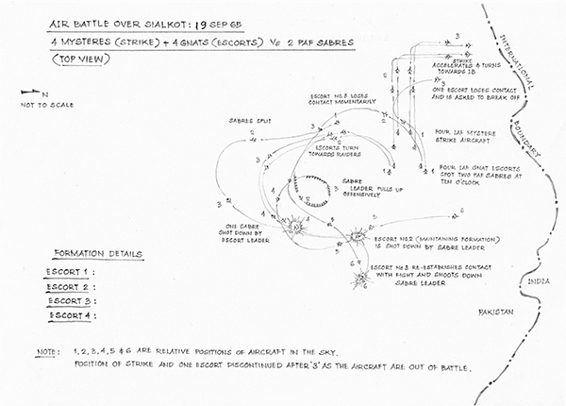
An aerial dogfight involving two or more fighter aircraft is a thrilling spectacle if witnessed from the ground; for the aerial gladiators, however, it is a matter of life and death with split-second decision making and situational awareness holding the keys to survival and victory. By 19 September, the IAF had recovered from the initial setbacks and started asserting itself in aerial battles with PAF Sabres. Not only had many IAF Gnat and Hunter pilots selectively deciphered Pakistani tactics, they had also started imposing their numerical superiority and started wearing down the PAF, which had started preserving its dwindling air resources after the first week of the war. One such dogfight involved four Gnats from the IAF’s 9 Squadron, also called the Wolfpacks, and four Sabres from the PAF’s 17 Squadron.47Telephonic conversation with Wing Commander Mayadev on 3 December 2014.
The four Gnats were flown by Flight Lieutenant Denzil Keelor as leader with Flying Officer Rai as his No. 2, Flight Lieutenant Vinay Kapila as subsection leader and No. 3, and Flight Lieutenant Mayadev as his No. 4. Escorting four Mysteres of 1 Squadron who were on a tank-hunting and busting mission, they spotted two Sabres (there were two more around, reported to have joined the fight according to some) loitering over the tactical battle area. As roughly depicted in the diagram on the next page, and based on a detailed conversation with Mayadev, the two pairs of Gnats were flying on both flanks of the Mysteres and it was the left pair that spotted the Sabres first. As Kapila and Mayadev peeled off for the attack, they were spotted by the Sabres, who executed what was known in those days as a defensive split in which the lead aircraft continues turning loosely in the same initial direction while the second aircraft momentarily tightens his turn and then pulls up to pose a dilemma to the attacking pair whether they should split too and convert the fight into two separate one-versus-ones, or continue to fight as a pair. The danger in doing the latter was that the defender who had split could now manoeuvre offensively and get behind the second attacker. This was a standard PAF tactic and the IAF was still hazy about how to counter it. This was surprising because Sajad Haider confirmed in his email to Jagan Mohan that the PAF had been practising this manoeuvre since 1957. It is even more perplexing why the IAF pilots who had trained in the US on the Sabre did not insist that the IAF understand these tactics and evolve standard operating procedures (SOPs). These then could have been widely disseminated to all fighter and bomber squadrons so that they could be reasonably prepared to counter them.
In this aerial encounter, while Kapila got behind the lead Sabre with Mayadev covering his tail, the second Sabre, after executing a split, managed to sneak in behind Mayadev and shoot him down before the second pair of Gnats led by Denzil Keelor could come to his assistance. It is a different matter, however, that soon after Mayadev was shot down, Denzil Keelor did shoot down the second Sabre too. For the record, it was two Sabres shot down for the loss of one Gnat – and two Vir Chakras for Kapila and Keelor. The exchange ratio, Mayadev felt, could have been better had the IAF exploited their numerical superiority better and flown more aggressively. Luckily for Mayadev, he survived to tell his tale as he ejected over enemy territory and was taken POW and returned along with others in January 1966.48Ibid. More than describing the combat over Chawinda, the diagram represents how fighter pilots of the time would come back from a mission and try to recapitulate what happened in the air on a blackboard in what was a called a ‘combat debrief’. Such a debrief system would continue in the IAF till sophisticated aircraft like the Mirage-2000 and Su-30 were inducted in the 1980s and 1990s. Needless to say, combat debriefs have always been bruising encounters in aircrew briefing rooms across the world as fighter pilots debate the correctness or otherwise of split-second decisions and manoeuvres executed at speeds of up to 1,000 km/hour.
For many young combat pilots of the IAF, the years preceding the 1965 war saw them fly as many as five combat aircraft in three years. The absence of a centralized combat and tactics development establishment and minimal interaction with more developed Western air forces meant that their learning curve was slower than their Pakistani counterparts, who had benefitted immensely from their training at United States Air Force combat schools. While the IAF did set up a combat school after the 1965 war, it continued to remain isolated from innovative Western aerial tactics till the 1980s.49Attrition figures are reasonably accurate and if enthusiasts want more authentic figures, they could compare an Indian perspective in P.V.S. Jagan Mohan and Samir Chopra’s book, while a Pakistani perspective is available in Asghar Khan’s book. The flavour of my rendition of events primarily focuses on the rather amateurish planning of missions by both the PAF and the IAF. To be fair to both air forces, it was probably the first real aerial tussle between two ‘at par’ air forces without much prior combat experience in the modern ‘aerial war fighting’ era, which commenced over Korea in the mid-1950s. The last two weeks of the war saw a lot of night missions being flown by Canberras from both air forces and continuous close air support and interdiction missions in support of the various ground battles, but no more classical large-scale aerial engagements were seen in the western sector till the guns fell silent.50