Part IV: Across Borders
Operations Gibraltar and Grand Slam
The basic tactical concept of the Pakistan Army did not vary fundamentally from our own. In its application, however, there was an unmistakable evidence of the dominant influence of American and Chinese techniques of warfare. This selective grafting of tactical doctrine did not, however, pay the expected dividends for want of imaginative implementation.1Lieutenant General Harbaksh Singh, War Despatches: Indo-Pak Conflict of 1965 (New Delhi: Lancer International, 1991), p. 186.
Multi-Pronged Assault
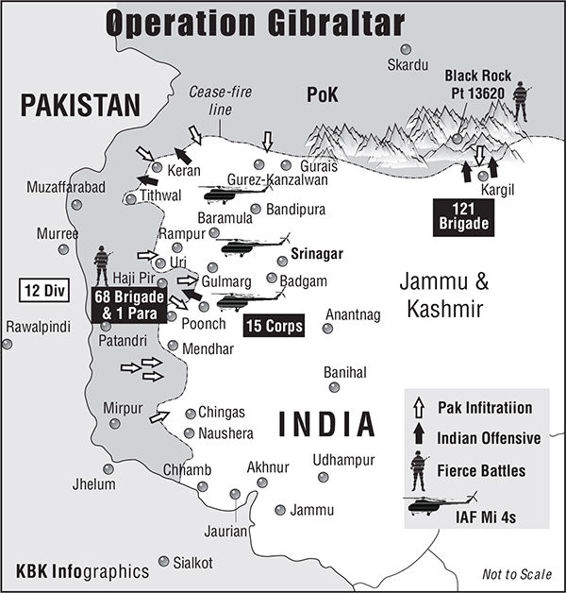
Operation Gibraltar’s infiltration plan comprised eight thrust lines along the ceasefire line starting from the Kargil sector in the north and extended along the river Kishenganga all the way southwards till Poonch. Learning from their 1947–48 experience, Pakistan chose not to open a large front in the Kargil sector beyond attempting to cut the Leh–Srinagar Highway as it was well defended by the Indian Army and there was little possibility of subverting the local population in Ladakh, which comprised a majority of Buddhists and a sprinkling of Shia Muslims. With Pakistan having been carved out of India, the search for a historical legacy inevitably turned to the numerous Islamic warrior-kings who invaded India from the eleventh century onwards. All the thrust lines and forces were named after these Muslim invaders and all the mujahid battalions were indoctrinated with stories of the valour of these warriors. The forces were named Tariq, Qasim, Khalid, Salauddin, Ghaznavi, Murtuza, Nusrat and Babar.2S.N. Prasad (chief editor) and U.P. Thapliyal (general editor), The India-Pakistan War of 1965: A History (Dehradun and Delhi: Natraj Publishers, 2011). It is interesting to understand this strategy, coupled as it was with a political directive by Ayub Khan to his military commanders about India’s ability to withstand an offensive. One of the paragraphs in that directive read:
As a general rule Hindu morale would not stand more than a couple of hard blows delivered at the right time and place. Such opportunities should therefore be sought and exploited.3Brian Cloughley, A History of the Pakistan Army (New Delhi: Lancer, 1999), p. 71.
While Western commentators like Brian Cloughley, an accomplished Australian military historian, called these comments as ‘crass’,4Ibid. it reveals a lot of the prevailing mindsets in the subcontinent, particularly in the stereotyping of clans and races and their martial abilities. Clearly, the ‘martial race’ theory as propounded by the British in their reorganization of the Indian Army in late-nineteenth century had identified Punjabi Muslims, Baluchis and Pathans as excellent fighting material and this is what remained as a mindset within the Pakistan Army.
The plan of infiltration was to launch all thrusts almost simultaneously with mujahid battalions, and wherever there was potential for success, it would be further exploited by regular forces. According to Harbaksh Singh it was ‘brilliant in conception’5Lieutenant General Harbaksh Singh, War Despatches: Indo-Pak Conflict of 1965 (New Delhi: Lancer International, 1991), p. 26. and expected to garner local support and trigger a mass uprising against the state that would be impossible to handle by the state administration and the Indian Army. My own analysis points at an intelligence and analysis failure by Pakistan, which relied excessively on inputs from a few Islamist radicals within the Kashmir Valley who promised more than they could deliver in terms of being able to whip up anti-India sentiment amongst the local population.
What Ayub also did not reckon with was the Indian Army’s commander of the Western Command, Harbaksh Singh. A WW II veteran who had been incarcerated by the Japanese as a POW after the fall of Singapore in 1942, Harbaksh commanded the famous 1 Sikh Regiment and then a brigade in the 1947–48 conflict in J&K. His brigade notched up numerous successes in the Tithwal sector during Thimayya’s ambitious summer offensive of 1948. In October 1962, he was rushed to NEFA as corps commander of the beleaguered IV Corps after Phase I of the offensive by the Chinese to replace an ailing Kaul. Harbaksh was known to be a no-nonsense and aggressive commander with high expectations from his subordinate commanders. With so much prior knowledge of the area, there was no way in which Harbaksh was going to allow 1947 to be repeated all over again. It is quite evident that Pakistani intelligence did not anticipate the tough and immediate response from units of the Indian Army’s Western Command located along the ceasefire line. His aggressive intent was evident from as early as May 1965 when he ordered 121 Infantry Brigade group, which was holding the ceasefire line in the Kargil sector, to evict Pak intruders from two prominent heights (Pt 13620 and Black Rocks). These heights were overlooking the Srinagar–Leh Highway and had the potential to act as observation points that could direct artillery fire on to the highway. Accordingly, 4 Rajput Regiment launched a daring infantry night assault on 17 May with light artillery support from 85 Light Regiment. They were led by two brave officers, Major Randhawa and Captain Ranbir Kang, who displayed leadership qualities of the highest order under fire. Major Randhawa, who was killed in the operation, was awarded the first Maha Vir Chakra of the extended conflict, while Kang was awarded the Vir Chakra.6For a short and crisp account of the battle, see Mandeep Singh Bajwa, ‘The First Kargil Battle,’ Hindustan Times, Chandigarh, 2 July 2012, available at
Infiltration by the mujahid battalions and regulars of the Pakistan Army into the Kashmir Valley commenced on 5 August 1965, covered by heavy artillery fire and stray engagements between regular units of the two armies. As the mujahids initially fanned out into the Valley along seven or eight thrust lines, the main ones being in Gurez, Kupwara, Uri, Poonch, Mendhar, Naushera and Akhnur,7‘Pak Saboteurs begin Armed Raid’, The Sunday Standard, New Delhi, 7 August 1965, p. 1, microfilm at Nehru Memorial Museum and Library (NMML), (accessed 16 September 2013). Also see Brian Cloughley, A History of the Pakistan Army (New Delhi: Lancer, 1999), p. 65. they were surprised by the singular lack of support from the local population. Many of them were captured by the Indian Army and the state police and divulged the elaborate subversion plans. It was revealed that the saboteurs were a mix of Razakars and mujahids, and according to one captured mujahid, belonged to what he called the ‘Gibraltar Forces’.8‘Pakistan Guerilla Attack Crushed,’ The Indian Express, New Delhi, 11 August 1965, p. 1 on microfilm at NMML, (accessed 16 September 2013). This force was said to have numbered approximately 4,000 to 5,000 and been divided into approximately eight forces of five companies each. These companies of 110–120 were divided into infiltrating groups of 50 to 60 with regular junior commissioned officers (JCOs) and a few soldiers embedded in the group to provide leadership. They carried with them leaflets and pamphlets to incite the local population along with transistor radios pre-tuned to Radio Pakistan. The force commenced training in May 1965 under the supervision of HQs 12 Division in Murree, familiarizing themselves for six weeks in infiltration, sabotage techniques and the use of weapons like LMGs, rifles, Sten carbines, detonators and fuses.9Ibid.
By 12 August, more than 1,200 infiltrators had been captured by a combination of the Indian Army and state police forces. Many of the infiltrators were in their early twenties and demonstrated a zealously calm countenance when captured, demonstrating that they had undergone extensive religious indoctrination prior to the operation. By 21 August the infiltration was crushed and the last remnants of Khaled Force, the most stubborn force, retreated into Pakistan after suffering heavy casualties.10‘Indian Troops Cross Ceasefire Line at Two Places’, The Indian Express, New Delhi, 26 August 1965, p. 1. An overconfident Major General Akhtar Malik, the mastermind of Operation Gibraltar, had not done his homework well! He had met his match in the form of the strapping 6-foot Sikh warrior, Lieutenant General Harbaksh Singh. Having operated extensively in the Kashmir Valley during the 1947–48 conflict, Harbaksh knew the terrain like the back of his hand and had regular forces waiting at almost all entry points.
After conducting mopping-up operations for a few days, Harbaksh decided to complete some unfinished business from 1948. Encouraged by the success of his counter-infiltration campaign and somewhat frustrated with the lack of aggressiveness of the corps commander of XV Corps, Lieutenant General Katoch, who was directing the battle in J&K, Harbaksh pushed for two major offensives to seal J&K from further infiltration. He first turned his attention to the Kishenganga–Tithwal sector area wherein, as a brigade commander in 1948, he had notched up significant successes, but could not consolidate those gains in terms of territorial gains. Three battalions comprising 2 Rajput, 3/8 Gorkhas and 1 Sikh captured four significant heights in the sector which overlooked the Muzaffarabad–Kel Road, a key road in POK that linked the western areas with the northern areas. After a series of tough battles extending for almost a month, this operation finally got over on 20 September with the capture of two heights overlooking the vital Mirpur bridge over the River Kishenganga.
The second offensive was concentrated in the strategic bulge between Uri and Poonch with a final objective to capture Haji Pir Pass and a few heights around it.11For a detailed analysis of the Tithwal sector and Haji Pir operation see Lieutenant General Harbaksh Singh, War Despatches: Indo-Pak Conflict of 1965 (New Delhi: Lancer International, 1991), p. 44–47. Also see S.N. Prasad (chief editor) and U.P. Thapliyal (general editor), The India-Pakistan War of 1965: A History (Dehradun and Delhi: Natraj Publishers, 2011), p. 70–74. Interestingly, these were captured with significant casualties to own forces in 1948 and then handed back on a platter to Pakistan after the ceasefire agreement of 1948. These heights occupied a special place in the hearts of many soldiers and officers of the Indian Army who had seen action there and Harbaksh was determined to wrest them back. Troops of 68 Infantry Brigade and 1 Para (a total of five infantry battalions with adequate artillery support) from 19 Division commenced operations to capture Haji Pir Pass and other surrounding heights in the strategically located bulge between Uri and Poonch. Haji Pir Pass and seven more posts in the bulge were finally captured between 28 and 31 August after fierce fighting.12Lieutenant General Harbaksh Singh, War Despatches: Indo-Pak Conflict of 1965 (New Delhi: Lancer International, 1991), p. 48–50. The valour of Major Ranjit Singh Dayal, a company commander with 1 Para Battalion during the final assault on Haji Pir Pass was specially acclaimed by Harbaksh in his book13Ibid.. Dayal was decorated with the Maha Vir Chakra for his bold and imaginative leadership. Also decorated with the Maha Vir Chakra in these operations were Lieutenant Colonel Sampuran Singh, CO of 19 Punjab, the brigade commander of 68 Infantry Brigade, Brigadier Zorawar Chand Bakshi and the divisional commander of 19 Infantry Division, Major General S.S. Kalan.14S.N. Prasad (chief editor) and U.P. Thapliyal (general editor), The India-Pakistan War of 1965: A History (Dehradun and Delhi: Natraj Publishers, 2011), p. 74–77.
One of India’s most accomplished paratroopers and counter-insurgency experts, Lieutenant General Thomas Mathews, missed the action in 1965 as he was commanding 2 Para Battalion in the north-eastern state of Tripura as part of 61 Brigade based at Agartala. He, however, recollects that during the initial operations to capture Haji Pir Pass, Sank, one of the adjoining heights, was an initial objective for 1 Para Battalion and when the first attack failed, the CO told his brigade commander, Zorawar Bakshi, that he would be able to launch a second assault only with better artillery support. With none available, it called for tremendous courage on the part of Major Ranjit Singh Dayal, one of the company commanders, to lead the attack with existing resources. Hailing from a humble Sikh family, Dayal’s father was a subedar major from the pre-Independence era and the young daredevil paratrooper was always willing to push the boundaries of human endurance. The capture of Sank raised the morale of 1 Para Battalion significantly and paved the way for the subsequent fall of Haji Pir Pass on 28 August.15Interview with Lieutenant General Thomas Mathews (retd) at Pune on 30 January 2015. Kargil sector too saw the Indian Army quickly capturing some Pakistani posts overlooking the Leh–Srinagar Highway in a daring night operation on 15 August.16S.N. Prasad (chief editor) and U.P. Thapliyal (general editor), The India-Pakistan War of 1965: A History (Dehradun and Delhi: Natraj Publishers, 2011), p. 67–68.
Since India had honoured the 1949 UN Security Council resolution on Kashmir in terms of not placing fighter aircraft at Srinagar, the IAF could not intercept some of the clandestine missions launched by PAF C-130 aircraft to resupply and support the raiders in the Valley.17P.V.S. Jagan Mohan and Samir Chopra, The India-Pakistan Air War of 1965 (New Delhi: Manohar, 2009), p. 64–66. These resupply dropping missions, many of which were executed by night, were fairly accurate, but failed to stem the rout. Despite war not being officially declared between India and Pakistan, the IAF innovatively modified Mi-4 helicopters in the gunship role and also employed Alouette light helicopters for casualty evacuation in support of the counter-infiltration operations after Harbaksh suggested to the air chief that he badly needed helicopters to act as a force multiplier in the Valley. The willingness of Harbaksh to use all resources at his disposal to thwart the widespread infiltration campaign, and immediate support from the IAF, were essential if India was to decisively put down the multi-pronged Pakistan backed subversion in Kashmir. Responding with alacrity to a call from him, the IAF put together a helicopter task force at Srinagar comprising ten to twelve Mi-4 utility helicopters that were fitted with machine guns and modified to carry 25 lb bombs. The ability to shift small-sized forces from one sector to the other along with casualty evacuation capability in the Valley was a significant morale enhancer. Surprising the infiltrators in areas that were not accessible by ground forces, the Mi-4s caused a fair amount of psychological degradation rather than direct destruction and demonstrated good coercive intent on the part of the India’s armed forces.18Rajesh Isser, Purple Legacy: Indian Air Force Helicopters in Service of the Nation (New Delhi: KW Publishers, 2012), p. 25–27. Also see S.N. Prasad (chief editor) and U.P. Thapliyal (general editor), The India-Pakistan War of 1965: A History (Dehradun and Delhi: Natraj Publishers, 2011), p. 77. Harbaksh Singh also acknowledges the role of helicopters in the counter-infiltration campaign in the ‘Lessons Learnt’ portions of his book. See Lieutenant General Harbaksh Singh, War Despatches: Indo-Pak Conflict of 1965 (New Delhi: Lancer International, 1991), p. 197.
The narration of events from an Indian perspective would not be complete without a word about ‘behind the enemy lines operations’ by Meghdoot Force, a special unit from the Rajputana Rifles and Rajput Regiment. Led by Major (later Lieutenant Colonel) Megh Singh, a WW II veteran with experience in covert operations in Burma, and supported to the hilt by Harbaksh Singh who himself had experience of operations behind enemy lines in Malaya during the war. The unit caused a fair amount of mayhem and confusion by blowing up bridges behind enemy lines and bringing on harassing fire on surprised infiltrators from the rear. The force was to shift south into the Chhamb sector as the conflict expanded.19Lieutenant General Harbaksh Singh, War Despatches: Indo-Pak Conflict of 1965 (New Delhi: Lancer International, 1991), p. 52–53.
Tough, unyielding and a demanding commander, Harbaksh Singh had ensured by mid-September that all the infiltrators had been pushed back and the much awaited ‘Liberation of Kashmir’ was nothing but a pipe dream for Pakistan. In the final analysis, Operation Gibraltar ended with a whimper and a resounding victory for India. It was a chastening defeat for Ayub Khan and his rabidly anti-India foreign minister, Bhutto. For India, it was a much needed morale booster after the reverses in Kutch. Operation Gibraltar in many ways was Harbaksh’s finest hour – what it also did was to give him immense confidence to tackle subsequent battles on the western front with an aggressive mindset.
The Guns Boom In Chhamb
The failure of Operation Gibraltar to achieve any of its strategic or operational objectives was a severe jolt to Ayub Khan. He had to think of a face-saving gambit to distract Harbaksh’s forces in Kashmir and maintain Pakistan’s offensive momentum. As Kashmir was the main plank on which Ayub and Bhutto had sold the war with India to the people of Pakistan, it was time to open another front in Kashmir as a last-ditch attempt to cut it off from Punjab.
If Operation Gibraltar had gone as per plan, the final nail in India’s coffin would have been Operation Grand Slam, a surgical and swift artillery-supported armour-led thrust into the Chhamb–Akhnur bulge culminating in the capture of the vital town of Akhnur. This would have cut the arterial Pathankot–Jammu Highway and isolated J&K from the rest of the country.20Brian Cloughley, A History of the Pakistan Army (New Delhi: Lancer, 1999), p. 72. In the prevailing circumstances, Ayub Khan decided to launch this operation anyway. It was time for high stakes and desperate measures considering that Pakistan had lost a number of passes and heights to Indian forces towards the end of August in the Tithwal, Uri and Kargil sectors.
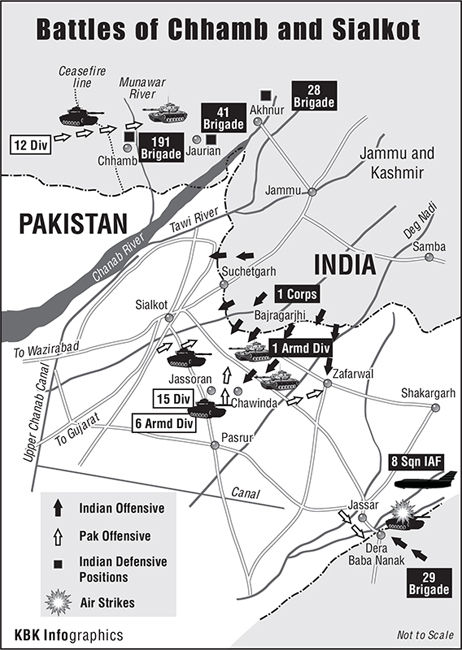
What is not widely known is that Major General Akhtar Malik, General Officer Commanding 12 Division, the architect of both Operation Gibraltar and Operation Grand Slam, had cleverly woven in an artillery plan to support the southern thrust lines of the infiltration. The plan was to concurrently cause heavy attrition to the lone artillery regiment that supported India’s 191 Infantry Brigade, which was also supported by only a single squadron of light AMX-13 tanks. As the unsuspecting batteries of the Indian Army’s 14 Field Regiment celebrated Independence Day on 15 August, they were struck at multiple locations by well-directed and concentrated fire from Akhtar Malik’s artillery brigade and the regiment was crippled with the loss of 6 to 8 guns and huge ammunition stockpiles. Worse still, the brigade commander, Brigadier Masters, was killed during one of the bombardments.21For a detailed account of the lopsided artillery battle during the battle of Chhamb, see Brigadier Chowdhury, ‘Chhamb – The Artillery Battle’, USI Journal (April–June 2013): p. 294–302. Though Harbaksh Singh speedily replaced the loss with a battery of medium guns and placed Brigadier Manmohan Singh, who was commanding a brigade in the adjoining division in command of 191 Brigade, the damage had been done. Pakistan had scored a significant preliminary success thanks to its superior artillery before the battle had even begun.
On 1 September 1965, well before the crack of dawn, the hamlets around the Indian border town of Chhamb awoke to the rumbling of Patton tanks and a thundering artillery barrage from 105 and 155 mm guns. Pakistan’s 12 Division had launched Operation Grand Slam with almost three brigades supported by two regiments of armour leading the assault with an entire artillery brigade comprising all elements including a large number of field and medium artillery guns, gun-locating regiments and an air defence regiment in support.22The best commentary on the Chhamb battle from a Pakistani perspective comes from Major Agha Humayun Amin (retd). See Major Agha Humayun Amin (retd), ‘Grand Slam – A Battle of Lost Opportunities,’ at
Though Professor Sumit Ganguly argues that India subscribed to the strategy of ‘defence and deterrence through punishment and retaliation’,23Sumit Ganguly, Conflict Unending: India-Pakistan Tensions since 1947 (New Delhi: Oxford University Press, 2002), p. 38. this was seen only as rhetoric and not through effective posturing on ground and in the air, particularly after India was given a wake-up call after the Rann of Kutch incident. Punishment was never a strategy that was discussed within the strategic establishment with any seriousness given India’s reluctance to be seen as a country that was ready to use military power as a tool of statecraft. That India thought that any conflict in Kashmir would remain as it was in 1947–48 – a localized conflict – was strategic naivety of the highest order. That India did not expect Pakistan to launch an offensive when it finally did and be ready for it, particularly in the air, was a failure of intelligence and lapses in operational leadership.
Where was the requirement for the brigade commander to wait for a clearance from Delhi for air strikes? Should this joint appreciation not have been done in the preceding weeks by the Western Army and Air Commands and prior clearance been obtained from Delhi to launch air strikes should Pakistan attempt to expand the conflict? At 5 p.m., by the time the oldest operational aircraft in the IAF’s inventory, the Vampire, was launched to stall the Pakistani armoured offensive, the two forces were in close contact on the ground – not the best situation for close air support. Flying into the setting sun without any air defence escorts, by the time sorties were flown, the effectiveness of the IAF strikes was muted. While the offensive had slowed down after quite a few Pakistani Patton and Chaffee tanks were knocked out by the Vampires, the Indian Army too lost some troops and tanks to ‘friendly fire’ – 3 Mahar Regiment and 20 Lancers in particular suffered. Equally demoralizing was the loss of four Vampires to ground fire and enemy air defence fighters in the form of the formidable F-86 Sabre jets, which were waiting over the tactical battle area.24According to Shuja Nawaz, ‘PAF Sabres, however, provided superb ground support in all phases of the attack.’ See Shuja Nawaz, Crossed Swords: Pakistan, Its Army, and the Wars Within (Karachi: Oxford University Press, 2008), p. 211.
Two main thoughts came to my mind when I sat down to analyse the first significant air action by the IAF in the 1965 War. First was that the response was too late – the first sorties should have been launched at dawn before the Pakistani armour had come in close contact with the few tanks of 191 Brigade. This would have allowed a clear and early demarcation of the Forward Line of Own Troops (FLOT) so that there was minimal possibility of fratricide. This would have also surprised the PAF, which might not have been able to send Sabres to the area in time. Since the attacks would have come from the east and the rising sun, it would have made it more difficult for the attacking aircraft to be picked up by both ground-based ack-ack guns and air defence aircraft. Second was the rationale to first send in the slowest and most vulnerable aircraft into a fairly dense air defence environment. More about the air battle over Chhamb later as it is time to get back to the action on the ground as 12 Division of the Pakistan Army attempted to gain a foothold across the Munawar Tawi river.
Rearguard Action
After bearing the brunt of the Pakistani artillery bombardment and armoured thrust, and suffering some losses to friendly fire as IAF Vampire jets bombarded enemy positions on the evening of 1 September, 3 Mahar Regiment acquitted itself admirably under adverse conditions. Commanded aggressively by Lieutenant Colonel G.S. Sangha, who even requisitioned machine guns from battle casualty AMX tanks of 20 Lancers as his battalion withdrew, the unit continued to harass the enemy during the night. For his grit and bravery in a defensive battle under trying conditions, Sangha was awarded the Maha Vir Chakra.
As all three battalions of 191 Brigade and the lone squadron of AMX tanks withdrew, first to Jaurian by early morning on 2 September and then across the Munawar Tawi to Akhnur by the same evening, they caused significant attrition to the advancing Pakistani forces. Inexplicably, as it seemed at the time, the Pakistani offensive slowed down on 2 September as Akhtar prepared to cross the Munawar Tawi. This provided a breather for India to quickly reorganize its defensive line around Akhnur with 191 Brigade and a fresh 28 Brigade. While another newly inducted brigade in the area, 41 Brigade, created a forward defensive line around Jaurian, another tactically sound position at Troti heights overlooking the Munawar Tawi river was created. All the brigades were placed under command of 10th Division of XV Corps in a hastily put together reorganization of forces.
By the time the squadron (typically 12 to 14 tanks) of 20 Lancers withdrew across the Munawar Tawi under the nose of a whole regiment of enemy Patton tanks, they were left with only three tanks with the rest having been destroyed by the advancing Pakistani forces. A few Indian tanks were also said to have been knocked out by IAF Vampires the previous evening. The squadron commander, Major Bhaskar Sen, was also awarded the Maha Vir Chakra.
While the Pakistani offensive caught their opponents by surprise, there were differences within its senior leadership over the depth to which the offensive was sustainable. While General Musa, the Pakistan Army chief, and the headquarters staff at Rawalpindi wanted to go for the jugular and capture Akhnur at the earliest so as to threaten the Pathankot–Jammu highway, Major General Akhtar Malik, the GOC of 12 Division, seemingly felt that this plan was not sustainable as the Indian Army would regroup and cut off his force. He preferred to consolidate around Jaurian before advancing to Akhnur. Surprisingly, he was replaced by Major General Yahya Khan on 2 September. Yahya was the GOC of 7 Division, another formation that was moving north from the Lahore area to reinforce 12 Division. This change in command caused some confusion and delay amongst Pakistani ranks; many commentators have attributed this to Pakistan’s failure to drive home the advantage they had gained on the opening day. When one of Yahya Khan’s brigade commanders, Brigadier Janjua, pressed for a clearance to go for the jugular and take Akhnur, he was reportedly cautioned by Yahya so: ‘Dig deep Ifti, my boy! Dig deep! Chaudhuri is no fool! He will counter attack!’25Ibid., p. 212.
Though that counter-attack never materialized, the delay of one day was enough for India to rush in enough reinforcements and armour to fight a decent defensive battle in the area from 3 to 6 September with almost a division-sized force. As a result, the Pakistanis just did not have the numbers to fight a meaningful offensive battle in the plains. Another reason for the delay caused to the Pakistani advance was the counter-attack launched by 41 Brigade on 4 September on the insistence of Lieutenant General Harbaksh Singh.26Major General Lachhman Singh, Missed Opportunities: Indo-Pak War 1965 (Dehradun: Natraj Publishers, 1997), p. 168. Wilting under a fierce artillery and armour assault on its integral artillery regiment on 3 September, 41 Brigade asked to withdraw to Akhnur, barely a day after occupying defences. Instead, Harbaksh Singh asked them to launch a counter-attack on 4 September and then redeploy. It was at his insistence that the forward defensive line rallied around Jaurian and blunted the Pakistani offensive, while the main divisional defences were strengthened at Akhnur. By the time the Pakistanis attacked the forward defences around Akhnur on 6 September, they ran out of firepower and were decisively beaten back. This rearguard action allowed Harbaksh sufficient time to launch his offensive in the Lahore and Sialkot sectors to deflect the immense pressure building up in Chhamb. By late evening on 6 September, Pakistan had seen the writing on the wall and started moving much of their armour and artillery out of the Chhamb sector towards the Sialkot sector, where an Indian offensive was under way, leaving just about enough forces in Chhamb to blunt any Indian counter-attack.
The Iaf Over Chhamb
Pathankot airfield is located at the northern tip of Punjab adjoining the Jammu region. It was developed as a forward airbase to support operations in one of the most vulnerable areas from an Indian perspective in a likely India–Pakistan conflict. The Chhamb–Akhnur–Jammu sector along with Jhangar, Poonch and Uri sectors were identified as operationally important, and aircraft from Pathankot could be over these areas in minutes, should the need arise. As Operation Gibraltar unfolded in Kashmir, Pathankot buzzed with activity as it prepared for the eventuality of a full-blown conflict. As on 1 September, the base had two Mystere squadrons and a large detachment of Vampire jet trainers. What their role was going to be was not clearly spelt out. Once the decision to employ offensive air power was taken by the Government of India at 4:30 p.m. on 1 September, the first fighters in the air were three waves of Vampire jets from 45 and 220 Squadrons in a four-aircraft formation armed with rockets in anti-armour role. They were over the target area in a jiffy and what they saw on the ground was a close-contact battle between Pakistani Patton tanks, Indian AMX tanks and troops of 3 Mahar Regiment. Despite the difficulty in segregating targets the Vampires tried their best to discriminate between friend and foe and fired their rockets. What they did not realize was that PAF Sabre jets would be over the area in a flash to intercept the second and third waves of Vampire jets. Though four Vampires were shot down in minutes by the vastly superior Sabres and fierce ack-ack fire, the exploits of Mysteres of 31 Squadron of the IAF operating from Pathankot under the command of Wing Commander William Goodman cannot be forgotten as it flew numerous close air support missions over Chhamb, and ably assisted the rearguard action by 191 Brigade by slowing down the Pak advance. IAF strikes accounted for 12 to 13 Patton and Chaffee tanks, two artillery guns and a large number of soft-skinned vehicles. Unfortunately three Indian AMX tanks, ammunition-carrying vehicles and some troop concentrations were also hit during the close-contact air-land battle.27P.V.S. Jagan Mohan and Samir Chopra, The India-Pakistan Air War of 1965 (New Delhi: Manohar, 2009), p. 75.
The IAF hit back fiercely in the air too on 3 September after inducting the highly manoeuvrable Gnat fighters of 23 Squadron into Pathankot. The squadron was to provide air defence cover to the town and escort the Mystere close air support missions over Chhamb and Jaurian. With an aggressive squadron commander in the form of Wing Commander Raghavendran (later Air Marshal and Vice Chief of Air Staff), and an accomplished air combat tactician, Squadron Leader Johnny Greene, who was posted at Ambala and attached to the squadron, 23 Squadron was the pioneer unit that developed low-level air combat tactics in the IAF.28For a detailed narrative of his years as the CO of 23 Squadron during the 1965 war, see Air Marshal S. Raghavendran (retd), Panther Red One: The Memoirs of a Fighter Pilot (New Delhi: KW Publishers, 2013). Air Vice Marshal Milind Shankar was a young flying officer in the squadron and recounts how Johnny Greene, a UK-trained fighter combat leader and the detachment commander at Pathankot was asked by the station commander of Pathankot, Group Captain Roshan Suri, to give a pep talk to all aircrew at Pathankot on 2 September:
The station was silent when 23 Sqn landed from Adampur. Johnny Greene was asked to speak to all aircrew on air combat; a much needed pep talk as he described the mechanics and dangers of air combat. He talked about basic things like fear and how to overcome it with skill and courage. He also spoke to us on split-second decision making, situational and combat awareness.29Conversation with Air Vice Marshal Milind Shankar on 25 October 2013. He was a young pilot in 23 Squadron, which was the first Gnat squadron to draw blood in combat with the Sabres. He spoke about the need to conquer our needless fear of the adversary and to go up there and shoot well and shoot straight. ‘It is as simple as that,’ he said. Johnny Greene inspired a bunch of eager Gnat pilots from 23 Squadron (The Panthers) to go into combat from the next day onwards with a clear sense of purpose. He was the only air defence pilot of the IAF to be awarded a Vir Chakra in 1965 for inspirational leadership without shooting down an enemy aircraft during the course of the war; 30Air Marshal S. Raghavendran (retd), Panther Red One: The Memoirs of a Fighter Pilot (New Delhi: KW Publishers, 2013), p. 213. it is a different matter altogether that he did get into a few situations where he was in a position to shoot down a Sabre, but the Gnat’s notoriously unpredictable gun let him down.
I had the privilege of listening to Johnny Greene speak on air combat and leadership twenty years later when he was an air marshal and the senior air staff officer at Central Air Command. It was probably the most inspiring talk I have ever heard in my entire career and left an indelible impression on me about matters right and wrong, be it in air combat, leadership or within the larger canvas of life in general. It is a pity there was no YouTube or Facebook in those days – the talk would have garnered thousands of ‘likes’ in no time.
A better day for the Indian Air Force was 3 September 1965. Some even call it a red-letter day as 23 Squadron bagged the first aerial combat kill for the IAF since Independence. Flying as low-level escorts to a large formation of Mysteres, four Gnats engaged an equal number of Sabres and Starfighters in an aerial duel over Chhamb in which Flight Lieutenant Trevor Keelor shot down a Sabre. The next day, another ‘young gun’, Flight Lieutenant Pathania, bagged another Sabre. Both were awarded the Vir Chakra and the entry of the Gnats coincided with the scaling down of the Pakistani offensive in Chhamb around 6 or 7 September as the Indian Army opened up the Lahore front.
The personal war diary of a young Gnat pilot from 23 Squadron, Manna Murdeshwar, tells the tale of the IAF response between 1 and 6 September:
2 Sept, ’65: Sqn Ldr Johnny Greene, Self [then a flight lieutenant], Flt Lt AJS Sandhu and Flt Lt Trevor Keelor were nominated by HQ WAC to move to Pathankot – ostensibly for ORP duties at that airfield. When the 4 of us landed at sunset, we were greeted by grim faces and learnt about the downing of 4 Vamps by the PAF Sabres. We were surprised to find that ‘our 4’ aircraft & pilots on landing at Halwara, had been rerouted to Pathankot and were awaiting our arrival.
3 Sept, ’65: Our first Gnat ops sortie was also the first air battle post Korean War. On that day, we escorted 4 Mysteres to the C-J sector to initiate a Sabre kill. We planned for the Mysteres to be at 20G to entice the Sabres, while we, in the Gnats, were to remain at low level [under PAF radar] and await the arrival of the Sabres. Once they were sighted, the Mysteres were asked to return to base and we climbed up to engage the Sabres. At heights, in the combat that ensued, Trevor allegedly shot down one Sabre which was hailed as our first ‘Victory.’ The PAF later disputed this ‘kill.’ An unfortunate result of the air battle, was that one of our team members, apparently not proficient in close combat, got lost, and landed at Pasrur, in Pakistan.
4 Sept, ’65: Johnny, self, AJ and Pat enroute to C-J sector, encountered 4 Sabres strafing our troops. All of us rolled over and each managed to get behind a Sabre. Johnny was the first to get behind one, but had a high ‘angle off ’, so was unable to fire. I was in a good 400 yds line astern position with the ‘diamonds pipping’ the Sabre, but my guns, frustratingly, stopped after a single round of fire! AJ too had some problem, which I can’t presently recall. Pat however, managed to get a kill before his guns also jammed.31Email exchange with Group Captain Manna Murdheshwar (retd).
Albeit with significant hiccups, the battle of Chhamb was the first air–land battle fought by India in the modern era against an adversary with better tactical and communication procedures; many of the Pakistani tank crews and fighter pilots had trained in the US under the Military Assistance Programme (MAP) and were reasonably proficient in directing close air support aircraft onto targets in the tactical battle Area. In a defensive battle, particularly in the plains, the most effective way of employing air power is not in the contact battle, but by ensuring that the attacker is not able to build his force ratios to sustain his offensive. This is done by interdicting his follow-on forces and reserves, and is possible only if a joint appreciation has been done prior to the battle. None of this was done and by calling in air power at the last moment without proficiency in forward air controlling, nothing better could have been expected. It was an eye-opener for both the IAF and the Indian Army as they did well in the years ahead to build on this experience.
The PAF too was guilty of continuing to assume a defensive posture over Chhamb and failed to carry out interdiction missions against Indian reinforcements that were being inducted for the relief of Chhamb, Jaurian and Akhnur. Had the PAF combined an interdiction and an air campaign as a counter against IAF airfields on 1 September, the Indians would have been hard-pressed to coordinate a suitable response. Pakistani tentativeness was clearly evident! As the fighting petered out in Chhamb, both India and Pakistan were readying themselves for what would be fairly intense air–land battles further to the south in the Lahore and Sialkot sectors.