Part II: The DNA of India's Armed Forces
The Indian Army: Coming of Age
The safety, honour and welfare of your country comes first, always and every time; the honour, welfare and comfort of the men you command come next; your own ease, comfort and safety come last, always and every time.
The story of India at war from 1939 to 1945 has been pushed to the margins by the telling and retelling of the story of independence and the partition of British India into the republics of India and Pakistan.
The Great War
Though hastily deployed initially in large numbers as an Indian expeditionary force with little or no acclimatization after the initial reverses faced by the Allies in Europe, the Indian Army performed gallantly during WW I, particularly in the early battles of France and the deserts of Egypt, Palestine and Mesopotamia. In a scathing indictment of the callous manner in which the Crown inducted the Indian Army into the European theatre of battle, David Omissi writes: 'As they arrived, these underequipped troops were fed piecemeal into the frontline in an attempt to stem the German rush between Ypres and La Bassee.'3David Omissi, Indian Voices of the Great War (New Delhi: Penguin/Viking, 2014), p. 3.
Operating as an integrated corps-sized force with approximately two infantry and two cavalry divisions, Indian troops soon won the respect of their German adversaries for their tenacity and courage under extreme fire. During the first Battle of Ypres in October 1914, Sepoy Khudadad Khan of the 129 Baluch Regiment was left as the last man standing and won the Indian Army's first Victoria Cross (VC).4Ian Cardozo, ed., The Indian Army: A Brief History (New Delhi: Centre for Armed Forces Historical Research, 2005), p. 27–28. Naik Darwan Singh Negi of the Garhwal Rifles was the second Indian soldier to win the VC in the Battle of Neuve Chapelle in November 19145Ibid., p. 28. as units of the Sikh Regiment, Bhopal Infantry and Garhwal Rifles did the Indian Army proud both in offensive and holding operations. Indian sappers (military engineers) too would prove their mettle with Havildar Maruti Jadhav being among the few Indian soldiers to be awarded the French Legion of Honour for displaying courage and initiative of the highest order at Neuve Chappelle in France on 28 October 1914.6From the Honours and Awards Gallery section at the Bombay Sappers Regimental Centre at Kirkee, Pune. Fighting in cold and alien weather conditions till March 1915 in brutal trench warfare and hand-to-hand combat operations, the Indian Army can be proud of taking part in the first offensive operations launched by the Allies.
Indian cavalry units too acquitted themselves with distinction as units like the Poona Horse, Hodson's Horse,7For an excellent article on Hodson's Horse and the exploits of the Indian Army in WW I, see the official magazine of India's Ministry of External Affairs, India Perspectives, Vol. 29, No. 4 (July–August 2015), p. 60–64. 2nd Lancers and Skinners Horse rode across the wet plains of Europe fighting for a cause they did not really understand. Lance Daffadar Gobind Singh of 2nd Lancers was among the few Indian cavalrymen to win a Victoria Cross as he carried messages across the battlefield under withering fire during the Battle of Cambrai in December 1917.8Mandeep Singh Bajwa, 'Indian Cavalry on Western Front, 1914–1919,' Hindustan Times, Chandigarh, 24 August 2014, available at http://www.hindustantimes.com/punjab/chandigarh/indian-cavalry-on-western-front-1914-18/article1-1255827.aspx (accessed 17 October 2014). Gallipoli and Mesopotamia were also witness to the courage and bravery of Indian troops who suffered heavy casualties in the various battles fought in that sector. Similarly, the Allied campaign in Egypt and Palestine too relied heavily on the Indian Army.9Ian Cardozo, ed., The Indian Army: A Brief History (New Delhi: Centre for Armed Forces Historical Research, 2005), p. 29–30. Though Cardozo puts the number of Victoria Crosses at sixteen, a more recent brochure brought out by the Commonwealth Graves Association puts the figure at eleven. By the end of the war the Indian Army had lost 74,000 men and won eleven Victoria Crosses (Indian soldiers) and ninety-nine Military Crosses.10Stephen P. Cohen, The Indian Army: Its Contribution to the Development of a Nation (New Delhi: Oxford University Press, 1990), p. 68. More importantly, it had won the respect of the British Army and the gratitude of the Crown, albeit with tremendous loss of life.
Philip Mason writes poignantly about the sacrifices made by Indian troops during WW I:
No one can think of the carnage of this war without horror. But in the case of the Indian deaths there is a special question to be asked, grim but wry. In every English village, there, survivors thought they knew why these men had died. It was to defend their homes. For Indian soldiers, though, there was no village memorial.11Philip Mason, A Matter of Honour (London: EBD Education in arrangement with Jonathan Cape, 1988), p. 443.
Mason goes on to try and understand how the British Indian Army commemorated their dead at the end of the Great War:
To die for one's country or to save the life of a leader or comrade is a noble end. To die for the regiment is not very different if that regiment is part of the national tradition. But in India's case the regiment was not part of the national tradition and the time was not far off when the allegiance of the regiment would be transferred from the King Emperor to the President of India.12Ibid.
While the British officers of the Indian Army propagated the idea that the men had died for the regiment, deep down the men knew that their comrades had really died for izzat or honour – for their clan, their villages and their individual honour. Many colonial historians believe that the core ethos of the Indian Army emerged from the bloody battlefields of WW I. They believe that the creed of Naam, Namak, aur Nishan (individual honour, integrity and loyalty to the regimental flag) emerged from the bloody trenches of the Great War and still remain as defining benchmarks for service in the Indian Army. While that was true to some extent in colonial India, I will argue later in the book that there were other drivers that shaped the DNA of independent India's army. The valour of the British Indian Army during WW I is enshrined on the walls and pillars of the magnificent memorial at India Gate in the national capital of Delhi. It is a moving memorial and took ten years to build. Designed by Edwin Lutyens, who designed what is modern New Delhi, it was completed in 1931. It signified awakening of the conscience of India's colonial masters and a realization of the need to honour their dead soldiers and the role they played in building and sustaining their empire. Eighty-five years old now, India Gate remains the most magnificent war memorial in India; ironically built by India's colonial masters in honour of the 'natives' who laid down their lives for 'the empire'. After years of procrastination by successive governments on the need for independent India to have a central war memorial, the Modi government recently approved the construction of a National War Memorial very close to India Gate. India commemorated 100 years of WW I in 2014 with a series of wreath-laying ceremonies at all WW I cemeteries at cantonments like Kirkee (near Pune) and other Indian cities that had large army presence during those days.
Inter-War Years
The post–WW I era saw the tired Indian Army emerge victorious in a one-sided campaign in Afghanistan called the Third Anglo-Afghan War of 1919 against Amanullah Khan, the jihad-declaring emir. The same force, comprising mainly Gorkha battalions, was also involved in stray skirmishes against Afridi and Mahsud tribes in Waziristan13John Gaylor, Sons of John Company: The Indian and Pakistan Armies, 1901–1991 (Turnbridge Wells: Para Press Ltd, 1992), p. 315. before the soldiers returned to their barracks in the various cantonments to recoup after the war. This phase was one of rapid demobilization, development of the 'cantonment culture' and the relative alienation of the army from the masses. As a result of the introduction of the regimental system many pairs of cavalry units were merged to form one unit, five to six infantry battalions were regrouped into regiments, and officer affiliation with fixed tenures for troops ensured that there was a greater degree of integration, commitment and loyalty of the troops not only towards the Crown, but also towards the regiment. In response to growing nationalist aspirations, a few promising young Indian youth with officer potential were educated at public schools like Daly College, Indore, and the Prince of Wales Royal Indian Military College, Dehradun,14The Prince of Wales Royal Indian Military College was later renamed as the Rashtriya Indian Military College (RIMC) after Independence. It boasts amongst its alumni four army chiefs and one air force chief from independent India's armed forces. Major Somnath Sharma, an old boy of the school, was the first Param Vir Chakra winner in independent India. as a precursor to officer training at the Royal Military Academy at Sandhurst. Illustrious soldiers like Field Marshals Cariappa and Ayub Khan, General Thimayya and Lieutenant General L.P. Sen were amongst those from the first few batches of Kings Commissioned Indian Officers or KCIOs about whom you would read more as we go along.
Unable to cope with the increased requirement of Indian officers, the Indian Military Academy was opened at Dehradun in 1932. While this saw an increased number of Indians as KCIOs and the commencement of formal professional military education, it also brought into the open the discrimination between officers commissioned in England and those commissioned in India. While the former could serve in any regiment of His Majesty's Land Forces, the latter could only serve in regiments of His Majesty's Indian Land Forces.15John Gaylor, Sons of John Company: The Indian and Pakistan Armies, 1901–1991 (Turnbridge Wells: Para Press Ltd, 1992), p. 22–24. In essence, while the former could also command British troops, the latter could only command Indian troops.
The year 1919 was surely a 'black year' for the Indian Army as it saw the blind obedience of Indian troops at Jallianwala Bagh in Amritsar where Brigadier General Dyer asked Indian troops of the Gorkha regiment to open fire on innocent and unarmed civilians who had gathered for a meeting on the auspicious occasion of Baisakhi16John Keay, India: A History (London: Harper Press, 2000), p. 475–77. inside a walled compound. In the ensuing massacre it is estimated that there were approximately 1,500 casualties including 379 dead. This incensed India's nationalist leaders and was the beginning of a growing divide between Indian soldiers and officers of the British Army and the growing band of nationalist leaders led by Jawaharlal Nehru. This suspicion was to linger on after Independence and could be considered as the beginning of the civil–military divide in modern India. Despite championing the cause for increased indigenous officer representation in the Indian Army, leaders of India's peaceful freedom movement had little empathy for the growing band of Kings Commissioned officers.
Coming of Age: World War II
If WW I was the testing ground for the British Indian Army, WW II would be a sterner challenge and a 'coming of age' for the men and officers of the Indian Army. They would go on to prove that they had transformed themselves into a truly professional army under senior British leadership and a large number of junior and middle-ranking KCIOs at the battalion and brigade levels. Troops were exposed to armoured warfare in the deserts of Africa, mountain warfare at Casino and jungle warfare in the Burma theatre. Celebrated field commanders like Viscount Slim and Field Marshal Auchinleck mentored Indian officers under them in actual battle conditions and assiduously prepared them for higher command. Auchinleck in particular was perceptive enough to realize that Indian aspirations for command and leadership could not be subdued for long and ensured that Indian officers were gradually given command responsibilities whenever British officers were on leave.17Christopher Bayly and Tim Harper, Forgotten Armies: The Fall of British Asia, 1941–1945 (Cambridge, Massachusetts: Belknapp Press of Harvard University, 2004), p. 74. Officers like Cariappa served as a company commander with the 10th Division in Iraq; fought in Iran and Syria; saw action with the celebrated 8th Army in North Africa and then came back to India to become the first KCIO to command an infantry battalion, the 17th battalion of the Rajput Regiment. He then headed to Burma to serve with the 26th Indian Division till almost the end of the war under the legendary Lieutenant General William 'Bill' Slim.18Air Marshal K.C. Cariappa, Field Marshal K.M. Cariappa (New Delhi: Niyogi Books, 2007), p. 40–41.
It is believed that the downsizing of the Indian Army after WW I led to widespread unemployment with a large proportion of retrenched soldiers returning home to rural areas to engage in subsistence farming. Therefore, when the call to arms was sounded across rural India in 1939, the number of volunteers was overwhelming and the Indian Army, which was considered by the Crown as a strategic reserve, turned out to be one of the key factors in the initial success of the Allies in North Africa in 1941, and later on in Burma in 1944–45. From an army of 2,00,000 at the beginning of 1939, which primarily comprised ninety-six infantry battalions and eighteen cavalry regiments,19Ian Cardozo, ed., The Indian Army: A Brief History (New Delhi: Centre for Armed Forces Historical Research, 2005), p. 42. the Indian Army grew to 15,00,000 by 1941 and more than 25,00,000 by the end of the war in 1945.20Daniel P. Marston, 'A Force Transformed: The Indian Army and the Second World War,' in P. Marston and Chandar S. Sundaram, ed., A Military History of India and South Asia, (New Delhi: Pentagon, 2007), p. 103. As in WW I, the Indian Army faced severe equipment shortages with most of the logistics and equipment being diverted to the regular British Army. Yet, they trained hard in anticipation of being inducted sooner than later into the desert theatre of Iraq, Persia and North Africa.21Ibid. This training paid rich dividends and under commanders like Wavell and Auchinleck, Indian divisions like the 4th and 5th played a pivotal role in the defeat of the Italians in East Africa before they were moved north in early 1941 to support Wavell's holding action and Auchinleck's counter-attacks against Field Marshal Erwin Rommel's Afrika Korps offensive.
The Indian Army of WW II with approximately 2.5 million men was the largest volunteer army of all times. Nearly 50,000 Indian troops and officers lost their lives in the war.38Latest figures from the Commonwealth Graves Commission brochure issued during the centenary commemoration of WW I in early 2015. Of the nearly 6,300 awards won by the Indian Army for gallantry during WW II were thirty-one Victoria Crosses, four George Crosses, 252 Distinguished Service Orders (DSOs) and 1,311 Military Crosses.
The Indian Army's first Victoria Cross in WW II was won by Second Lieutenant Premindra Singh Bhagat, a sapper officer in Abyssinia (modern-day Ethiopia) of the 4th Indian Division. Excerpts from his citation from the War Office in London dated 10 June 1941 read:
During the pursuit of the enemy following the capture of Metemma on the night of 31 Jan/01 Feb, 1941, 2 Lt Bhagat was in command of a section of a 21 Fd Coy, Sappers and Miners, detailed to accompany the leading mobile troops (Bren Carriers) to clear the road and adjacent areas of mines. For a period of four days and over a distance of 55 miles this officer in the leading carrier led the column. He detected and supervised the clearing of fifteen minefields. Speed being essential, he worked at high pressure from dawn to dusk each day. On two occasions when his carrier was blown up with casualties to others and on third occasion when ambushed and under close enemy fire, he himself carried straight on with his task. He refused relief when worn out with strain and fatigue and with one eardrum punctured by an explosion, on the ground that he was now better qualified to continue his task to the end. His coolness, persistence over a period of 96 hours and gallantry, not only in battle, but throughout the long period when the safety of the column and the speed at which it could advance were dependent on his personal efforts, were of the highest order.
Wilting under relentless pressure, the British and Indian 4th and 5th Divisions fought a series of bruising rearguard battles at Benghazi and Tobruk in Libya before falling back to Egypt in late 1942 and holding a defensive line; waiting for Rommel to tire himself out and stretch his logistics line. That, however, is the story of the 8th Army with the 4th Indian Division remaining the only Indian formation to remain in the deserts of North Africa and taste victory under Montgomery a year later.23Daniel P. Marston, 'A Force Transformed: The Indian Army and the Second World War,' in P. Marston and Chandar S. Sundaram, ed., A Military History of India and South Asia, (New Delhi: Pentagon, 2007), p. 108. For a more detailed analysis of the Indian Army in the North Africa Desert, see Kaushik Roy, ed., The Indian Army in the Two World Wars (Leiden: Brill, 2011).
A Sapper's Tale
Lieutenant Colonel Chanan Singh Dhillon from the Bengal Sappers passed away in 2011 at the ripe old age of ninety-four. A WW II veteran with combat experience with 41 Field Park Company of the 8th Army in North Africa as a non-commissioned officer, he was two days away from sailing back to India to accept an officer's commission when he was captured by Rommel's Afrika Korps during the Battle of Mersa Matruh in June 1942 as the 8th Army retreated into Egypt towards El Alamein. His remarkable and fascinating story was narrated to me one night in one of the narrow lanes of South Extension, a popular residential neighbourhood of south Delhi, by his son, Gurbinder Dhillon.24Extracts from the unpublished memoirs of Lieutenant Colonel Chanan Singh Dhillon, courtesy his son Gurbinder Dhillon.
Following his capture between Mersa Matruh and El Alamein on 29 June 1942, Dhillon and over 300 other Indian prisoners were bundled onto an old freighter, Loreto, on 9 October and shipped to Italy across the Mediterranean to be interned at one of the POW camps there. Fate, though, had ensured that the freighter would be tracked and sunk by the British U-class submarine, HMS Unruffled. Dhillon was among the survivors who lived to tell his tale. Transported from an Italian POW camp to a Stalag (camp) near Frankfurt in Germany after a series of escapes and recaptures, he was repatriated after the war and served the Bengal Sappers as a junior commissioned officer till he was granted a commission in the Indian Army in 1960, eighteen long years after he was originally slated to wear his pips. After hanging up his uniform in 1975, Lieutenant Colonel Dhillon meticulously recorded his life and there is a wonderful story waiting to be written. Till that happens, readers will have to be satisfied with this small snippet – a story that epitomizes the grit and determination of the ordinary Indian soldier of yesteryears.
Into Italy
The reputation of the Indian Army during the invasion of Italy in 1943 was only enhanced with the conduct of the 8th Indian Division of the 8th Army. Comprising mainly Sikh, Punjabi and Gorkha troops and commanded with distinction by Major General Dudley Russell, the division landed at Taranto, a port on the southern coast of Italy, on 24 September after the town had been captured by a British Para Division. Almost seventy years later a distinguished retired captain of the Indian Navy had this to narrate in an email on one of the history Yahoo Groups after his ship docked at Taranto in 1967:
The expression of regret by the Mayor of Taranto (Italy) some time ago for the killing of two Indian fishermen by Italian marines from the Enrica Lexie, and his offer to take up the responsibility of educating the bereaved children gains significance from the city's historical association with India. I discovered that association quite by chance in 1967 when I was an officer on board INS Brahmaputra. My ship was diverted to Taranto owing to a coup against King Constantine in Greece, our original destination. The ship berthed in Taranto in the early hours of a Sunday. There was no one there apart from the shore berthing party of a few men. As time went by, a large number of Taranto's residents, including several senior citizens, started congregating near the ship. They carried placards welcoming the Indians to Taranto. It was a mystery to us as to why such a crowd was building up. We were told that the news of the Indian ship's arrival was announced on the local radio. By the evening, the crowd had swelled. Several residents held placards inviting us to dinners, lunches and picnics.
I was invited to dinner by the family of the late Ms. Ines Ghosh, the Italian wife of the late Surgeon Rear Admiral J.N. Ghosh, Indian Navy. Ghosh met Ines in Taranto where he was a prisoner of war.
There I heard heart-rending stories of World War II. They narrated how when the British 8th Army comprising British, Australian, Canadian, Indian and troops of other nationalities invaded southern Italy in July 1943, soldiers from all armies except the Indian Army indulged in rape, molestation and plunder. One of the elderly ladies present told us how she was being chased by two Allied soldiers when an Indian soldier intervened and protected her. He told the chasing soldiers not to harm her because she was his sister! In another instance a posse of Indian soldiers voluntarily guarded an apartment building and prevented soldiers of the other Allied armies from entering it. There were numerous stories of heroism like this. These marvellous episodes bear testimony to the ethical standards and professionalism of the Indian Army.
The following day there was a special reception in honour of the personnel of our warship INS Brahmaputra at the town hall. When the ship left port finally after four days, virtually the entire town was on the jetty with several bands in attendance to bid adieu. It was a very moving and emotional experience. The ethics of the magnificent Indian Army and its gentlemanly officers and men is still etched in the memory of the citizens of Taranto.
Burma
It is now time to shift focus to the steamy jungles of South-East Asia and Burma where the British Empire was under grave threat from the advancing Japanese. Stunned by the rapid advance of the Japanese Army along the twin fronts of Malaya and Burma in late 1941, the British Empire tottered as never before with the surrender of almost 85,000 troops as they fell back to the fortress of Singapore, which finally capitulated in February 1942. Of these, almost 60,000 were Indian troops – their confidence in the military might of Britain shaken badly.26Ian Cardozo, ed., The Indian Army: A Brief History (New Delhi: Centre for Armed Forces Historical Research, 2005), p. 49. As the remnants of General Alexander's Burma Corps retreated into India in April 1942, Lieutenant General William Slim (he would be promoted to Field Marshal as the war progressed), the commander of the newly formed 14th Army, set about reorganizing and preparing his army for an offensive while the Japanese were kept busy through multiple attempts by Allied forces to retake the Arakans. The composition of the 14th Army was a telling comment on the impact of colonial troops on the final outcome of the Burma campaign and the downward trajectory of British power in Asia: almost 70 per cent of the troops were Indian, Gorkhas, Burmese and Africans.27Christopher Bayly and Tim Harper, Forgotten Armies: The Fall of British Asia, 1941–1945 (Cambridge, Massachusetts: Belknapp Press of Harvard University, 2004), p. 294. Six Indian divisions with another three in reserve comprised the main punch of Slim's force.28John Connell, Auchinleck: A Biography of Field Marshal Sir Claude Auchinleck (London: Cassell, 1959), p. 757.
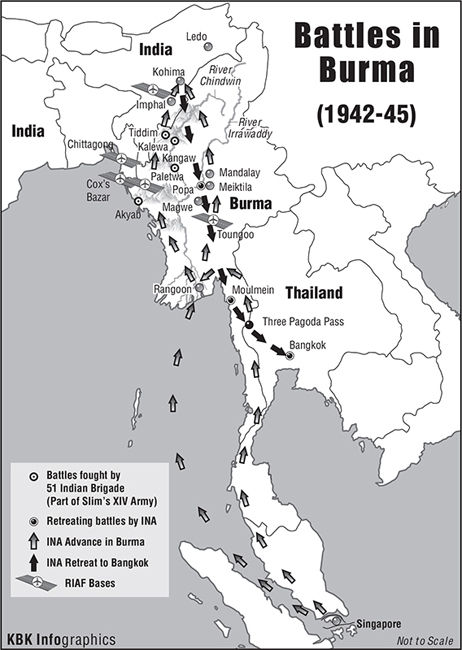
In an audacious move to outflank and cut off Slim's army in Burma and make inroads into India, the Japanese attacked the thinly held garrisons of Imphal and Kohima in March 1944. The defence and lifting of sieges of Kohima and Imphal proved to be the finest hour of the Indian Army in Burma and saw the emergence of significant synergy between the Indian Army and the Indian Air Force, which played a stellar role in not only sustaining the garrisons, but also in providing close air support under trying conditions. The ultimate honour for the Indian Army was to come almost seventy years later in April 2013 when a nationwide survey and public debate in Britain sponsored by the National Army War Museum chose the Battle of Imphal and Kohima as the Greatest Battle fought by Britain.29'Victory over Japanese at Kohima Is Britain's Greatest Battle,' Reuters report from London in The Indian Express, New Delhi, 22 April 2013. In a prize-winning essay titled 'Everybody's Friend' in the British newspaper, The Financial Times, Raghu Karnad, a young Indian military historian, calls the Battle for Kohima 'as desperate as any in the war, and although seldom remembered, it was as fateful as Tobruk or Normandy'.30Raghu Karnad, Everybody's Friend (London: Ebook from Vintage Digital, Random House, 2013). By the time the Japanese retreated from the frontiers of India in early 1945, they had stretched themselves to the limit both in South-East Asia and the Pacific, and were on the back foot against a rejuvenated Allied army that was seeking redemption for all the humiliating losses in the preceding years.
A unique experiment was tried out during the recapture of Burma in 1944–45 to validate the military prowess of a pure Indian brigade. The 51st 'All Indian Brigade' was formed in 25 Infantry Division to allow the Indians to either 'leap high or drown'. The three battalions in the brigade were commanded by three accomplished Kings Commissioned Officers (KCOs), Lieutenant Colonels L.P. Sen, S.P. Thorat and K.C. Thimayya.31C.B. Khanduri, Thimayya: An Amazing Life (New Delhi: KW Publishers, 2006), p. 83. The brigade distinguished itself in the Battle of Kangaw in early 1945, which none other than Field Marshal Slim called 'the fiercest battle fought in Burma'. All the three Indian battalion commanders were decorated with Distinguished Service Orders (DSOs) for their outstanding leadership during the Kangaw operations.32D.R. Mankekar, Leaves from a War Reporter's Diary (New Delhi: Vikas Publishers, 1977), p. 120. The exploits of one of the battalions, 8 Kumaon Regiment (then 8/19 Baluch Regiment), reflects the courage of the entire brigade and is well chronicled in the archives of the Kumaon Regimental Centre at Ranikhet, excerpts from which are highlighted below:
During the winter of 1944/45 the allied offensive to recapture Burma was in full swing and the Japanese were on the retreat. Kangaw, a small village was held by the Japanese on the coastal road, about 50 miles south of Myobaung, the ancient capital of Arakan. Kangaw was to be taken with utmost speed and for that purpose a wide flanking surprise approach through the sea was the only answer. On 23 Jan, 8 Kumaon under Lt Col (later Gen.) KS Thimayya was inducted into the beachhead with orders to capture Kangaw. On 29 Jan, after a fierce battle the regiment captured the village Kangaw and also a small hill feature close by to effectively deny the use of the road to the Japanese. The Japanese left 25 dead against own loss of three killed and six wounded. The Kangaw village and nearby hills were then held doggedly by the regiment as the Japanese counter attack on night of 06/07 Feb 1945 was beaten back. This marked the defeat of Japanese and victory of 51 Inf Bde in Kangaw.
In his inimitable and racy style, D.R. Mankekar, a war correspondent during the Burma campaign, described the three Indian commanding officers:
Thimayya struck me as a hail-fellow-well-met, tall athletic personality. His uninhibited laughter chased out the blues and put cheer in your soul. He was adored by his men as well as officers, who included three Britishers. Thorat, commanding 2/2 Punjabs, was a typically rugged Maratha, who with his clipped moustache looked every inch a soldier and talked of his men and their deeds like a proud and loving father. L.P. Sen, commanding 16/10 Baluch, only thirty-four, was the youngest of the three C.O.s and one of the youngest to command a battalion. He struck me as very handsome and very shy and had to be coaxed to speak about himself and the exploits of his battalion.34D.R. Mankekar, Leaves from a War Reporter's Diary (New Delhi: Vikas Publishers, 1977), p. 121.
By the end of the war, Thimayya had been promoted to the rank of brigadier and taken over the Indian brigade at Rangoon. He also became the first Indian to command a brigade as part of the peacekeeping force that was sent to Japan during the post-war reconstruction period.35C.B. Khanduri, Thimayya: An Amazing Life (New Delhi: KW Publishers, 2006), p. 97.
The exploits of the Indian Army during WW II will not be complete without heading back to Europe, this time to Sicily and Italy, where for the first time during WW II, three Indian army divisions (4th, 8th and 10th)36John Gaylor, Sons of John Company: The Indian and Pakistan Armies, 1901–1991 (Turnbridge Wells: Para Press Ltd, 1992), p. 316. of the 8th Army fought alongside US troops of the 7th Army as part of an expeditionary force that was to capture Italy. Of all the battles fought in Italy the battle for the monastery at Monte Casino and its surrounding heights was the bloodiest and involved a number of Indian battalions from the 4th and 8th Indian divisions. Indian troops won five Victoria Crosses in Italy and the respect of the American commander of the 15th Army Group, Lieutenant General Mark W. Clark, who commented in the foreword of a book The Tiger Triumphs:
I have had the distinction of having under my command a trio of great Indian divisions – the Fourth, Eighth and Tenth – whose fighting record in Italy has been a splendid one. No obstacle has succeeded in delaying these Indian troops for long or in lowering their high morale or fighting spirit.37Ian Cardozo, ed., The Indian Army: A Brief History (New Delhi: Centre for Armed Forces Historical Research, 2005), p. 48. Also see 'Tiger Triumphs,' India Defence Department, Director of Public Relations, London, 1946.
The Indian National Army
No analysis of the Indian Army during WW II is complete without looking at the Indian National Army (INA) and its impact on the consciousness of the Indian Army and the Indian nation at large. Inspired in part by the revolutionary Bengali leader Rash Behari Bose and led by the intensely nationalistic and militant Congressman, Netaji Subhas Chandra Bose, who attempted to seek help from the Axis powers to evict Britain from India, the core of the INA was called the Azad Hind Fauj. Comprising over 20,000 troops of the 60,000 Indian troops who surrendered at Singapore in February 1942, it was mainly manned by Sikhs and Muslims.39Address to Kashmir National Conference, Srinagar, 19 August 1945. It was featured in The Tribune of 20 August 1945. S. Gopal, ed., Selected Works of Jawaharlal Nehru, Vol. 14 (New Delhi: Orient Longman). Literally abandoned by their British officers, many young Indian officers who had joined the Indian Army because of their interest in soldiering felt cheated by the abominable collapse, and gravitated towards the idea of a 'liberation army'. The INA also included a motley bunch of Indian lawyers, businessmen and plantation workers from across Malaya and Burma who felt that the ongoing non-violent struggle for independence was largely ineffective.40Christopher Bayly and Tim Harper, Forgotten Armies: The Fall of British Asia, 1941–1945 (Cambridge, Massachusetts: Belknapp Press of Harvard University, 2004), p. xxxii. Stirred by intensely nationalistic and militant indoctrination by Netaji and his band of freedom fighters, they dedicated themselves to waging war to evict the British from India.
How did other Indian officers react to what the British called a 'betrayal'? Lieutenant General W.A.G. Pinto, an emergency commissioned officer during WW II, remarked in an interview with the author in 2014 that most of the Indian officers kept quiet and hardly discussed the issue as they were not privy to what actually happened in Singapore. But, he added, personally he felt that what his colleagues did by joining the INA was against basic tenets of soldiering like loyalty and allegiance. He added that the existing ethos and military programming of the time made most Indian officers uncomfortable with the idea of a uniformed person revolting against the authority he had voluntarily sworn to follow.41Interview with Lieutenant General (retd) W.A.G. Pinto, 23 October 2014. Harbaksh Singh, one of India's most distinguished commanders with combat experience in WW II, the India–Pakistan wars of 1947–48 and 1965; the India–China war of 1962, and a Japanese POW after the fall of Malaya, is one of the few officers who turned down the call by Netaji to join the INA. He did so not because he was any less of a patriot, but because he was not convinced of the INA's mission and its ability to execute a successful military campaign against a tested British Army.42Lieutenant General Harbaksh Singh, In the Line of Duty (New Delhi: Lancer, 2000), p. 130–36.
Netaji's core group of military leaders included the likes of J.K. Bhonsale, Captain Mohan Singh (later a general in the INA), Captain Shahnawaz Khan and Mohd Zaman Kiani, all of whom clearly justified the use of violence as a means to achieve political aims.43Stephen P. Cohen, The Indian Army: Its Contribution to the Development of a Nation (New Delhi: Oxford University Press, 1990), p. 99–102 and 150–62. However, this force did not have the anticipated operational impact on the war as it attempted to enter India by fighting alongside Japanese formations as they advanced through Burma into India. Comprising three divisions by mid-1943, including guerrilla units, which infiltrated Burma before the main Japanese advance, the INA deployed one division (approximately 12,000 men) to lead the advance into Burma alongside approximately 84,000 troops from front-line Japanese divisions.44Sugata Bose, His Majesty's Opponent (New Delhi: Penguin, 2011), p. 266–79. Less known is that Subhas Bose was adept at covert operations too. Before his forces advanced alongside the Japanese into Burma, four teams were landed on the Kathiawar coast by a Japanese submarine and melted away into the countryside in different directions. One of the teams operated from Calcutta from early 1944 onwards and remained in radio contact with Netaji for most of the remaining period of the war.45Ibid., p. 265–66.
After significant initial success that saw the force rapidly advancing through Burma in 1943–44, and knocking on the doors of India by mid-1944, they were outmanoeuvred and outfought by a numerically and tactically superior Allied force that numbered close to 1,55,000 troops.46Ibid. After having said to have raised the Indian flag at Moirang,47Raghu Karnad, Everybody's Friend (London: Ebook from Vintage Digital, Random House, 2013). about 45 kilometres south of Imphal in what is today the state of Manipur, their last frontal battle was fought further north at Kohima and Imphal in 1944 where thousands were killed and many surrendered when faced with the ferocious resistance from well-trained defenders and highly experienced Allied field leadership.48Philip Mason, A Matter of Honour (London: EBD Education in arrangement with Jonathan Cape, 1988), p. 516–18. Led by Bose himself, remnants of the INA retreated 3,000 miles to Bangkok without food or equipment – a feat that was acknowledged by the British as a masterpiece of military tactics and strategy.49S. Gopal, ed., 'Letters from Nehru to V.K. Krishna Menon,' Selected Works of Jawaharlal Nehru, Vol. 14 (New Delhi: Orient Longman). One of the INA's last stands during this south-bound retreat in early 1945 was at the Buddhist shrine of Mount Popa near Meiktila in Mandalay district of central Burma where the INA 2nd Division attempted to hold the rampaging 14th Army at bay.50Christopher Bayly and Tim Harper, Forgotten Armies: The Fall of British Asia, 1941–1945 (Cambridge, Massachusetts: Belknapp Press of Harvard University, 2004), p. 428. For a detailed description of the rearguard battles fought by the INA in 1944–45, see Eric A. Vas, Subhas Chandra Bose: The Man and His Times (New Delhi: Lancer, 2005), p. 199–200. By May 1945 it was all over for Bose as he reached Bangkok. Of the number of INA's Viceroy's commissioned officers (VCOs), non-commissioned officers (NCOs) and sepoys who were captured before the end of the war, a few were tried for espionage and sabotage and executed.51John Connell, Auchinleck: A Biography of Field Marshal Sir Claude Auchinleck (London: Cassell, 1959), p. 797.
The British classified the INA personnel after the war as 'white', 'grey' and 'black'. While the 'whites' were reinstated because they assisted the British, 'greys' were those who expressed regret for their action and were merely dismissed. The 'blacks', however, were put in detention camps to await trial for sedition and treason amongst other charges.52Ibid., p. 368.
Unfortunately, the reported demise of Bose in a mysterious plane crash in August 1945, which is still shrouded in secrecy, and the largely liberal historical discourse in independent India do not give him and the INA sufficient credit in the struggle for independence. The largely secular and egalitarian profile of the INA was also to play a significant role in influencing the demographic profile of independent India's armed forces. While the trial of high-profile INA prisoners including three officers in the Red Fort was an event of national importance and all of them were acquitted of the charges of sedition and treason, none of the officers, men and women of the INA were allowed to join the Indian armed forces even after Independence.
Though not much archival material is available on the actual reasons for this, it is possible that a quid pro quo agreement was reached between the British and the future leaders of India prior to the trial at Red Fort. In response to repeated requests from Nehru to acquit the numerous INA prisoners still held in prisons all over the country in 1946, Lord Mountbatten wrote to Nehru saying:
When you get your independence and have your own army, the people you want are those who remain loyal to their oath and will stay with you and not those who just change according to political opportunism.53Interview with Lord Mountbatten by B.R. Nanda, Oral History Project, NMML, 26 July 1967.
From November 1945 to April 1946, a number of high-profile INA prisoners were tried by military court martial for offences ranging from murder to waging war against the king. Many were harshly sentenced to transportation for life, cashiered, or made to forfeit their pay and allowances. Only after the trials were completed did Auchinleck, the C-in-C, remit the sentences to mere cashiering54John Connell, Auchinleck: A Biography of Field Marshal Sir Claude Auchinleck (London: Cassell, 1959), p. 802–07. and thereafter agree to drop all charges against INA soldiers except that of physical torture of other Indians.55Ibid.
Of all the British generals who commanded Indian officers and troops during WW II, it was Auchinleck who understood them best, be it on the battlefield or after the war as they struggled to make sense of the ongoing freedom struggle. Not only did he contribute immensely to raising the self-esteem of Indian officers and men as military professionals in an overtly racial British Indian Army, it is his sagacity which paved the way for an INA trial that combined military propriety with the recognition of a growing countrywide unrest. Writing to the viceroy and a fellow WW II field commander, Field Marshal Wavell, he argued:
I know from my long experience of Indian troops how hard it is for even the best and most sympathetic British officer to gauge the inner feelings of the Indian soldier, and history supports me in this view. I do not think any senior British officer today knows what is the real feeling among Indian ranks regarding the I.N.A. I myself feel, from my own instincts largely, but also from the information I have from various sources that there is a growing feeling of sympathy for the I.N.A and an increasing disregard for the brutalities committed by some its members … It is impossible to apply our standards of ethics to this problem …56John Connell, Auchinleck: A Biography of Field Marshal Sir Claude Auchinleck (London: Cassell, 1959), p. 806. Of all the British field commanders of the twentieth century who commanded Indian officers and troops during their service careers, Field Marshal Auchinleck understood them the best. His sagacity, empathy and apolitical approach in deciding the future of the Indian Army in a post-colonial dispensation shaped the thinking of many Indian commanders like Cariappa and Thimayya. It is only fair to attribute much of the leniency shown towards the high-profile INA prisoners to the wisdom of Auchinleck.
It is also likely that though Gandhi, Nehru and other leaders of the Congress party were highly vocal about the rehabilitation of the INA soldiers, they preferred that they join civilian life rather than return to the Indian Army. This, they felt, would ensure the completely apolitical nature of free India's armed forces as they feared that the entry of the former INA personnel into the armed forces would bring with it the aggressive political legacy of Subhas Chandra Bose. They, however, reaped enormous political mileage from the trial as Nehru very eloquently and publicly urged Field Marshal Auchinleck and Lord Wavell to reconsider their initial tough stand and drop charges of sedition and treason.57S. Gopal, ed., Selected Works of Jawaharlal Nehru, Vol. 14, from speech at Murree on 21 August 1945. Also see, Vol. 15, p. 90, letter to Claude Auchinleck and advice from Wavell, p. 95. The acquittal of Shahnawaz Khan, Prem Kumar Sehgal and Dhillon in January 1946 was seen as a triumphant moment for nationalism though large numbers of INA prisoners continued to languish without benefits till years later. Many of the Muslim commanders of the INA chose to shift their allegiance to Pakistan after Independence and were rehabilitated, though they faced some resistance from the Pakistan Army when it came to amalgamating them into the mainstream. Some like Kiani even participated in the covert war against India in Poonch during the 1947–48 conflict and then faded away into oblivion.58Shuja Nawaz, Crossed Swords: Pakistan, Its Army, and the Wars Within (Karachi: Oxford University Press, 2008), p. 18–19.
However, to be fair and objective about its overall impact on the British psyche, the INA put a serious doubt in the minds of Britain's post–WW II leaders that such a force had the potential to lead another internal war of independence. My own analysis and the intensely passionate and incisive biography of Subhas Chandra Bose by his grand-nephew, Prof. Sugata Bose, a history professor at Harvard and a current member of parliament, points at the coercive impact of the INA on the British decision to leave India before it was too late. Speaking in Thailand on 21 May 1945, Bose urged Indians to fight on for freedom saying, 'It may be that we shall not go to Delhi via Imphal, but the roads to Delhi are many like the roads to Rome.'59Sugata Bose, His Majesty's Opponent (New Delhi: Penguin, 2011), p. 294. As Bipin Chandra, an eminent Indian historian, reflects in his analysis of Subhas Bose and the INA:
Even though his strategy of winning freedom in cooperation with the fascist powers was criticised at the time by most nationalists, by organising the INA he set an inspiring example of patriotism before the Indian people and the Indian army.60Bipin Chandra, History of Modern India (New Delhi: Orient Blackswan, 2009), p. 325.
Writing on the impact of the INA on the British Indian Army despite its defeat in a chapter titled 'We Fight On' in Chalo Delhi, a compilation of his works, Netaji Bose argued:
There is, however, one silver lining in the cloud that has overtaken us, and that is, the British Indian Army of today is not the British Indian Army of the last war … There is no doubt that at heart large sections of the British Indian Army sympathize with the Azad Hind Fauj and its fight for freedom. But the British Indian Army is not yet ready to take the risk and line up with the revolutionaries. After coming into Burma, the eyes of the British Indian Army will be opened. They will see for themselves what the Provisional Government of Azad Hind and Azad Hind Fauj have done and how they have fought for India's freedom. The effect of this experience on the British Indian Army, and all other Indians who have come into Burma alongside the British, is bound to be great in the days to come.61Sugata Bose, His Majesty's Opponent (New Delhi: Penguin, 2011), p. 295.
In a prize-winning essay written for an Indian defence journal in 2013, Brigadier R.R. Palsokar (retd), one of the Indian Army's committed scholars and a brigade commander during India's turbulent intervention in Sri Lanka during 1984–87, writes with a detached objectivity about the British Indian Army and the INA trials:
There is a tendency to romanticise the deeds of the soldiers of the British Indian Army and the relations between the British officers and their Indian troops, particularly during the two world wars. But in a nationalistic context one has to take a more detached view. Two incidents prior to independence affected the Indian armed forces greatly. One was the affair of the Indian National Army led by Subhas Chandra Bose. Of particular interest is how the British dealt with the matter even as independence was round the corner. The Commander-in-Chief, Field Marshal Claude Auchinleck insisted that he would hold a symbolic trial of one Hindu, one Muslim and one Sikh, in the Red Fort for 'waging war against the King Emperor'. His purpose, as described later, was different and showed great sagacity. His main aim was 'to maintain the reliability, stability and efficiency of the Indian Army whatever the government be. He also believed that every Indian officer (at the end of the war there were 15,000 of them) and soldier was or should be a nationalist who wanted independence for his country. So he decided 'to confirm the findings of the guilt, confirm the sentence of cashiering, but to show clemency in respect of the sentence of transportation for life, which he remitted'. Knowing that the country was to become independent shortly, the temptation not to do anything and let matters drift must have been very great. But by this one action, Auchinleck left behind a legacy which was rightly upheld and continued by the first Indian C-in-C, General K.M. Cariappa that the army's creed was, 'I will obey.' If the Indian Army and the armed forces have remained apolitical, great credit must go to these two.62Brigadier R.R. Palsokar (retd), 'Whom We Serve,' a prize-winning essay submitted in 2013 to Defence Watch, a monthly journal of defence and security affairs published from Dehradun.
The legacy of the INA was rightfully recognized by General Shankar Roy Chowdhury, the chief of the army staff between 1994 and 1997, when he ensured that the stirring marching song of the INA became the official song of the Indian Army. Composed by Mumtaz Hussain and set to music by Ram Singh Thakur in March 1943,63http://en.wikipedia.org/wiki/Qadam_Qadam_Badaye_Ja (accessed 2 Apr 2013). the song is titled 'Qadam Qadam Badhaye Ja'. Literally translated, it means Forward March – Step by Step. Considering the turbulence of the moment, feeling of abandonment by a traditionally 'suppressed' community and the stirrings of freedom, the INA had a significantly greater impact on the British decision to leave India than what the existing historical discourse in both the countries is willing to acknowledge.
Transition, Adjustment and Freedom
How did the Indian army cope with the post–WW II period and the adjustments it had to make in the run-up to the Partition of India in 1947? Like the period after WW I, large-scale demobilization took place as the Crown struggled with the financial challenges of post-war reconstruction in Britain and Europe. Economist John Maynard Keynes pegged the cost of maintaining the Empire at 2,000 million pounds, with revenues declining alarmingly because of the drop in exports.64Narendra Singh Sarila, The Shadow of the Great Game (New Delhi: HarperCollins, 2009), p. 189. Within a year of the end of WW II, the strength of the Indian Army was reduced to less than half from 20,00,000 to 8,00,000 with plans to reduce it further to around 4,00,000 by 1947.65Daniel P. Marston and Chander S. Sundaram, ed., A Military History of India and South Asia, (New Delhi: Pentagon, 2007), p. 131–33. This caused some amount of heartburn amongst sections of India's martial communities like the Jat Sikhs66Ibid. and caught the attention of people like Field Marshal Auchinleck who were engaged in restructuring the Indian Army with independence looming on the horizon. The aftereffects of demobilization were also factored into the whole process of timing the grant of Independence to ensure minimum loss of face for the Crown.
Sir Michael Howard, one of Britain's greatest military historians of the modern era, writes poignantly in his book War in European History about the decline of British military power in the aftermath of WW II67Michael Howard, War in European History (Oxford: Oxford University Press, 2009), p. 138.:
The British, economically exhausted and chastened after a humiliation at the hands of the Japanese that not even their successful reconquest of Burma could redress, quickly accepted the impossibility of retaining the Indian subcontinent and abandoned it to its own devices, relinquishing thereby the Indian Army that had alone given them the status of a global military power.68Ibid.
The other major fallout of the mass mobilization phase prior to the two wars was that the Indian Army at Independence was no longer an elitist force dominated by martial races or upper castes but an inclusive force that represented the diversity of India – something that has also ensured the survival of the fledgling democracy. For example, four new regiments were raised by the British in 1941, which reflected this approach. These were Sikh Light Infantry, Mahar (one battalion of this regiment was raised in 1917, only to be disbanded after WW I), Bihar and Assam regiments.69John Gaylor, Sons of John Company: The Indian and Pakistan Armies, 1901–1991 (Turnbridge Wells: Para Press Ltd, 1992), p. 278–85. One has to look no further than Pakistan to realize that one of the main reasons for repeated martial rule in Pakistan is because the Pakistan Army has been dominated over the years by one major martial community, the Punjabi Muslim community.70This argument is repeatedly reinforced by Steven Wilkinson, Army and Nation: The Military and Indian Democracy (Cambridge, Massachusetts: Harvard University Press, 2015). Stephen Cohen, an accomplished US academic and arguably the most incisive western analyst on military matters in the subcontinent, has tracked the Indian and Pakistani armies closely for the last five decades and no study of the DNA of these two armies, particularly from a demographic and attitudinal perspective, is complete without a reading of his works.71For a detailed analysis see Stephen P. Cohen, The Indian Army: Its Contribution to the Development of a Nation (New Delhi: Oxford University Press, 1990).
As the Indian Army came out of WW II with its head held high, one cannot but help detect a weakening of British attitude towards the demand for independence. While traditional historians would argue that that the Quit India civil disobedience movement had reached a high point and significantly impeded the Crown's attempts to hang on to the Empire, astute British generals like Wavell and Auchinleck, who had fought alongside Indian troops in various campaigns, played a prominent role in convincing the post-war British government that it would be hard to hold on to India. This, they argued, was not only because of the surging countrywide aspirations for Independence, but also because the Indian Army along with its large band of Indian officers had matured to a point where the British would not be able to handle another military revolt, a sample of which had already taken place at Jabalpur where 1,700 men of the Signals Training Centre (STC) revolted on 26 February 1946 in the aftermath of the naval revolt. More of that will be highlighted in the next chapter. Eighty men behind the revolt were court-martialled and dismissed without pay and pension. Forty-one others were sent to prison. But the incident was quickly hushed up. The Jabalpur revolt had the British worried about what they took for granted – the British Indian Army's loyalty. Added to all this was the lingering impact of the INA and the legacy of Subhas Bose, which accelerated the British exit from India. Auchinleck in particular had reported back to the chiefs of staff in London that five divisions of completely loyal troops would be required to put down any widespread uprising this time around.72Major General V.K. Singh, Contribution of the Armed Forces to the Freedom Movement in India (New Delhi, KW Publishers, 2009), p. xii.
Christopher Bayly and Tim Harper in their eminently readable military history narrative of the last years of British Asia, Forgotten Armies, corroborate the military catalyst that accelerated the demise of the British Raj by writing:
Above all it was Indian soldiers, civilian labourers and businessmen who made possible the victory of 1945. Their price was the rapid independence of India.73Christopher Bayly and Tim Harper, Forgotten Armies: The Fall of British Asia, 1941–1945 (Cambridge, Massachusetts: Belknapp Press of Harvard University, 2004), p. xxix.
The VCOs and Kings commissioned Officers, loyal and increasingly well trained were not only the last soldiers of the British Raj, they were the advance guard of the new nation.74Ibid. p. 191
On the eve of Independence, the Indian Army was divided proportionately between India and Pakistan, with India retaining a strength of approximately 2,80,000 troops with less than 1,50,000 going to Pakistan. The Indian Army's share comprised fourteen cavalry and eleven infantry regiments from the erstwhile formations along with six of the ten Gorkha regiments. Speaking on the Gorkhas and their legendary bravery, Field Marshal Manekshaw is said to have once remarked: 'If a man says he is not afraid of dying, he is either lying or is a Gorkha.'
These forces were supplemented by the four new regiments that were raised in 1941 and alluded to earlier in the chapter.75John Gaylor, Sons of John Company: The Indian and Pakistan Armies, 1901–1991 (Turnbridge Wells: Para Press Ltd, 1992), p. 258. Regiments were still segregated into single-class, fixed-class, mixed-class or all-class entities76Stephen P. Rosen, India and Its Armies (New Delhi: Oxford University Press, 1996), p. 211. and attempts to do away with this system partially failed due to the fragile class and caste system that prevailed at the time of Independence. The system would continue for decades to come. However, to be fair to the Indian Army, a genuine attempt to move towards an egalitarian and a broad-based regimental system commenced in 1949 with the formation of the Brigade of the Guards. Now comprising fourteen battalions, the four initial battalions of the brigade were drawn from among the oldest battalions in the Indian Army. These were 2 Punjab Regiment, 1 Grenadier Regiment, 1 Rajputana Rifles and 1 Rajput Regiment. These were followed by the 5th battalion, which comprised troops from all the hill districts of India (Garhwal, Kumaon and the north-eastern hill districts among others). Soon after, the 6th battalion was formed with troops from all the south Indian states. A perceptive group captain once asked me whether the Indian Army's inability to completely do away with racial regiments after Independence meant that in part it acknowledged the foundational correctness of the policy. I explained to him that while to some the myth of the superiority of the so-called 'martial races' was a hangover from the colonial era, contemporary Indian military leaders looked at this merely as a method to ensure greater cohesion and homogeneity, rather than an exercise in keeping races separate. Actions in later years would prove the correctness of the latter argument as the Indian Army gradually moved towards a multi-class composition in most raisings, most significant being the raising of the Rashtriya Rifles to counter the insurgency in J&K.
Not entirely confident of passing on the leadership of the Indian Army to its own young generals like Cariappa, Rajendra Sinhji and Thimayya, and influenced in no small measure by Lord Mountbatten, Nehru and his cabinet chose to continue with General Lockhart and General Roy Bucher as the first two C-in-Cs of independent India's army. As the specially formed Punjab Force grappled with the horrors of the Partition, free India's army would be involved in a major military operation across three sectors in the princely state of Jammu and Kashmir within three months of Independence.
Officers and Men
A last word in this chapter about the officers and men who formed the immediate core of the Indian Army after Independence is important to understand civil–military relations as they unfolded in the years ahead. Endowed with a typically British flavour of soldiering in terms of operational orientation, but demonstrating an integrity and commitment to the new nation that they were now part of, despite not being active in the freedom struggle, most officers took time to absorb the idea of India, the contradictory nature of the INA struggle and the vision of their political masters. The experience of the Indian officers' relationship with their British counterparts was a mixed bag. While some were treated as equals in every way, many others like Major Generals U.C. Dube and 'Monty' Palit were scathing in their indictment of British racial overtones. Dube recollects that in the Gorkha regiment he was posted to, Indian officers were asked to dine in a separate room during guest nights when ladies would join the officers for a community meal in the officers' mess.77Narendra Singh Sarila, The Shadow of the Great Game (New Delhi: HarperCollins, 2009), p. 175. Palit is equally caustic when he says: 'I was never asked by my commanding officer, second-in-command or my company commander for a meal or a cup of tea in his (sic) house.'78Ibid.
The emerging political class too grappled with the complexities of understanding that the integrity and training of these officers would ensure that they would do whatever it took to protect the fragile democracy that India was nurturing. To make matters difficult, the inclusiveness that had permeated troop recruitment had not seeped down to the officer class which came mainly from the upper classes and martial races. This aspect did not really endear the officers to the political class, which represented the true diversity of India and felt that an army led by an elite band of officers could not be trusted.
There was also this feeling that as the independence movement gathered steam, large numbers of Indian officers should have resigned their commission and joined the movement. However, leaders like Motilal Nehru, Jawaharlal Nehru's father, thought otherwise.
In an anecdote narrated by noted US strategic affairs commentator of those times, Selig Harrison, in his article 'Thimayya', highlights this dilemma. The article describes an encounter at Allahabad in 1926 where Thimayya as a young subaltern was asked by Motilal Nehru during the intermission at a play: 'How does it feel in a British uniform?' A cool Thimayya replied laconically, 'Hot!'
Thereafter, in an intellectually stimulating discussion, he asked Motilal Nehru whether he should resign his commission and join the freedom movement to prove that he was no less of a nationalist. It was then that Motilal Nehru advised Thimayya to stay on and desist from doing anything foolish as free India would need a professional military. He also suggested that it would be best for all the Kings Commissioned officers to stay on, study the use of force and continue to serve the Crown.
Similarly when Lieutenant Prem Bhagat, the Indian Army's first recipient of Victoria Cross in WW II, approached Gandhiji with a similar dilemma, he was advised by Gandhiji to stay on as independent India would need the services of committed and intensely patriotic officers to build a modern army within a democratic political framework.
This lack of social cohesion and separation from mainstream Indian society, and the inability to share a common vision of India, would be the primary reason for not only the fragile civil–military relations in the years ahead, but also the detached relationship between the armed forces and Indian society at large.80Stephen P. Rosen, India and Its Armies (New Delhi: Oxford University Press, 1996), p. 197–98. It would take years for the typical Indian Army officer to shake off his colonial mindset and really understand the country he was defending so heroically. General Krishnaswamy Sundarji, arguably one of India's finest soldier-scholars in the post-Independence era, was a WW II emergency commissioned officer, not one of the archetypal Sandhurst or IMA products. His view of senior army leadership at Independence is one of the most honest descriptions I have come across and is at some variance with the popular discourse of the time which tended to eulogize the KCIOs:
Cariappa (and Thimayya) had become brigadiers just before the end of the war (WW II) and the rest remained at colonel or below almost till the end of the war, and so got their ranks pretty rapidly after independence with very little experience in each of the successive ranks. There was understandably a certain degree of tentativeness about their self-confidence and added to this was the subconscious feeling of being a second class citizen, engendered by the British. Officers today in similar ranks are professionally much more capable than people of that time; however on the positive side the old timers were less career conscious in their professional approach than the latter day lot!81General K. Sundarji, Of Some Consequences: A Soldier Remembers (New Delhi: HarperCollins, 2000), p. 112.
Similarly, the widespread feeling that the British-trained officers and the Viceroy's Commissioned officers (junior commissioned officers) formed the rock-solid edifice of the Indian Army was also contestable as the cheerful, hardy and selfless Indian soldier of the time also merits equal recognition. Driven more by the need to uphold the honour and pride of his clan, village, province or regiment, rather than any great loyalty to the Crown, the Indian soldier's toughness in battle was much acclaimed. The ability to withstand combat stress in conditions he had seldom been exposed to could be attributed as much to the harsh conditions of his rural upbringing, as it was to the disciplined and scientific training regimen of the Crown. What else can explain the performance of the Kumaonis during the amphibious assault at Kangaw – many of these hardy hill soldiers had never seen the sea before embarking for the operation!